AEDOBP344 Toilets & Baths ← All Standards ⬇ IRR PDF

BP344 · Appendix D · Section 6.3

Accessible Toilet & Bathroom Requirements
BP344 Philippines (IRR 2024)

Minimum cubicle dimensions (1800mm × 1800mm), wheelchair turning space, water closet height, grab bar placement, emergency call button, and ceiling hoist requirements per the 2024 amended IRR.

BP344 · Appendix D · Section 6.3

Toilet & Bath Provisions

D.1Minimum cubicle area: 1800 mm × 1800 mm. Door minimum clear width 900 mm, opening outward.
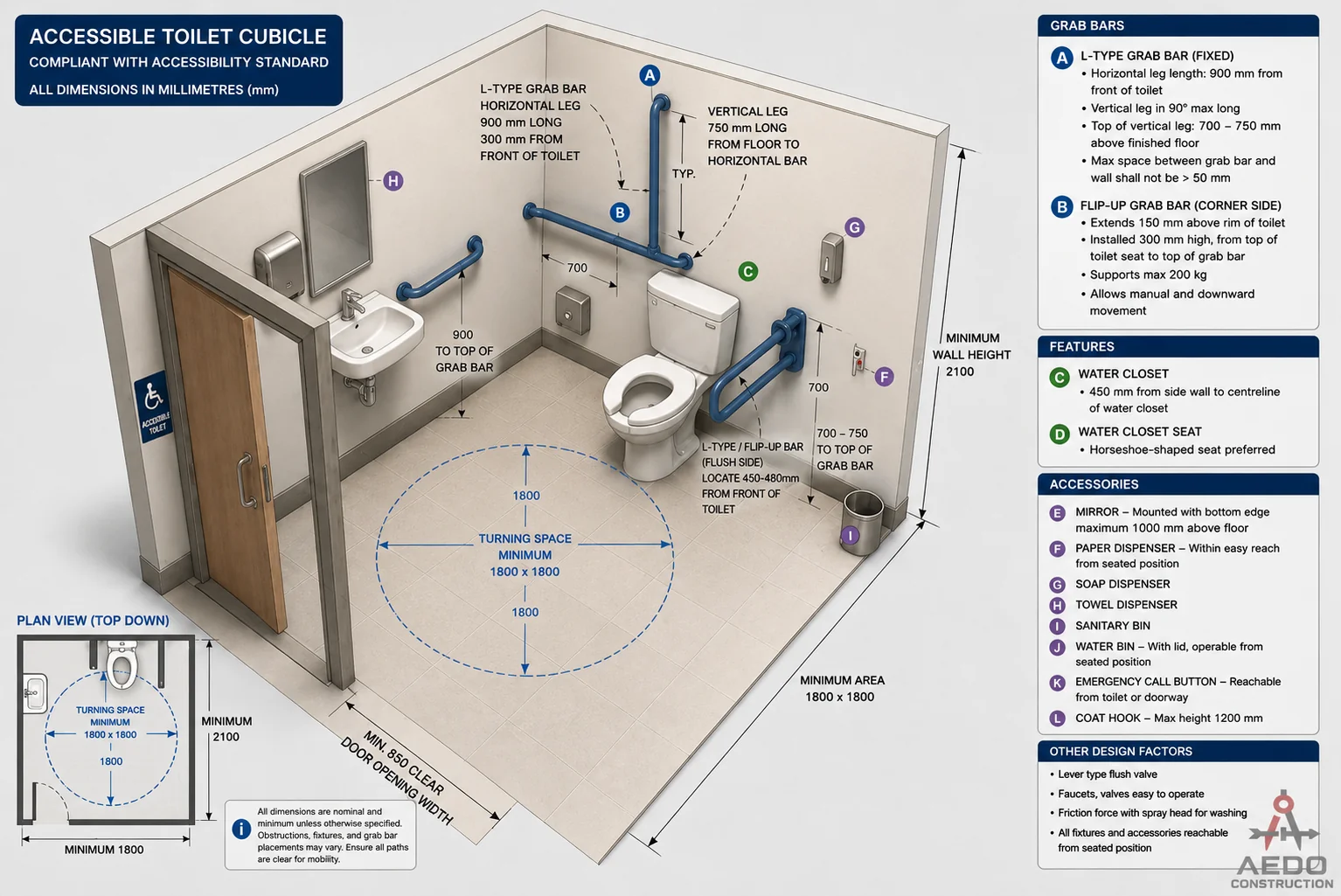
D.2Clear turning space: 1800 mm diameter circle inside cubicle. Clear transfer space min 750 mm adjacent to water closet.
D.3Water closet height: 450 mm from floor. Horseshoe-shaped seat preferred for lateral transfers.
D.4L-type grab bar (side wall): horizontal leg 900 mm long, 300 mm from front of toilet; vertical leg 750 mm long. Height: 700–750 mm from floor to bar top.
D.5Flip-up grab bar (opposite side): located 300 mm from front of closet. Extends 150 mm above rim.
D.6Emergency call button: 400–600 mm above floor. Mirror bottom edge: max 1000 mm. Coat hook: max 1200 mm.
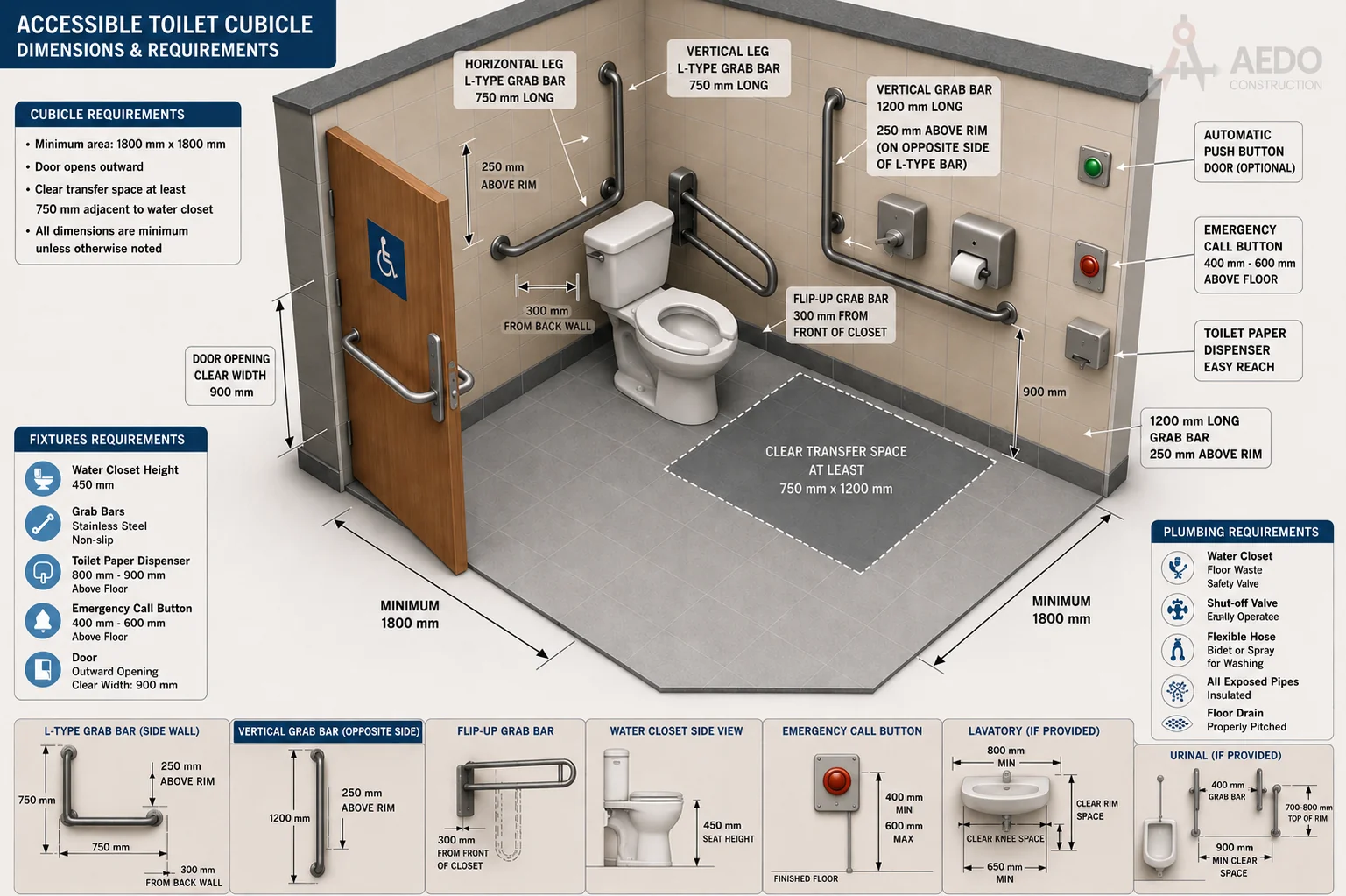
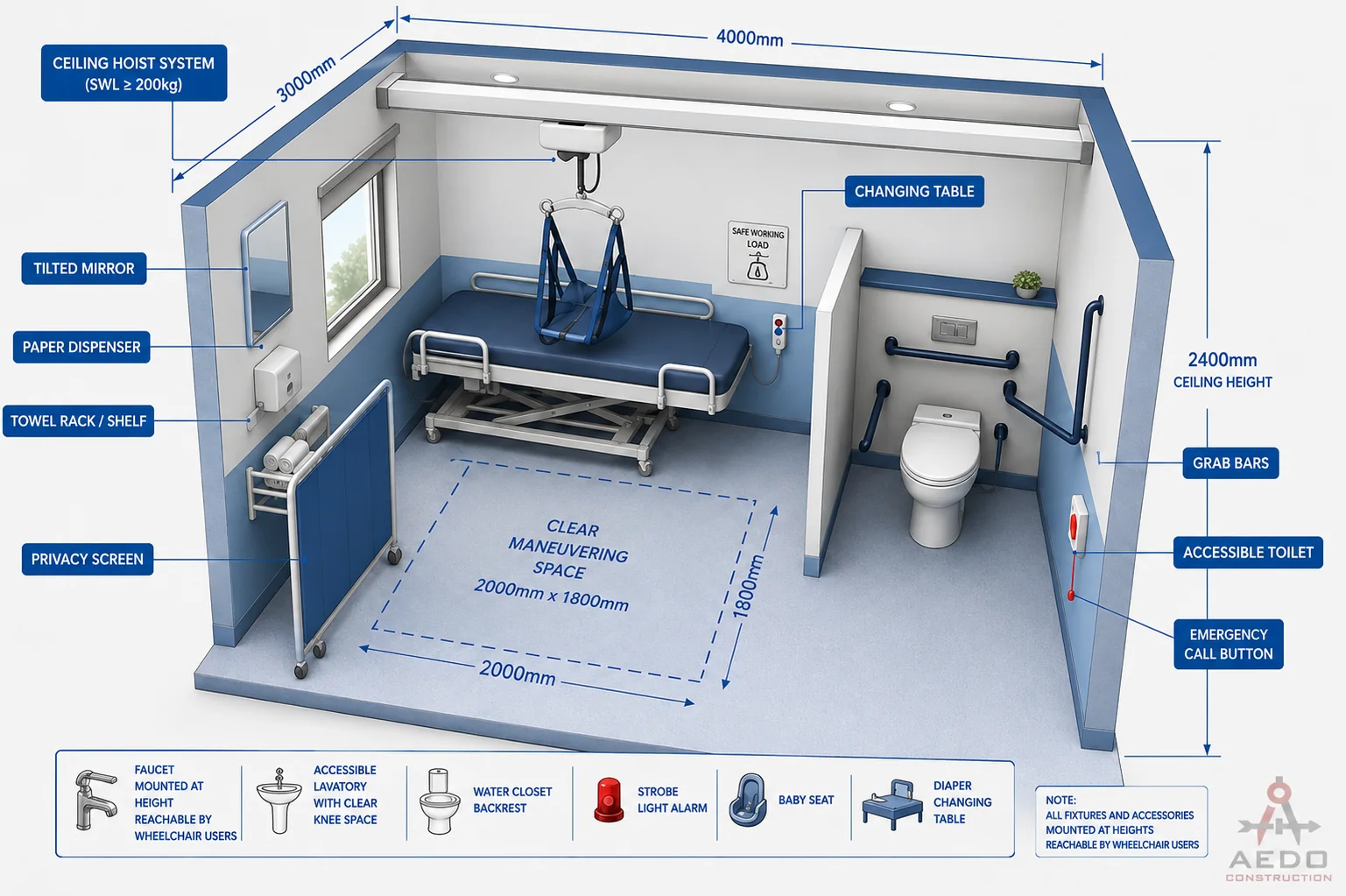
D.7Ceiling hoist system (where provided): min clear maneuvering space 2000 mm × 1800 mm. Min ceiling height 2400 mm.

Key Dimensions

ACCESSIBLE TOILET — CRITICAL MEASUREMENTS
Cubicle Size (min)1800 × 1800 mm
Door Clear Width900 mm (swings outward)
Turning CircleØ 1800 mm
Transfer Space750 mm min (beside WC)
WC Height450 mm from floor
L-Grab Bar (horiz.)900 mm long at 300mm from front
L-Grab Bar (vert.)750 mm long
Grab Bar Height700–750 mm from floor
Emergency Button400–600 mm from floor
Mirror Bottom EdgeMax 1000 mm
Coat HookMax 1200 mm

Reference Diagrams

Accessible Toilet Cubicle 3D View — BP344 Appendix D
Accessible Toilet · 3D View
Accessible Toilet Dimensions — BP344
Dimensions & Requirements
Accessible Toilet with Ceiling Hoist System — BP344
With Ceiling Hoist System

Detailed Fixture Standards

Annotated BP344 reference diagrams for individual sanitary fixtures — water closet, urinal, and accessible shower — showing clear floor space, fixture heights, and grab bar placement per the National Building Code (IRR of RA 7277).
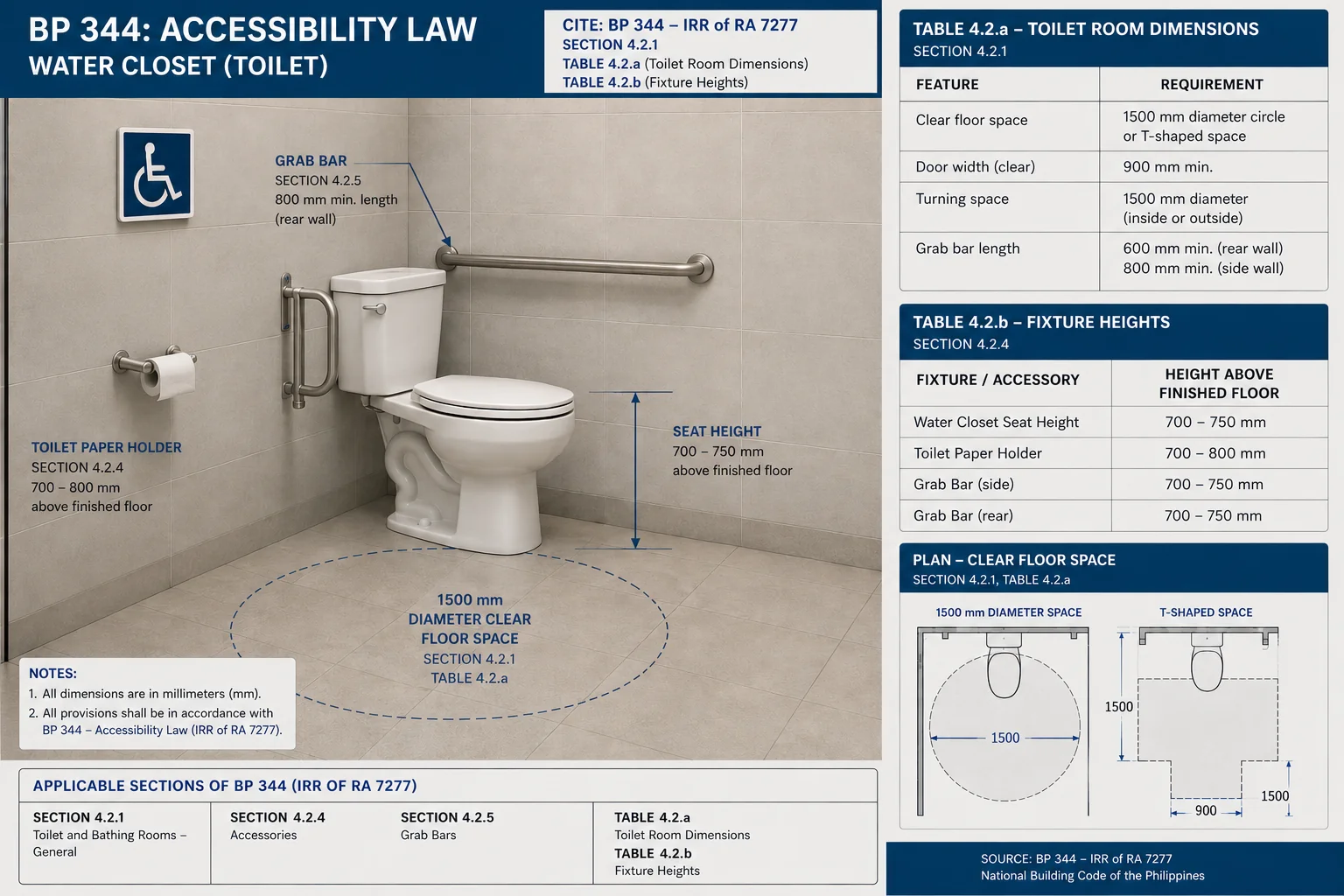
BP344 accessible water closet diagram — 1500mm diameter clear floor space, seat and grab bar heights, toilet paper holder at 700–800mm
Water Closet · Clear Space & Heights
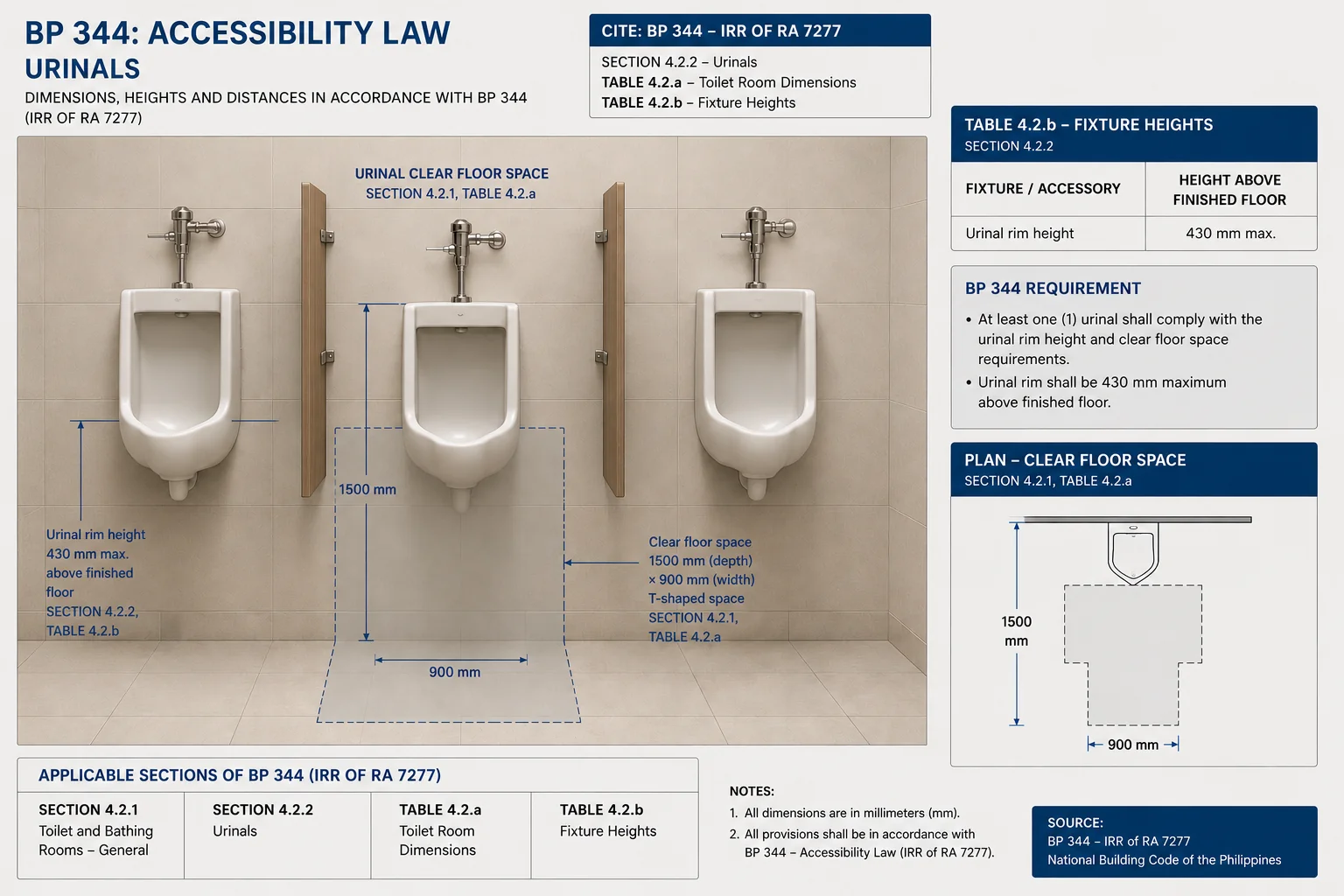
BP344 accessible urinal diagram — wall-hung rim at 430mm max above finished floor with clear floor space for wheelchair approach
Urinal · Rim Height & Approach
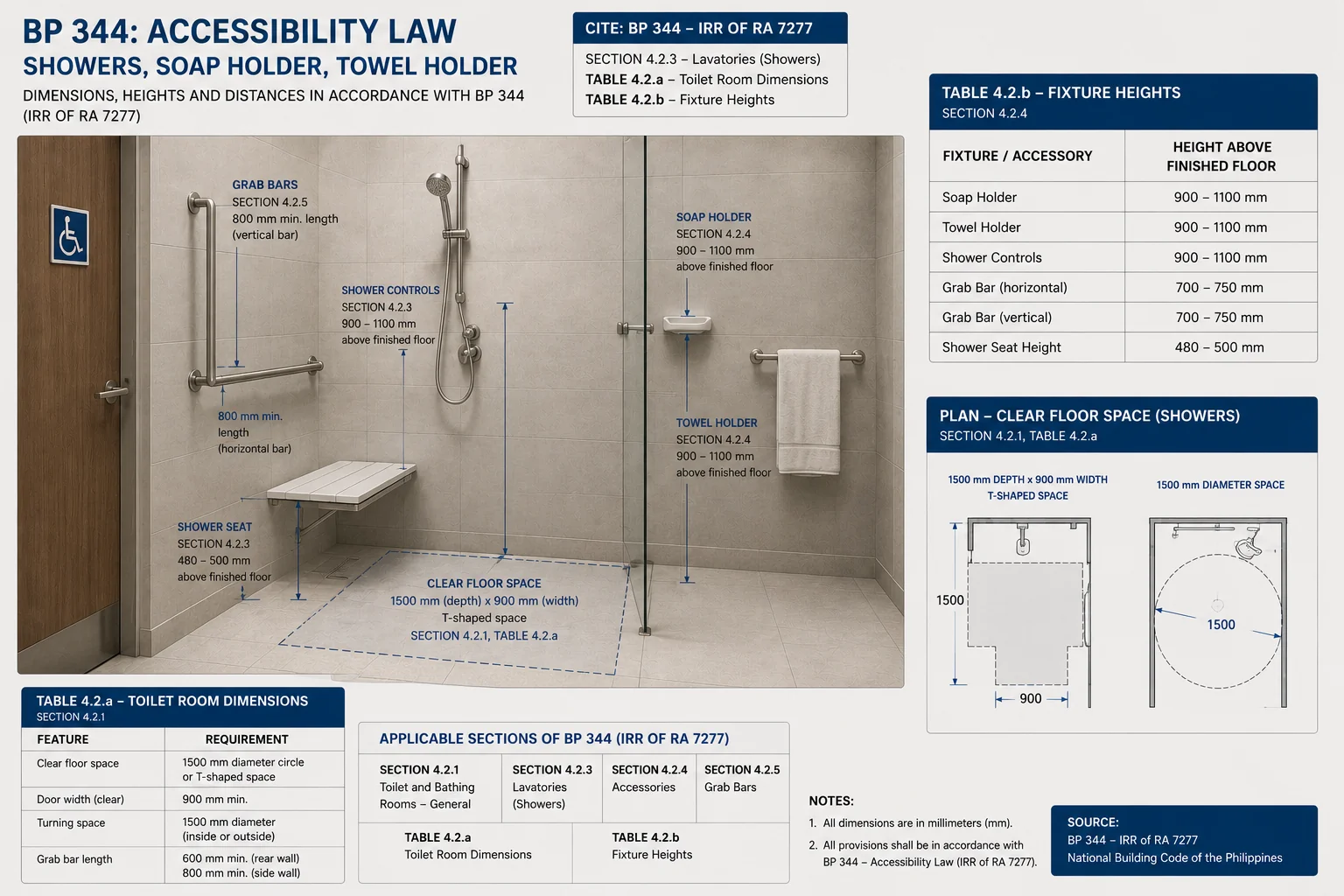
BP344 accessible shower diagram — shower seat at 480–500mm, grab bars, soap and towel holder heights, and T-shaped clear floor space
Shower · Seat, Controls & Grab Bars

Frequently Asked Questions

Why must the accessible toilet door swing outward?
The door must swing outward so that if a PWD falls against it, the door can still be opened from outside for emergency access. An inward-swinging door could be blocked by a fallen user.
What is the difference between an L-type and flip-up grab bar?
The L-type grab bar is fixed permanently to the side wall and provides support for lateral transfers. The flip-up grab bar is on the opposite side and can fold up to allow side transfer when needed, then flip down for grab support.
Is the ceiling hoist system mandatory under BP344?
The ceiling hoist system is required only "where provided" — it is not mandatory for every accessible toilet. However, if installed, BP344 sets minimum clearance of 2000mm × 1800mm and minimum ceiling height of 2400mm.
What is the maximum height for an accessible urinal under BP344?
BP344 requires at least one urinal to be wall-hung with the rim no higher than 430mm above the finished floor, with clear floor space in front for a forward wheelchair approach.
What are the BP344 requirements for an accessible shower?
An accessible shower must provide a folding shower seat at 480–500mm from the floor, grab bars, and reachable controls. Soap and towel holders are placed at 900–1100mm, with a T-shaped clear floor space for transfer and maneuvering.

Related BP344 Standards

Need BP344 Compliance Review?

AEDO Construction provides architectural plans and BP344 accessibility compliance review for Philippine construction projects.