BP344 Accessibility Standards by Aedo Construction
V1.0.0
Visual Standards Compliance Checklist ⬇ Download BP344 PDF
📋 Official Compliance Archive

BP344 ACCESSIBILITY REQUIREMENTS

Detailed visual guide for Batas Pambansa Blg. 344 — Amended IRR (Official Gazette, 2024). The definitive digital companion for architectural compliance, site planning, and infrastructure design. All provisions illustrated with rendered drawings for precise on-site reference.

♿ Human Centric 📐 Legal Specs 🔍 40 Drawings 📋 24 Sections
Initialize Standards  →
01

Accessible Ramps

BP344 · Appendix A.1 · A.5 · C.1
Provisions
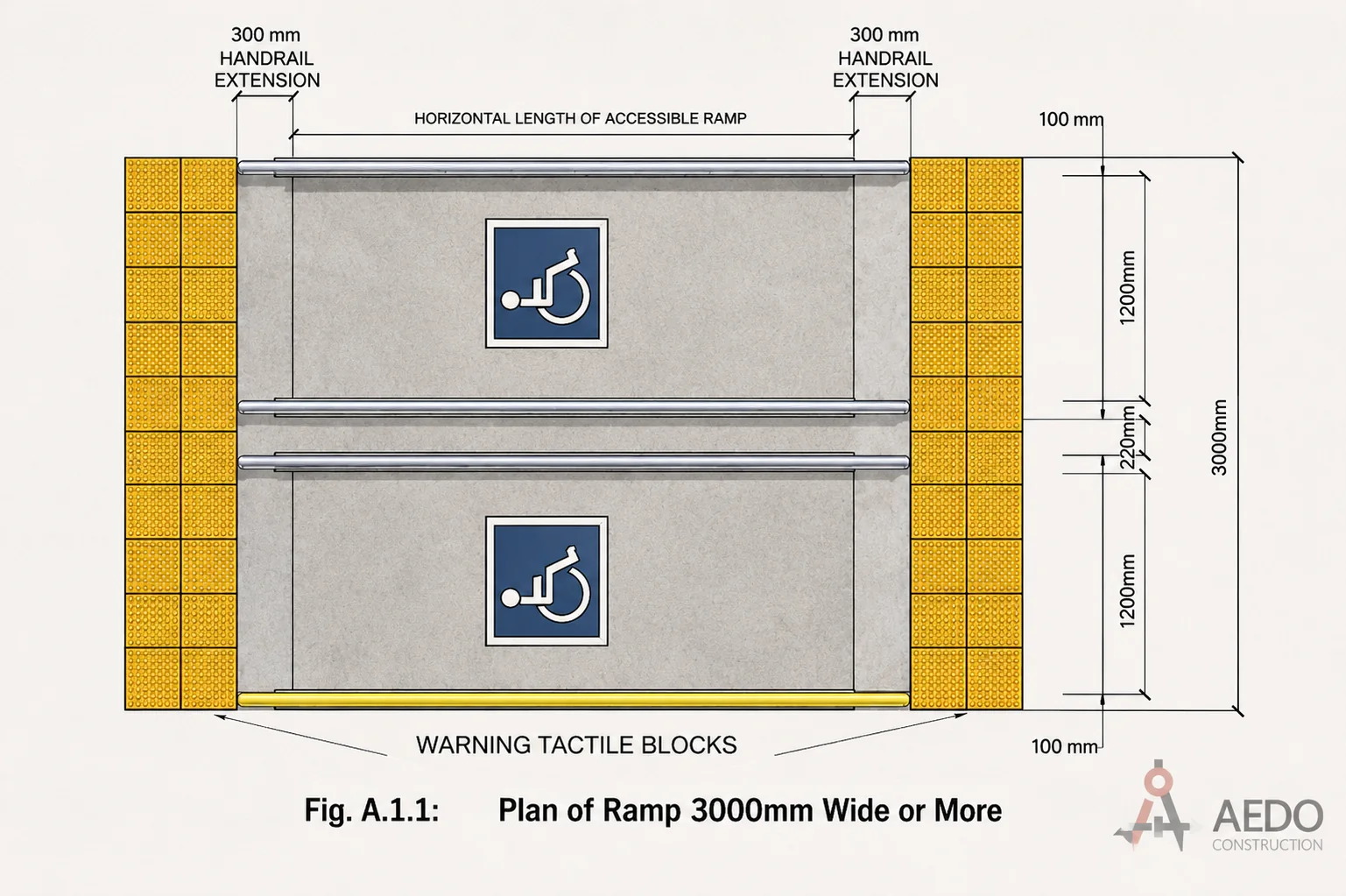
A.1.1Ramps shall be provided wherever there is a change in level. Minimum clear width: 1200 mm. Ramps ≥ 3000 mm wide require intermediate center handrails ("J-type" supports recommended).
A.1.2Maximum slope: 1:20 (standard). Steeper gradients up to 1:15 may be allowed in special cases. Maximum cross slope: 1:100. Level area min 1800 mm at top and bottom of ramp.
A.1.3Ramps longer than 10.50 m shall have intermediate landings min 1800 mm long. Raised edge min 100 mm on both sides.
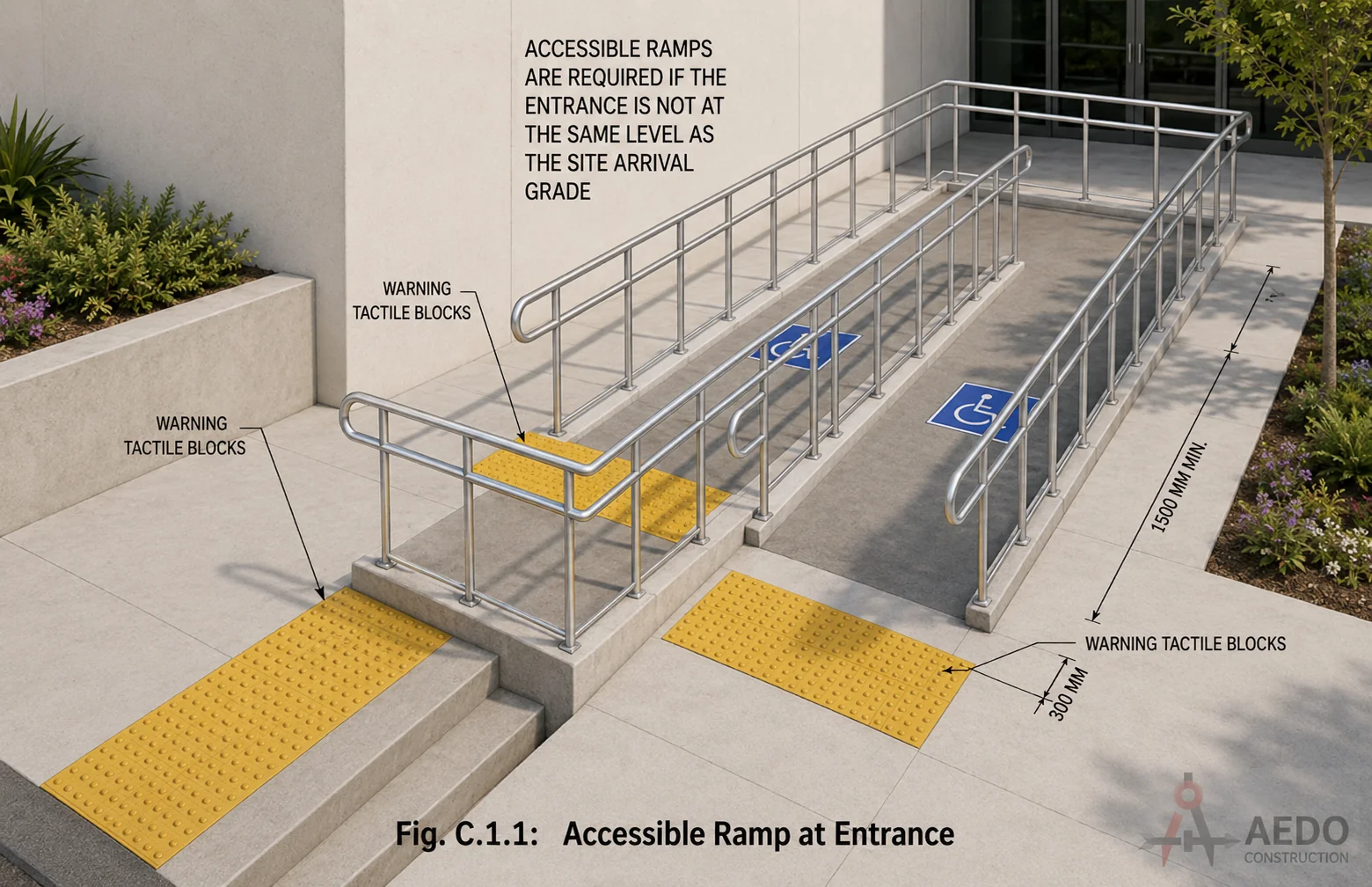
A.1.4Warning tactile blocks: depth 600 mm, installed 300 mm from head and foot of ramp and at center of each landing.
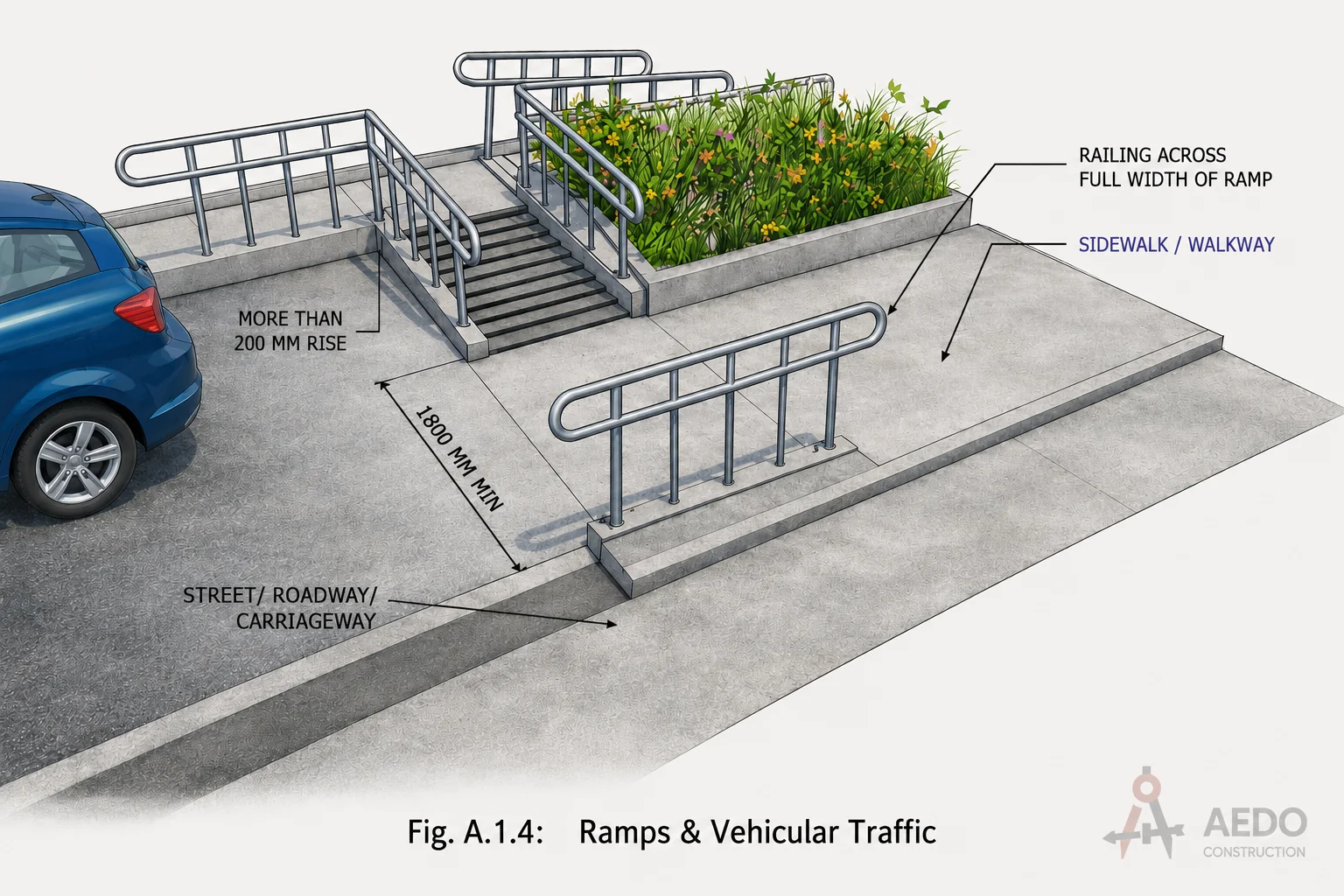
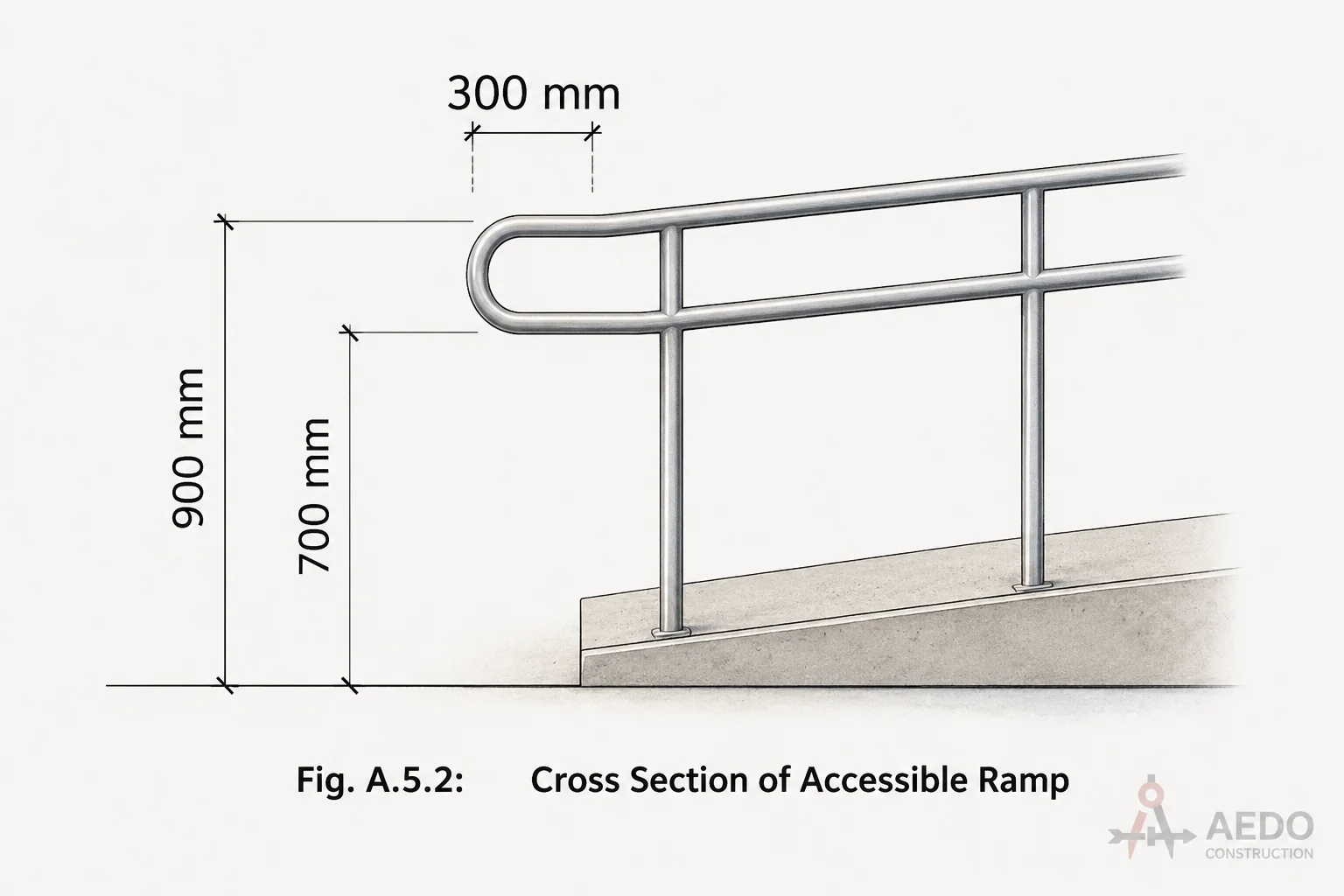
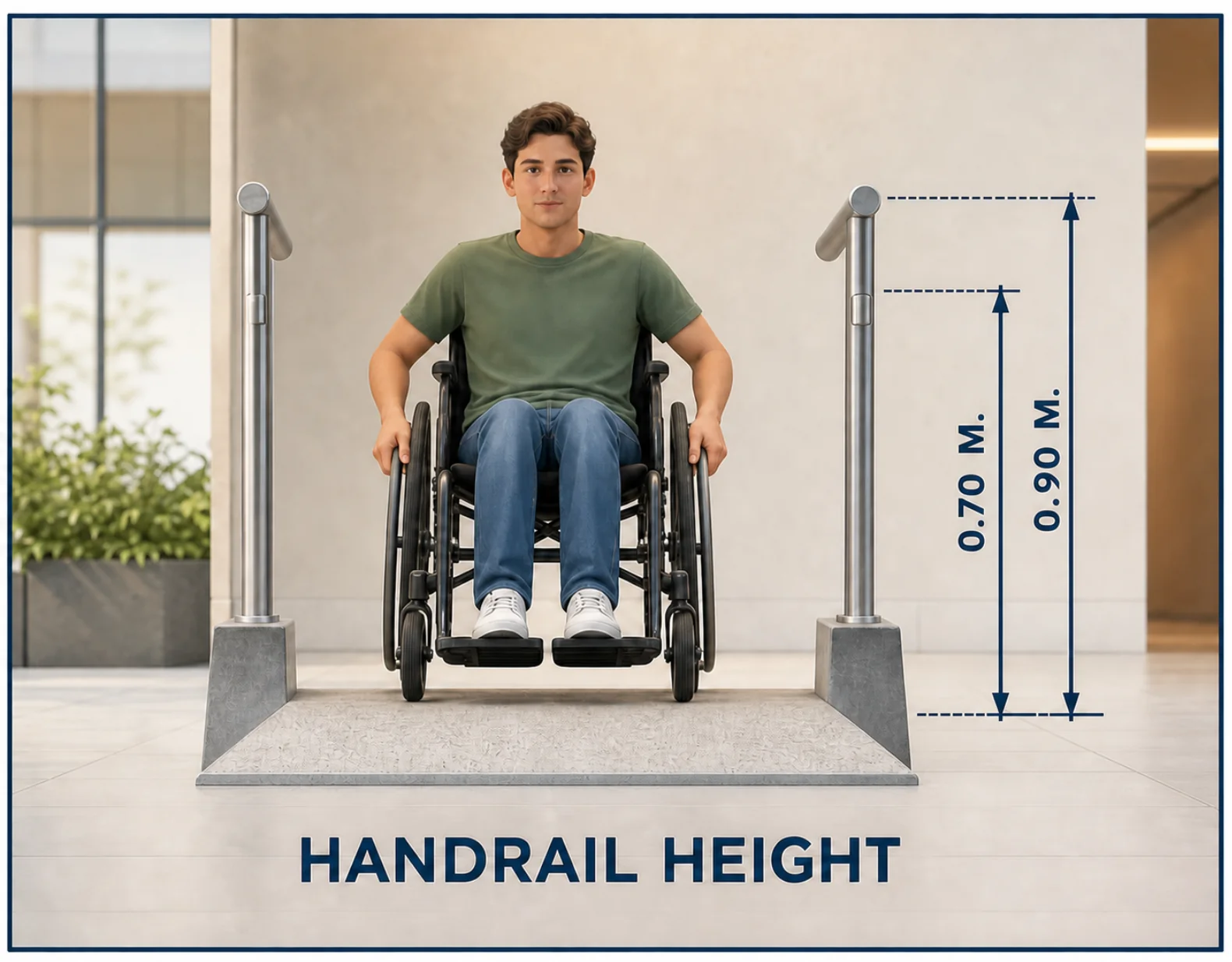
A.1.5Handrails on both sides at 700 mm and 900 mm. 300 mm horizontal extension at upper and lower ends. Safety railing required when ramp leads toward vehicular traffic, min 1800 mm from foot.
C.1.1Accessible ramps required at entrances not at the same level as site arrival grade. Warning tactile blocks at top and bottom.
Key Dimensions
Min Width1200 mm
Max Slope (std)1:20
Max Slope (special)1:15
Max Cross Slope1:100 (1%)
Level Area (top/bottom)1800 mm min
Intermediate Landing1800 mm min
Raised Edge100 mm min
Tactile Warning Depth600 mm
Tactile Setback300 mm from ramp end
Handrail Height700 mm & 900 mm
Handrail Ext.300 mm
Fig. A.1.1 Fig. A.1.4 Table A.1.1 Fig. C.1.1
Plan of Ramp 3000mm Wide
Fig. A.1.1 · Plan of Ramp 3000mm+
Ramps and Vehicular Traffic
Fig. A.1.4 · Ramps & Vehicular Traffic
Accessible Ramp at Entrance
Fig. C.1.1 · Accessible Ramp at Entrance
Table A.1.1 — Accessible Ramps
Max SlopeMax LengthMax RiseLanding Interval
1:2015 m
1:1510.50 m700 mm10 m
02

Handrails & Grab Bars

BP344 · Appendix A.5 · Section 7
Provisions
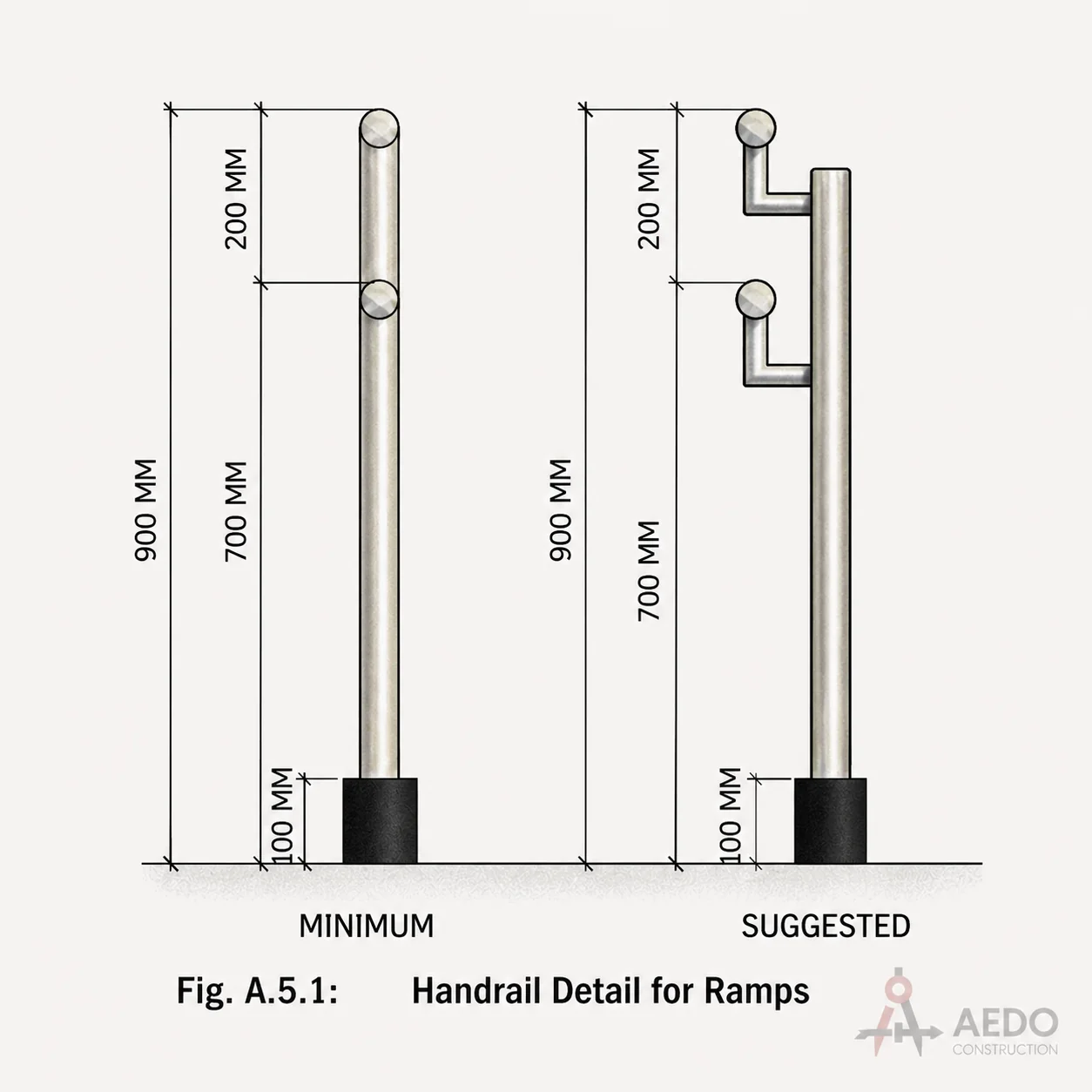
A.5.1Handrail height: 700 mm min, 900 mm max above ramp or stair nosing surface.
A.5.2Horizontal extension: 300 mm beyond top and bottom of ramp. The extension shall be parallel to the floor surface.
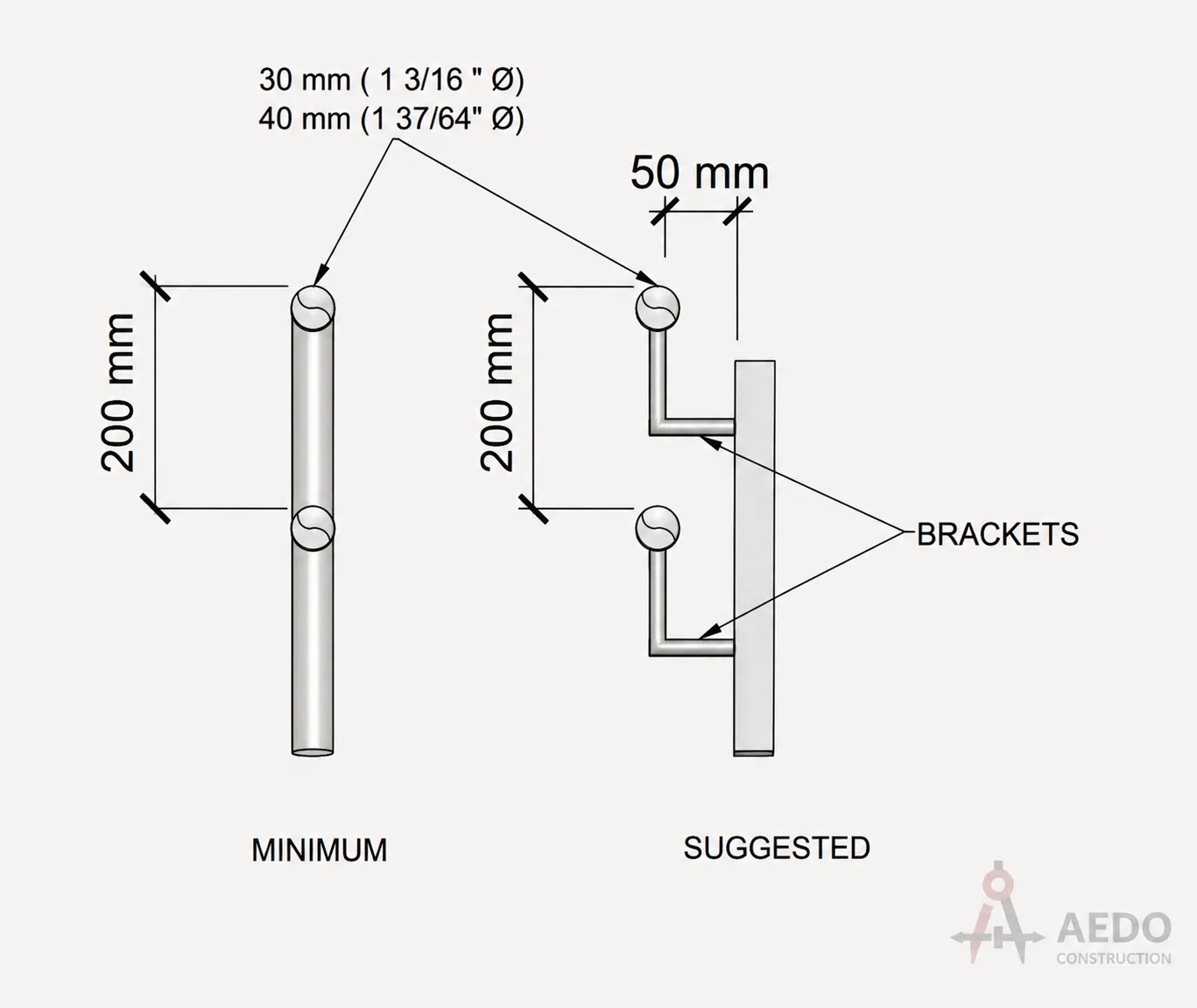
A.5.3Handrail diameter: 30 mm (1‑3/16") to 40 mm (1‑37/64"). Graspable profile for continuous grip.
A.5.4Minimum wall clearance: 50 mm. Brackets do not obstruct gripping surface.
A.5.5Handrails shall be continuous, with no sharp edges, and return to the wall or floor at both ends to prevent clothing catch.
Key Dimensions
Height (min)700 mm
Height (max)900 mm
Horizontal Ext.300 mm
Diameter30–40 mm
Wall Clearance50 mm min
Fig. A.5.1Fig. A.5.2
Handrail Detail for Ramps
Fig. A.5.1 · Handrail Detail
Cross Section of Accessible Ramp
Fig. A.5.2 · Cross Section
Handrail Diameter and Bracket
Diameter & Bracket Detail
03

Accessible Parking

BP344 · Appendix A.6
Provisions
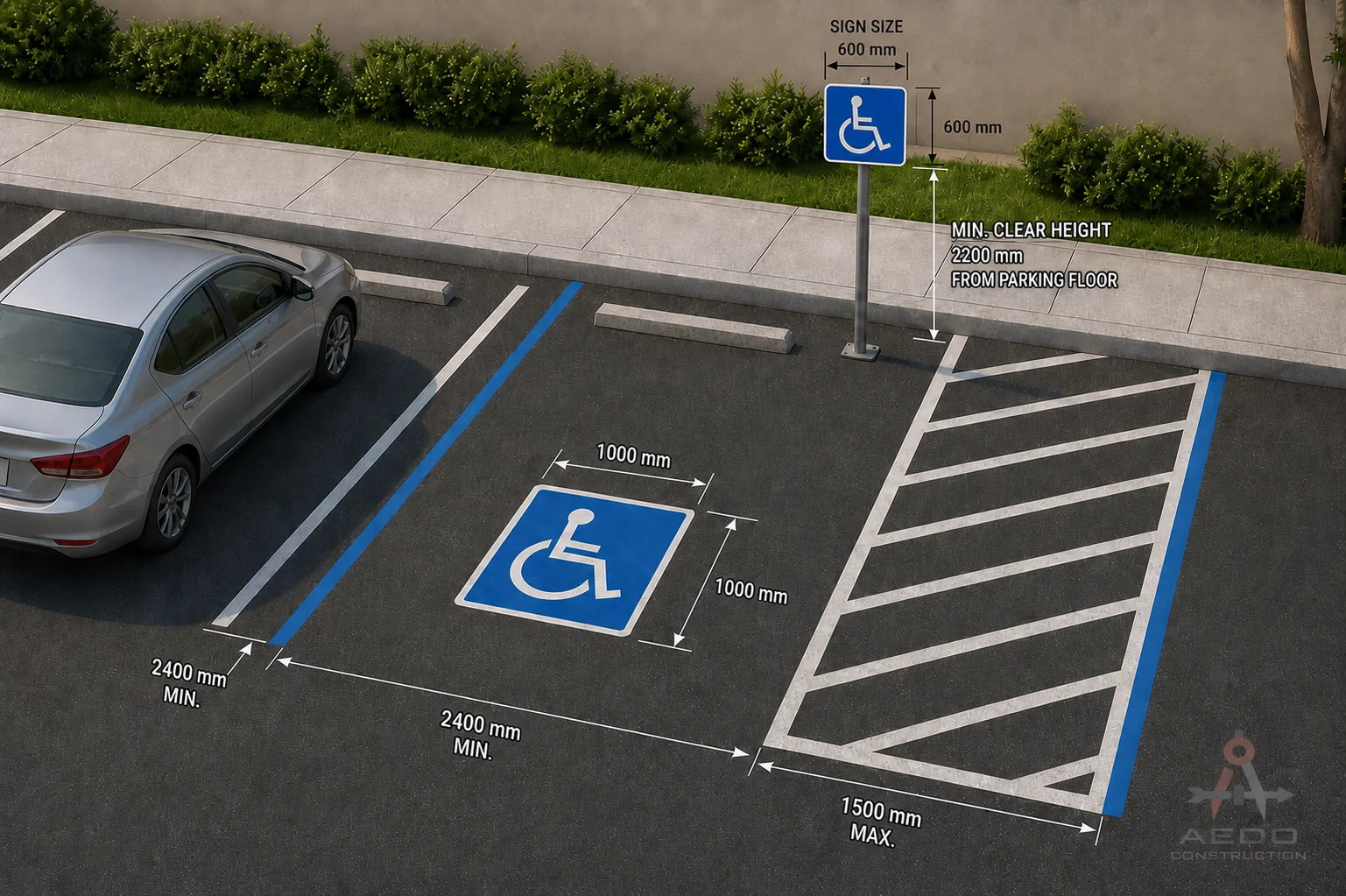
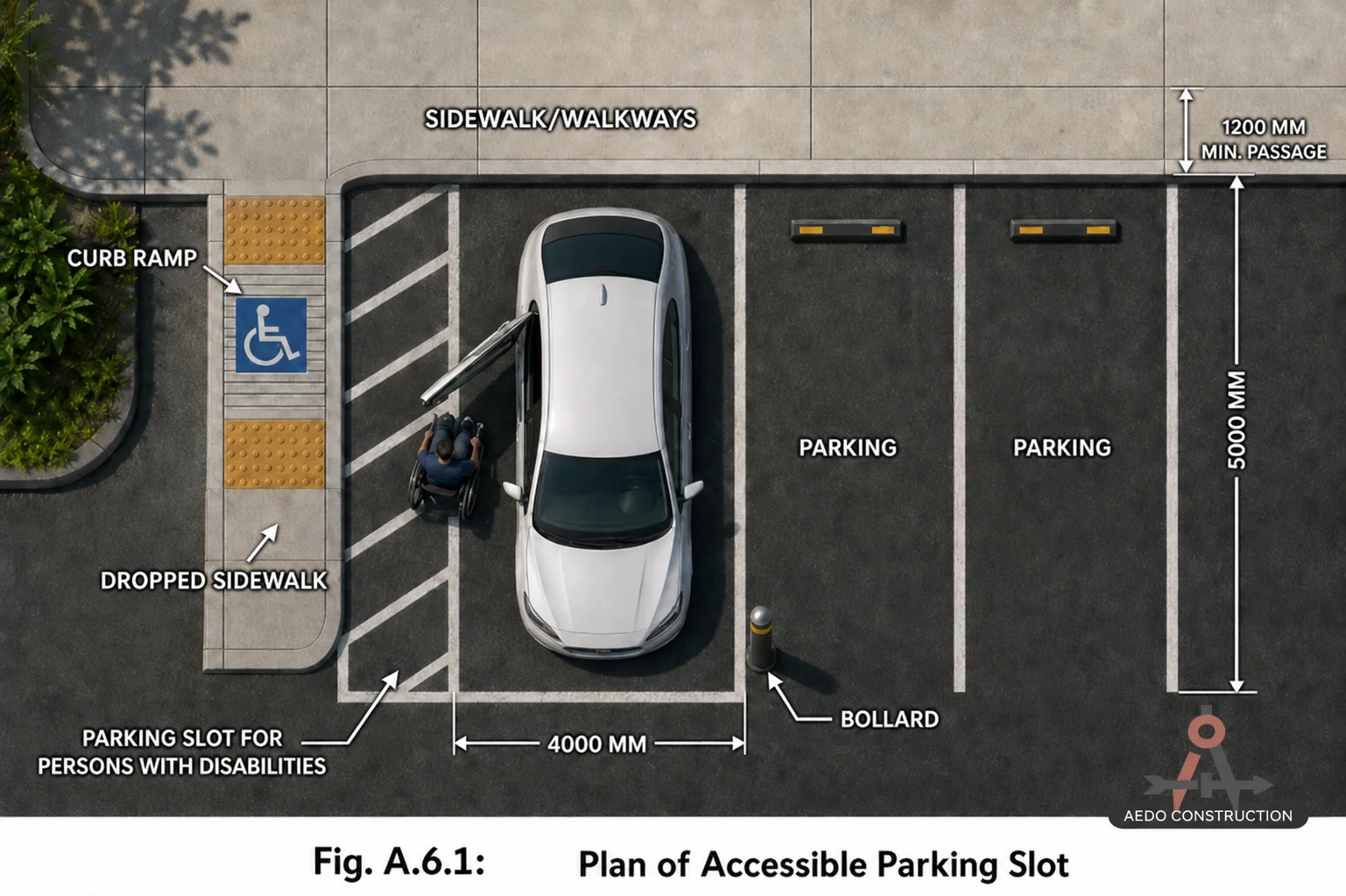
A.6.1Accessible stall: minimum 4000 mm wide × 5000 mm long. The extra 1500 mm vs standard slot ensures adjacent pathway accommodates wheelchair passage.
A.6.2Walkway min 1200 mm between front ends of parked cars. Stall surface: firm, level, no aeration slabs. Dropped sidewalk or curb ramp to parking level where walkways are raised.
A.6.3PWD access only: passenger with disability must be inside vehicle. Access parking placard with control number and PWD ID conspicuously hung on rear-view mirror.
A.6.4Pole-mounted ISA sign: 600 mm × 600 mm, min clear height 2200 mm from parking floor. Pavement ISA symbol: 1000–1500 mm square centered in stall, white figure on UN Blue (#5B92E5).
A.6.5Multi-story parking: accessible slots adjacent to elevators. Multiple entrances: slots dispersed nearest each accessible entrance. Never locate in ramped/sloping areas.
Key Dimensions
Stall Width (min)4000 mm
Stall Length5000 mm
Front Walkway1200 mm min
Pole Sign Size600 × 600 mm
Sign Clear Height2200 mm
Floor Symbol1000–1500 mm sq.
Fig. A.6.1Table A.6.1
Accessible Parking Perspective
Accessible Parking · Perspective
Plan of Accessible Parking Slot
Fig. A.6.1 · Plan of Parking Slot
Table A.6.1 — Accessible Parking Slot Requirement
Total Parking SlotsRequired Accessible Slots
1 – 251
26 – 502
51 – 753
76 – 1004
101 – 1505
151 – 2006
201 – 3007
301 – 4008
401 – 5009
501 – 10002% of Total
1001 & Over20 + 1 per 100 over 1000
04

Doors & Entrances

BP344 · Appendix C.2
Provisions
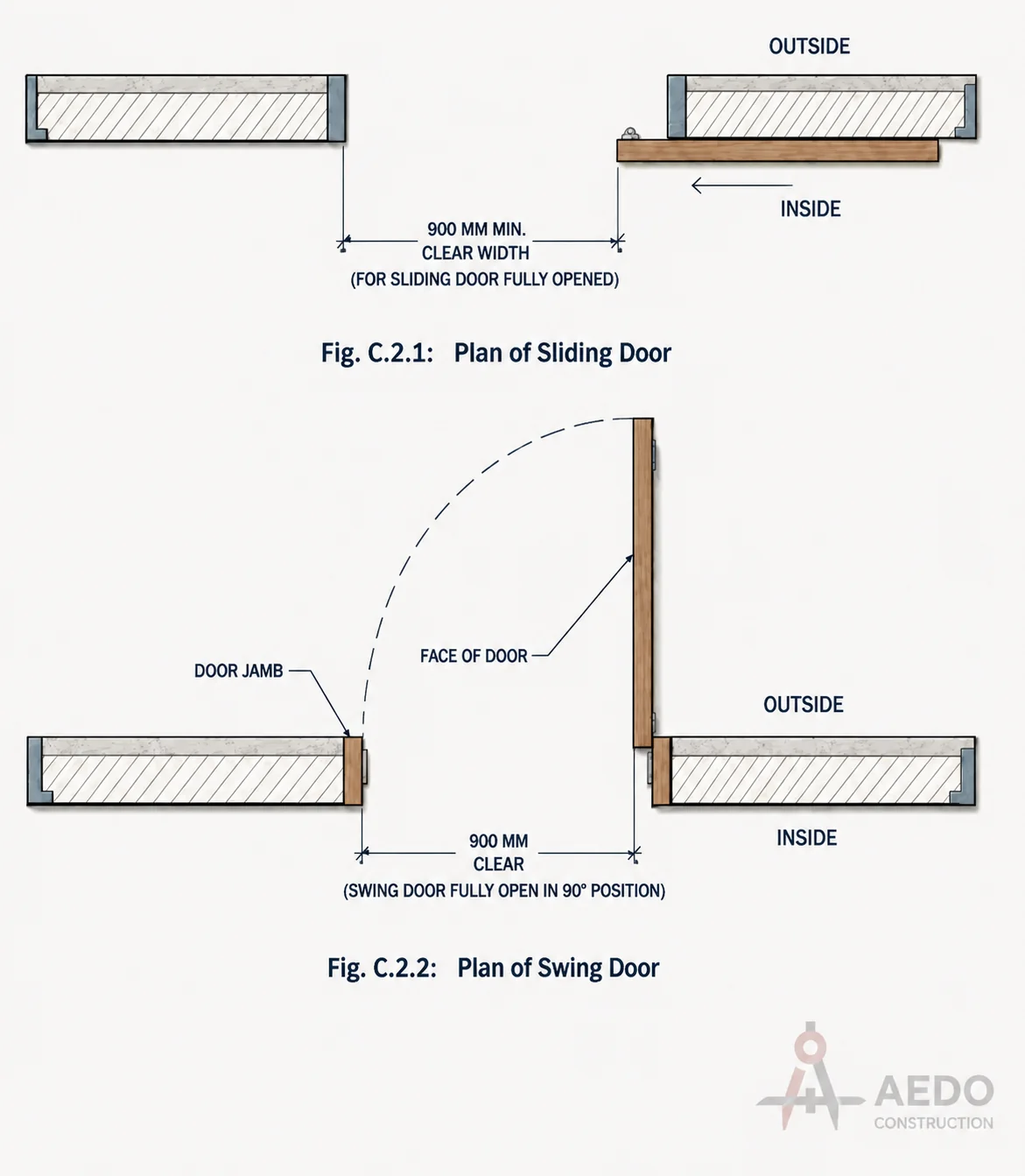
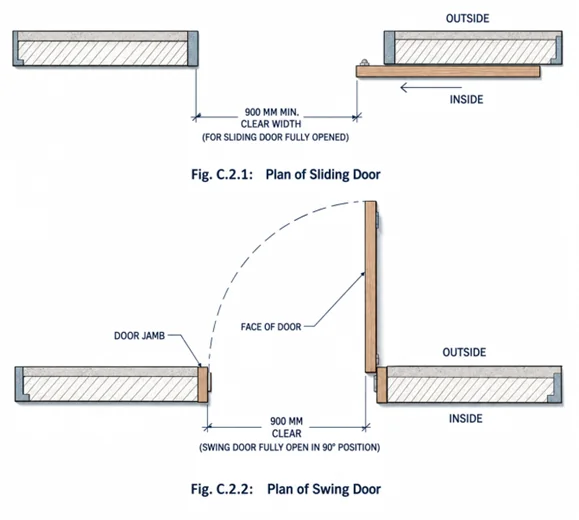
C.2.1Minimum clear opening width: 900 mm for both sliding doors (fully open) and swing doors (90° open position).
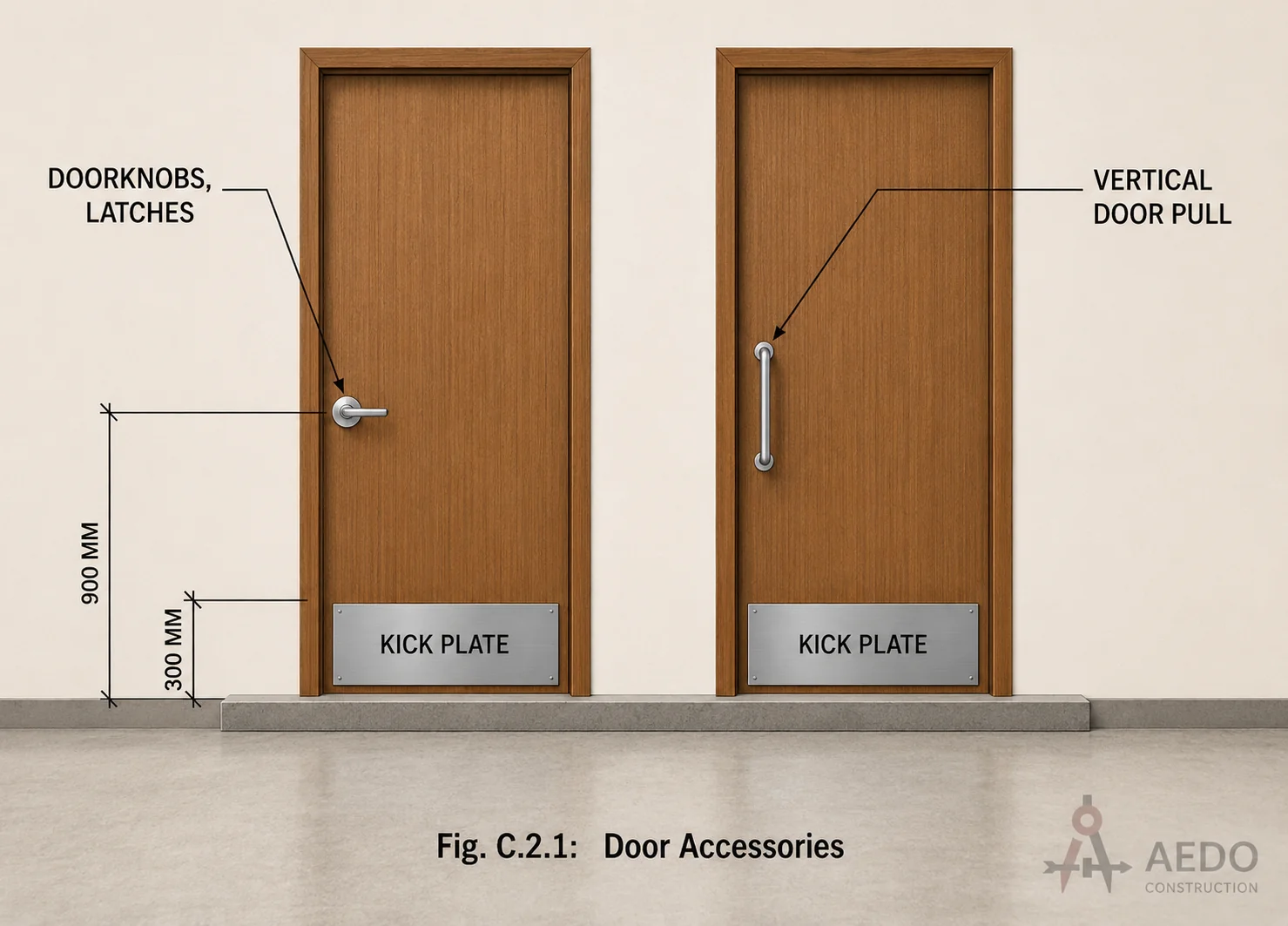
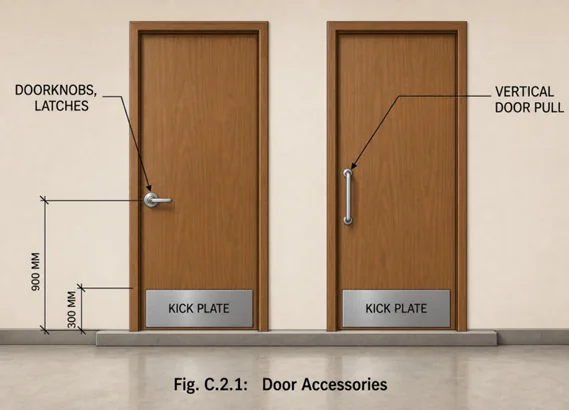
C.2.2Door hardware height: 900 mm from finished floor. Lever-type handles and latches preferred over knobs for persons with limited grip strength.
C.2.3Kick plate: 300 mm high from floor. Protects door from wheelchair footrests and provides visual contrast.
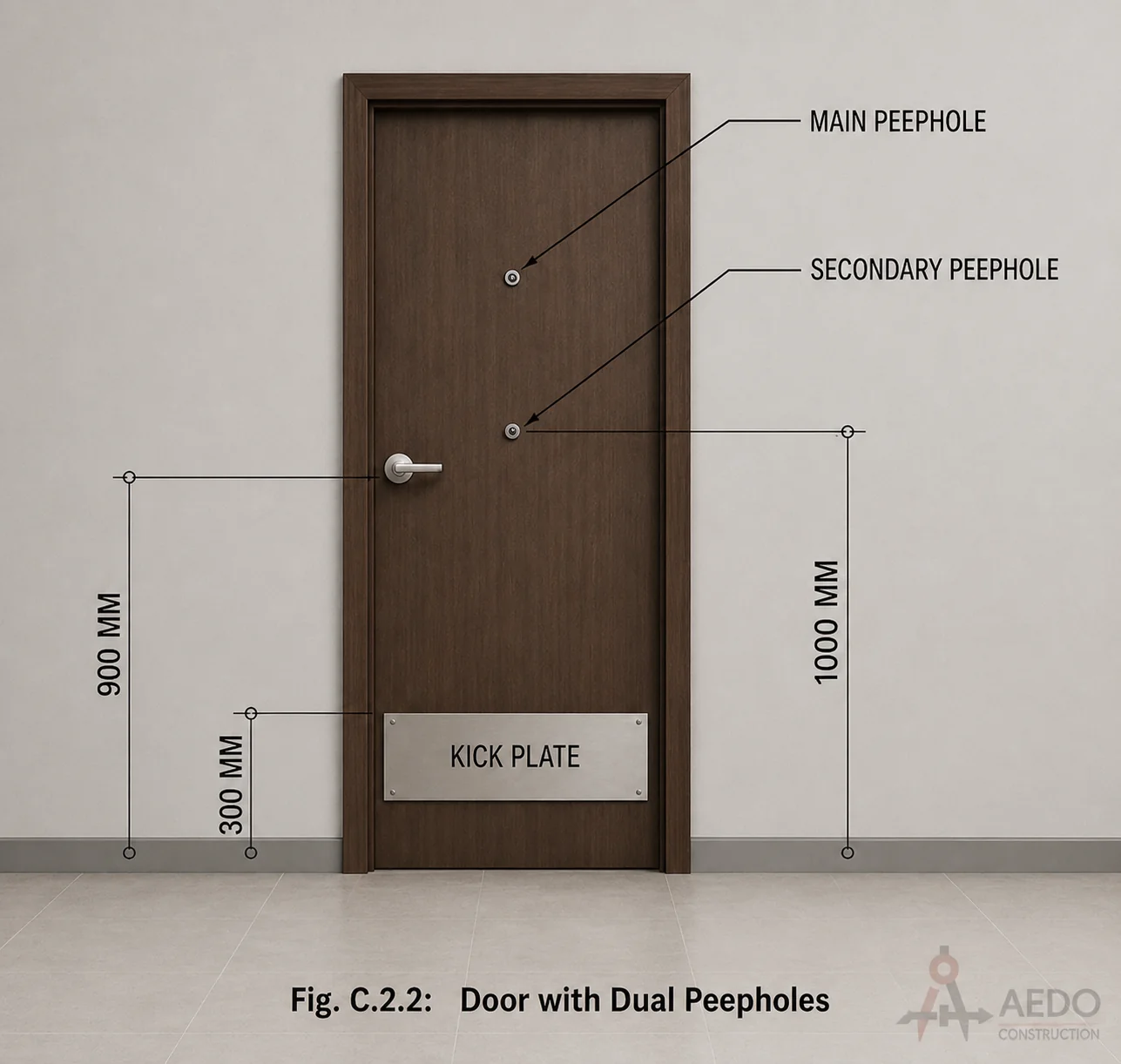
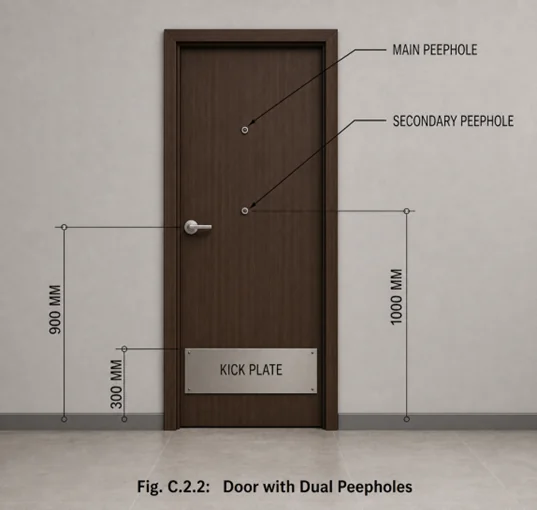
C.2.4Peepholes (where provided): dual peepholes at 900 mm (standard) and 1000 mm (for wheelchair users).
C.2.5Vertical door pull recommended on pull side. Accessible toilet cubicle doors shall swing outward.
Key Dimensions
Clear Width (min)900 mm
Hardware Height900 mm
Kick Plate300 mm high
Peephole (std)900 mm
Peephole (WC)1000 mm
Fig. C.2.1Fig. C.2.2
Door with Dual Peepholes
Fig. C.2.2 · Dual Peepholes
Door Accessories
Fig. C.2.1 · Door Accessories
Plan of Sliding and Swing Door
Plan · Sliding & Swing Door
05

Toilets & Baths

BP344 · Appendix D · Section 6.3
Provisions
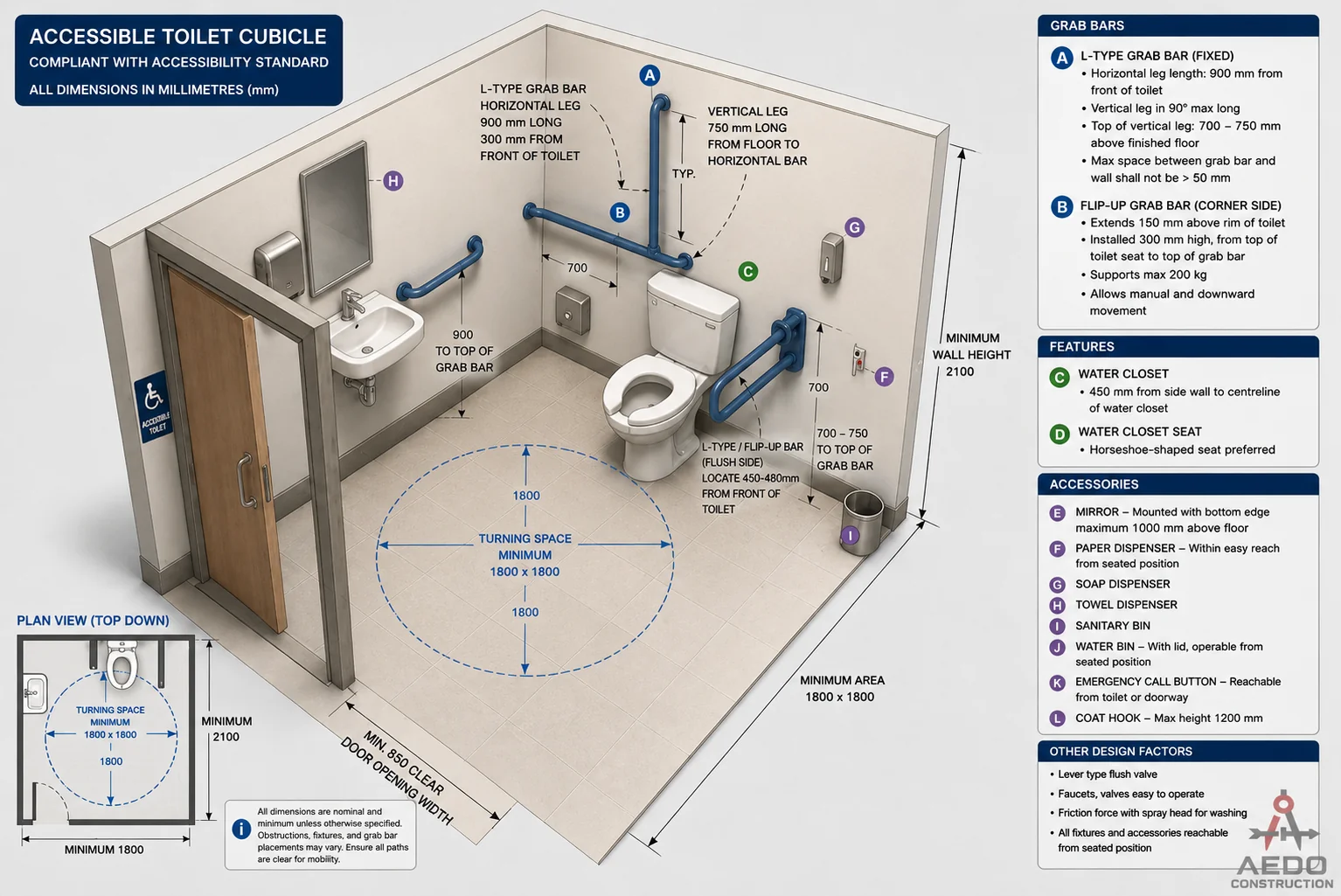
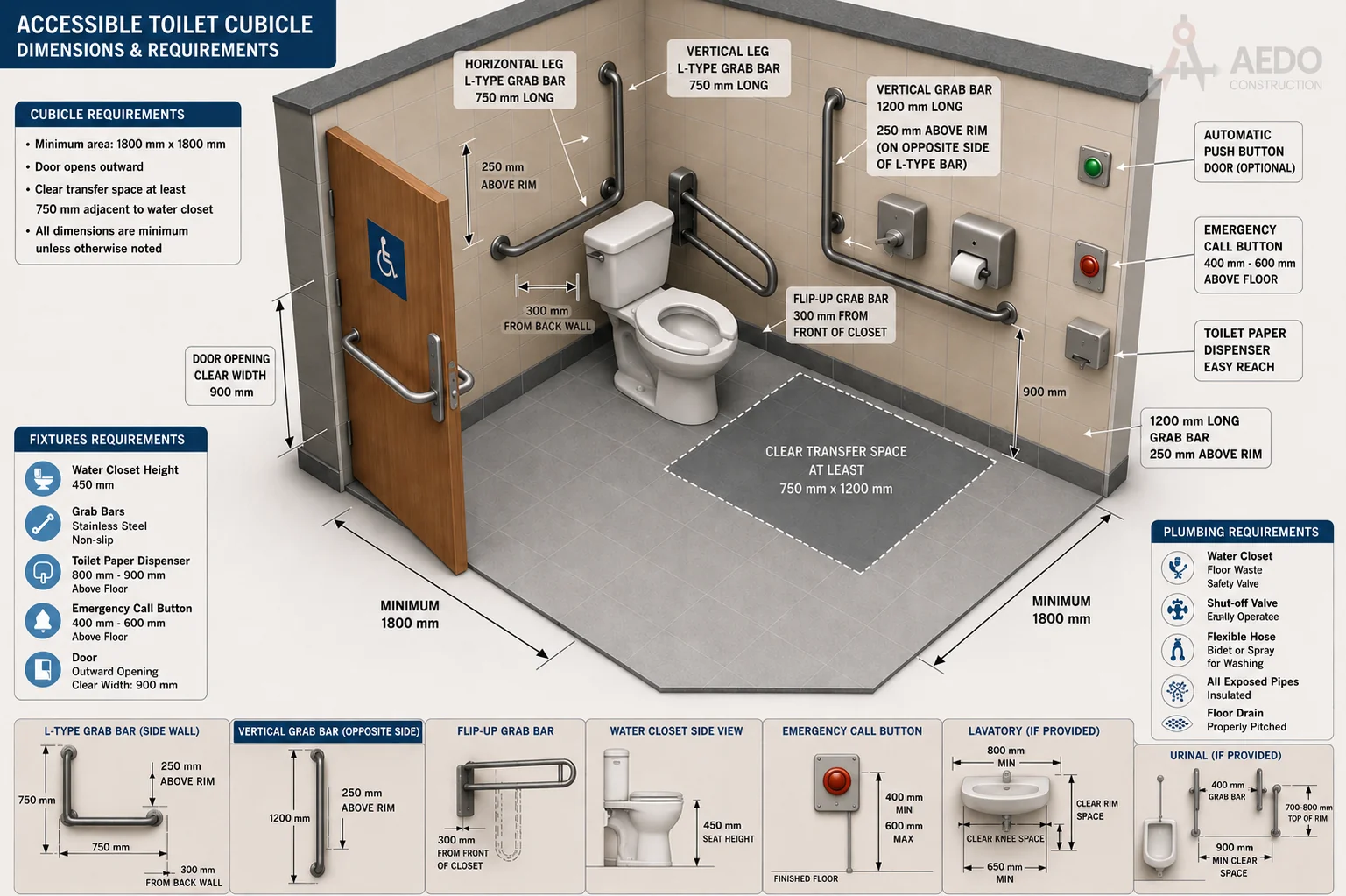
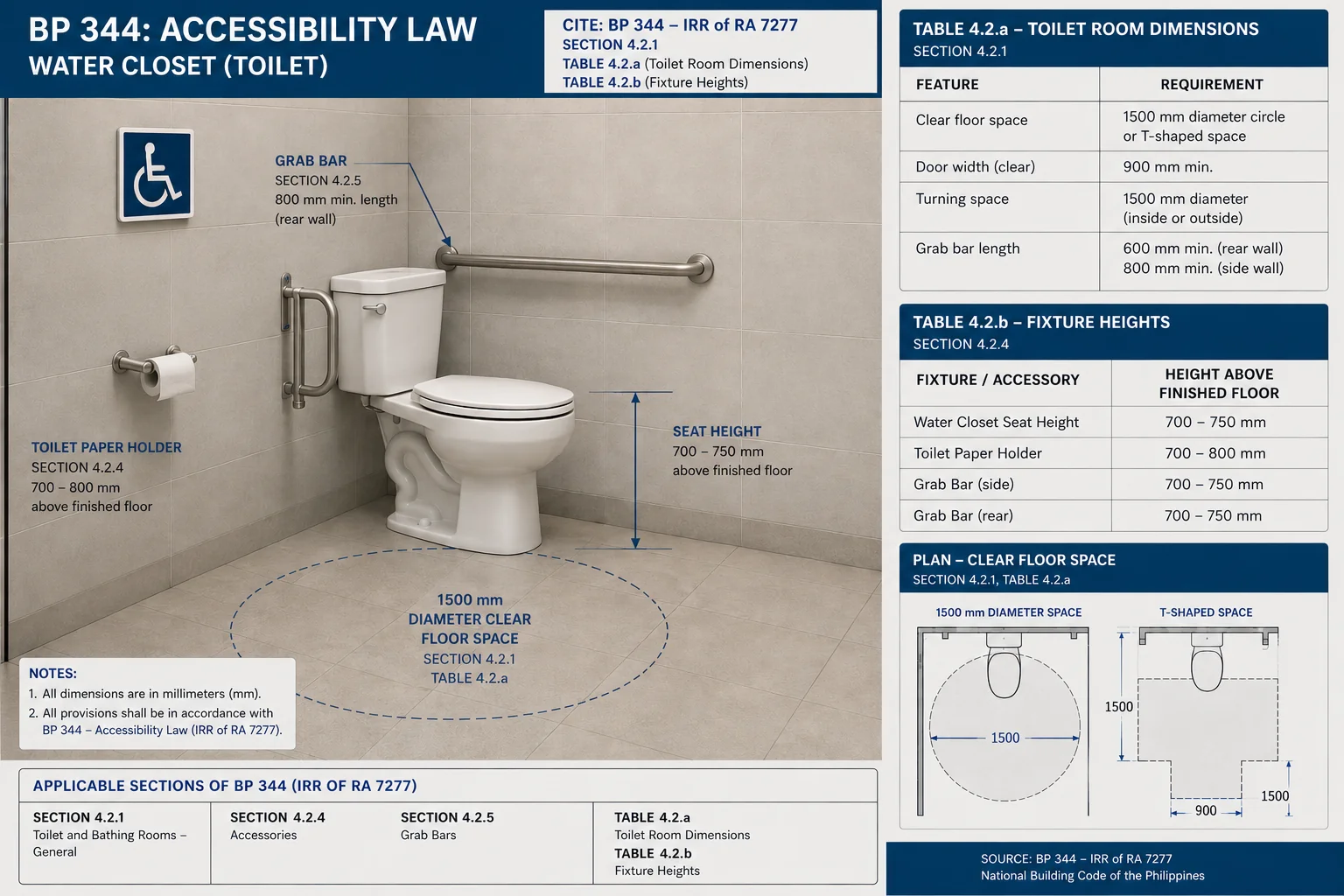
D.1Minimum cubicle area: 1800 mm × 1800 mm. Door minimum clear width 900 mm, opening outward.
D.2Clear turning space: 1800 mm diameter circle inside cubicle. Clear transfer space min 750 mm adjacent to water closet.
D.3Water closet height: 450 mm from floor. Horseshoe-shaped seat preferred for lateral transfers.
D.4L-type grab bar (side wall): horizontal leg 900 mm long, 300 mm from front of toilet; vertical leg 750 mm long. Height: 700–750 mm from floor to bar top.
D.5Flip-up grab bar (opposite side): located 300 mm from front of closet. Extends 150 mm above rim.
D.6Emergency call button: 400–600 mm above floor. Mirror bottom edge: max 1000 mm. Coat hook: max 1200 mm.
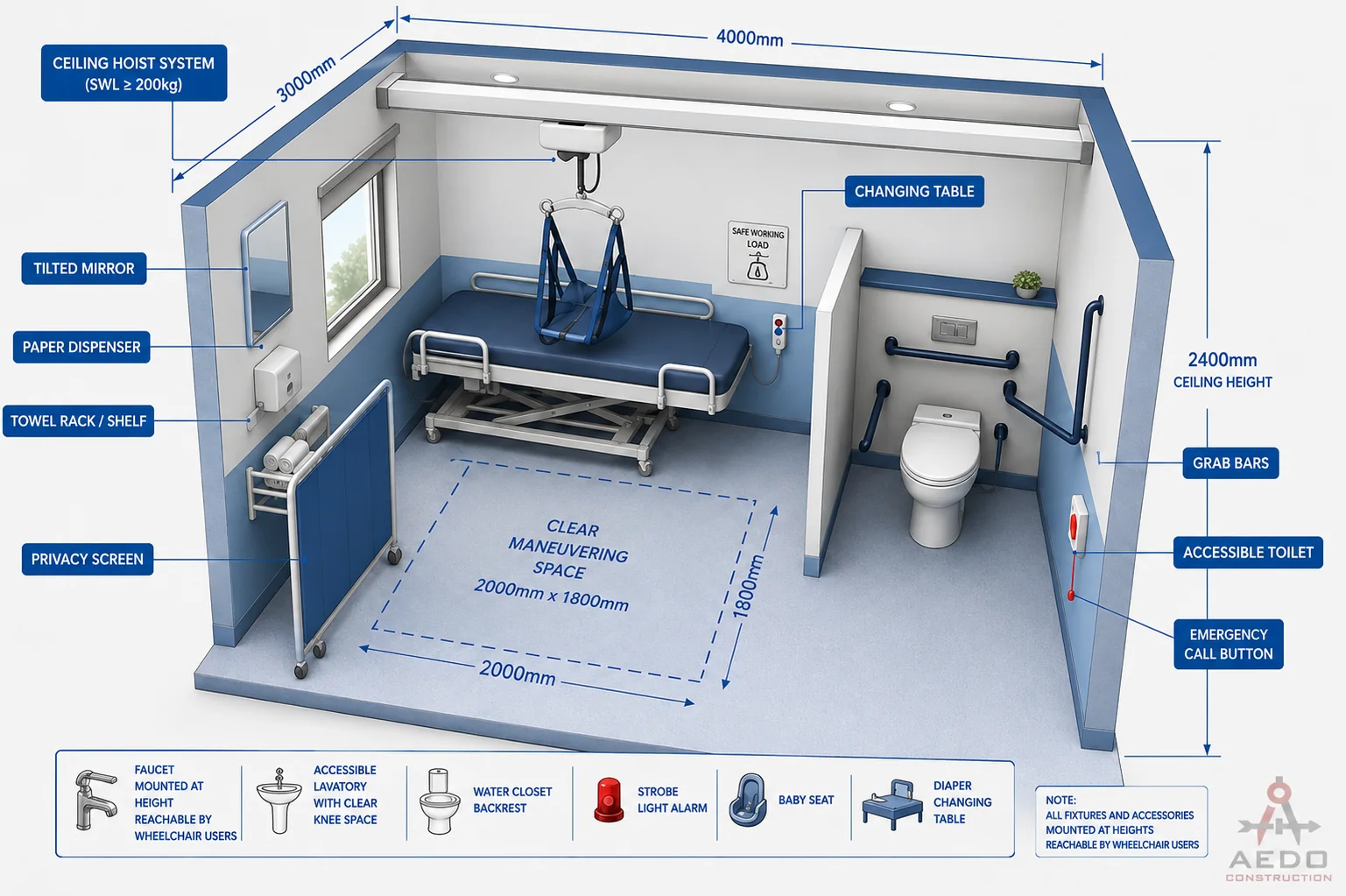
D.7Ceiling hoist system (where provided): min clear maneuvering space 2000 mm × 1800 mm. Min ceiling height 2400 mm.
Key Dimensions
Cubicle (min)1800 × 1800 mm
Turning SpaceØ 1800 mm
Transfer Space750 mm min
WC Height450 mm
Grab Bar (horiz.)900 mm long
Emergency Button400–600 mm
Clause 6.3Appendix D
Accessible Toilet Cubicle 3D
Accessible Toilet · 3D View
Accessible Toilet Dimensions
Dimensions & Requirements
Accessible Toilet with Ceiling Hoist
With Ceiling Hoist System
06

Signage & Wayfinding

BP344 · Appendix A.7 · Section 13
Provisions
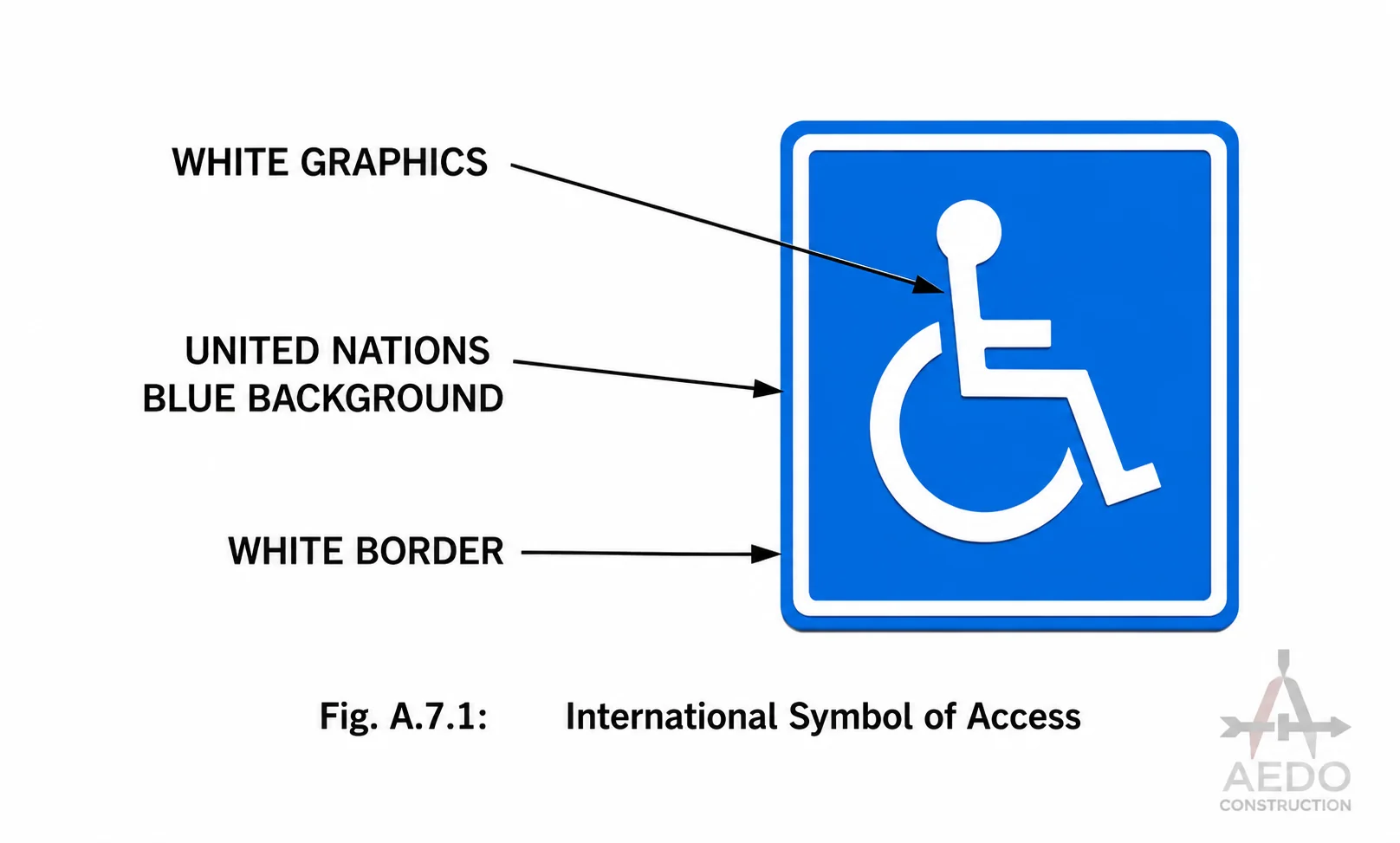
A.7.1International Symbol of Access (ISA): white figure on United Nations Blue (#5B92E5 / Pantone 279) background. Figure always faces right; add directional arrow if accessible area is to the left.
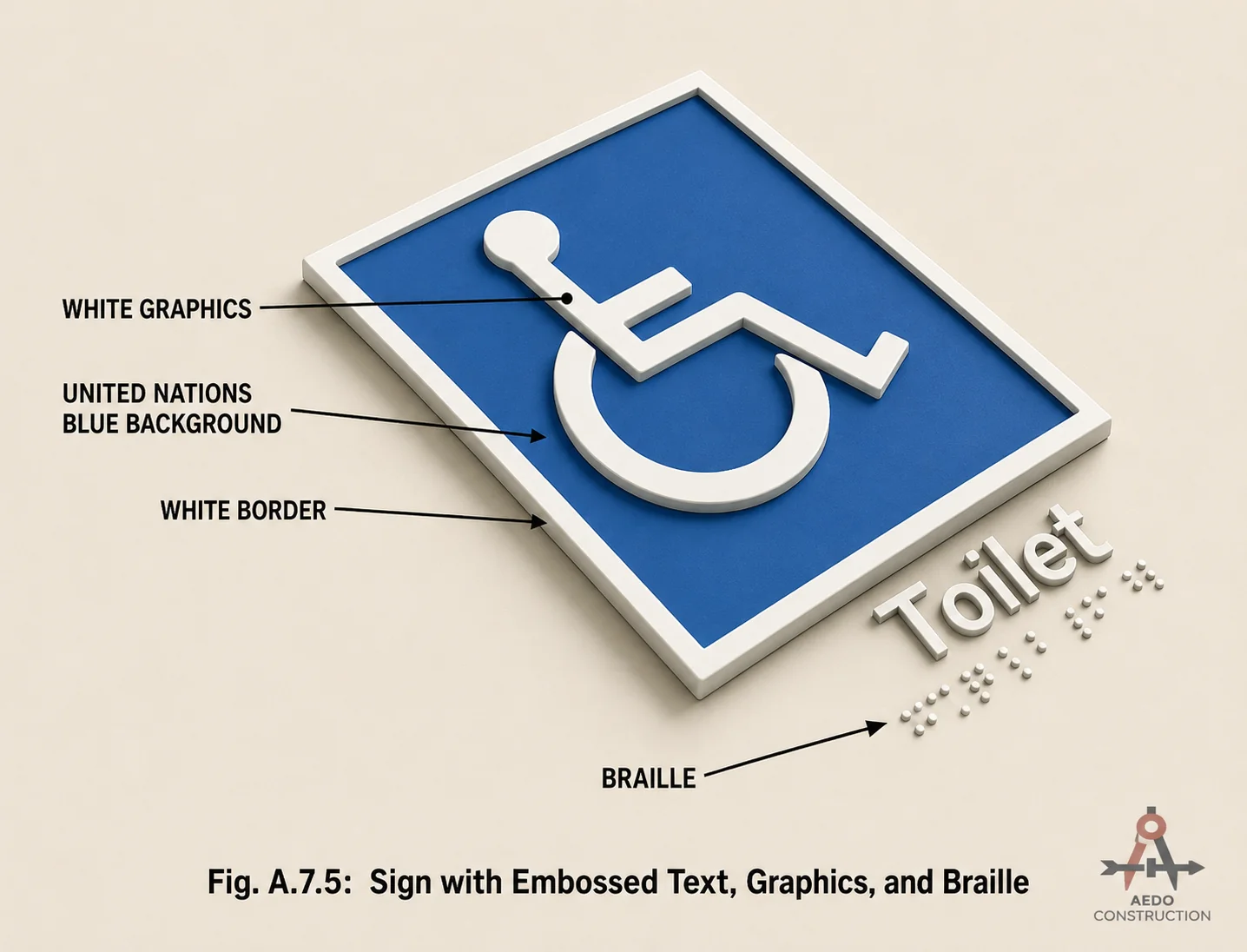
A.7.2All accessible signs shall have embossed text, graphics, and Braille. Raised characters min 16 mm high, Grade 2 Braille below text. Wall/door signs min 200 mm × 200 mm.
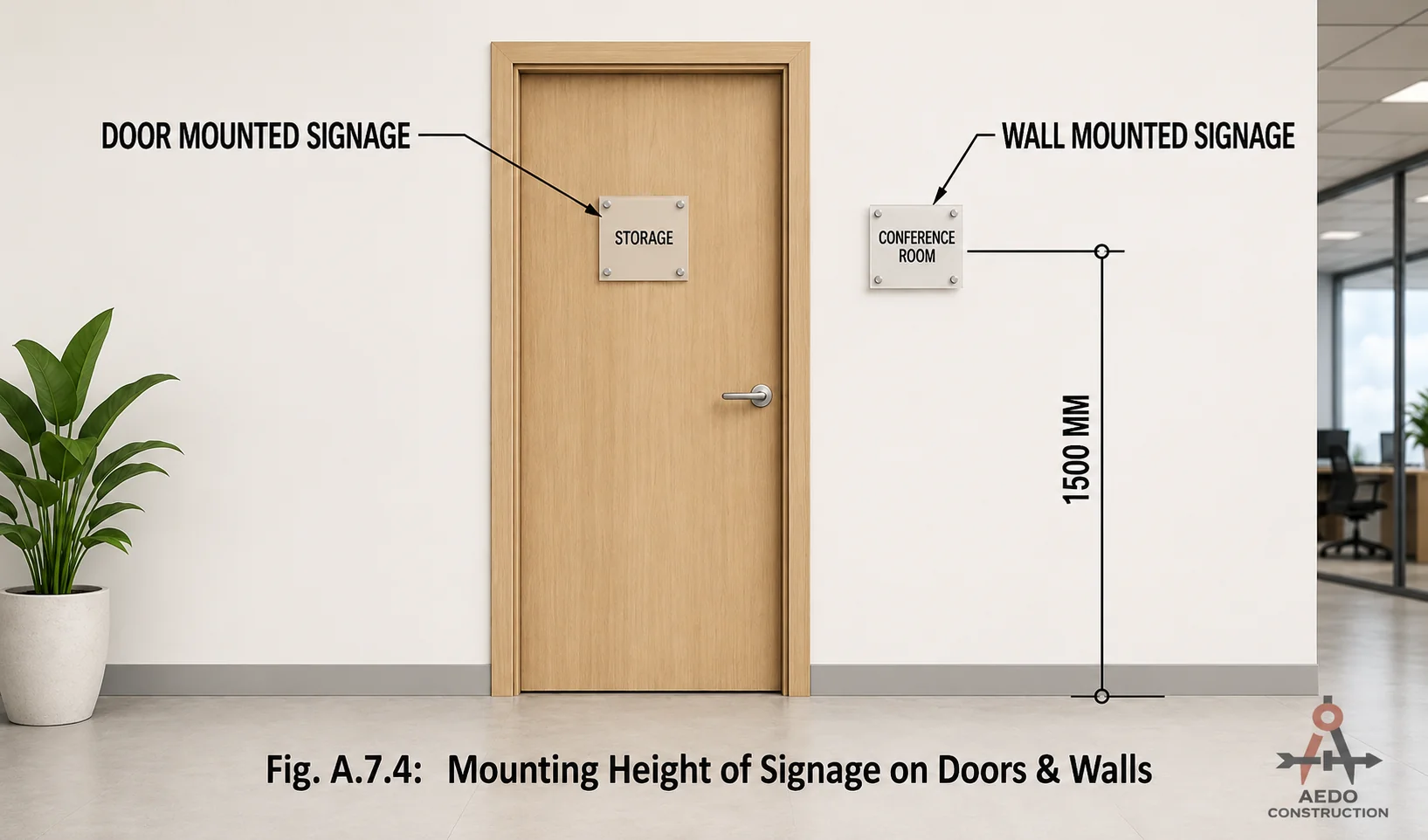
A.7.3Mounting height: center of sign max 1500 mm from finished floor. Signs with protrusion into walkways: min 2200 mm vertical clearance below.
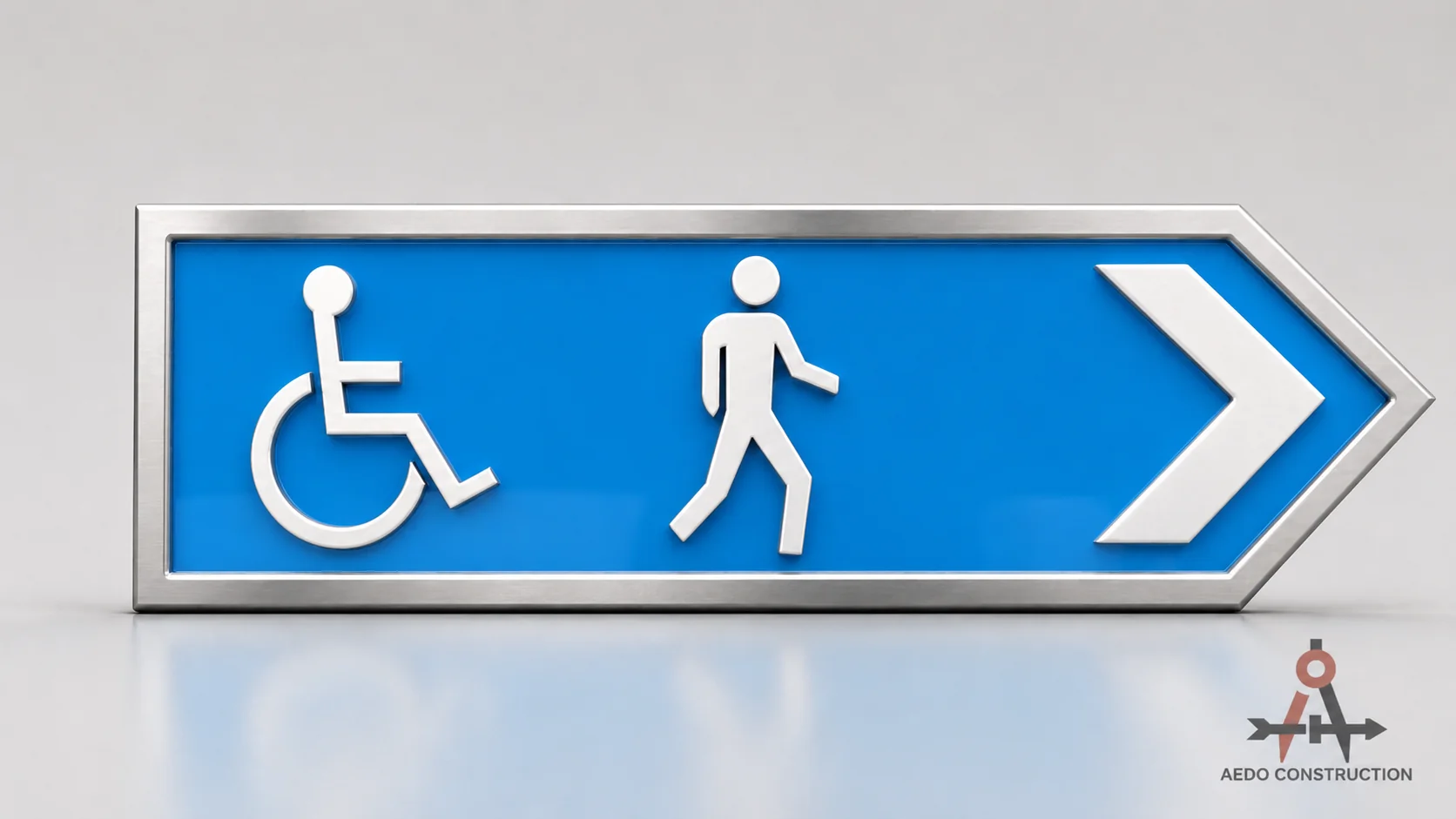
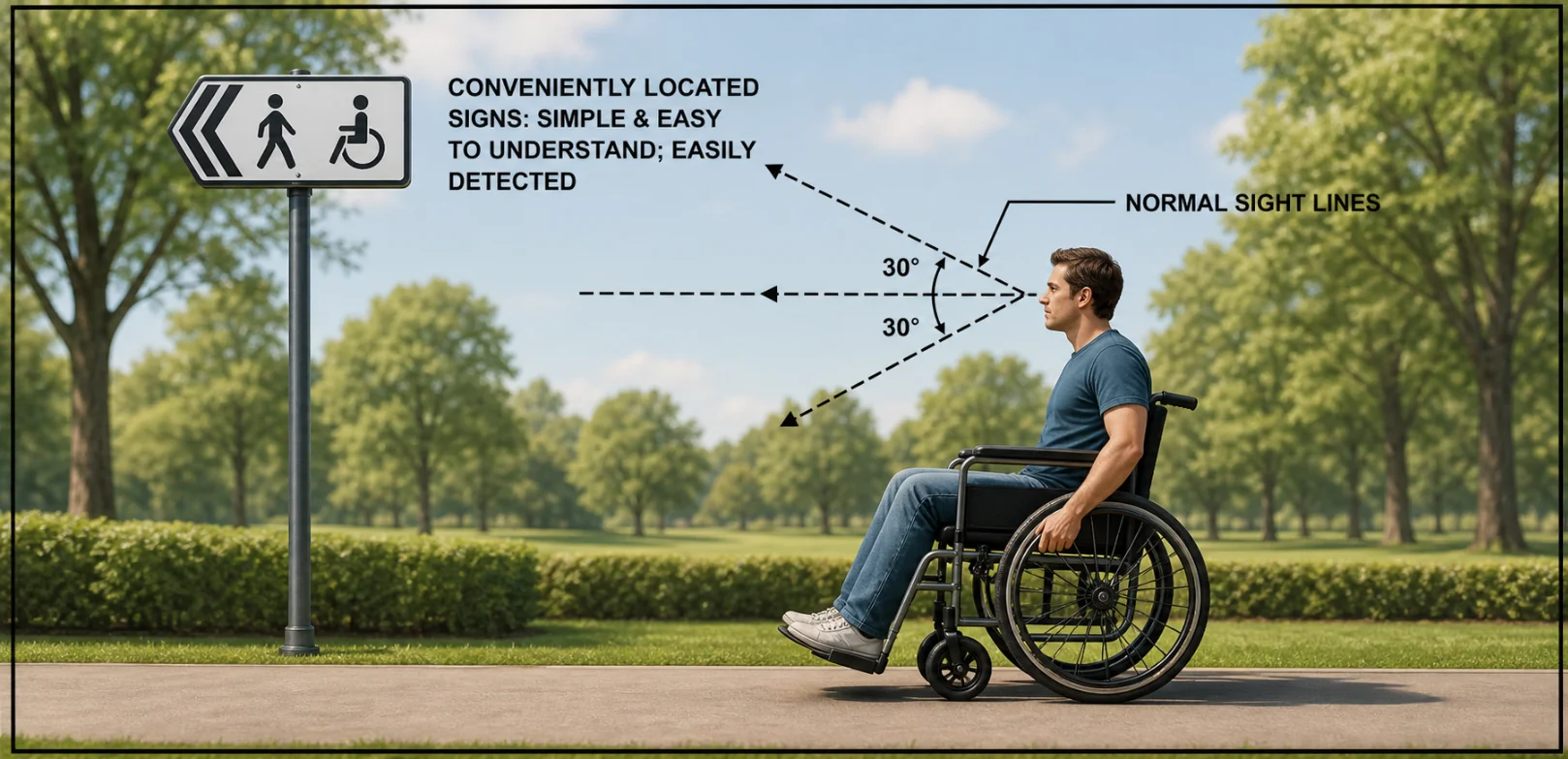
A.7.4Directional ISA signs at all passageways and direction-change points leading to lifts, entrances, toilets, parking, telephones.
A.7.5Luminance contrast min 30% from surroundings. Light characters on dark background. Eggshell/matt non-glare finish. Wall-mounted objects shall not protrude >100 mm at 685–2000 mm height.
A.7.11Tactile floor surfaces: min luminance contrast 50% from adjacent floor. Situated min 600 mm from tripping hazards, walls, columns. Required at stairs, escalators, ramps, open spaces, entrances, ticket gates, ATMs.
Key Dimensions
Sign Mount Height1500 mm (center)
Protruding Sign Clearance2200 mm min
Min Sign Size200 × 200 mm
ISA BackgroundUN Blue #5B92E5
Sign Contrast30% min luminance
Tactile Contrast50% min luminance
Raised Character Height16–50 mm
Tactile Clearance from Hazard600 mm
Fig. A.7.1Table A.7.1Table A.7.2Table A.7.3Fig. A.7.4Fig. A.7.5
International Symbol of Access
Fig. A.7.1 · ISA Symbol
Sign with Braille
Fig. A.7.5 · Sign with Braille
Mounting Height of Signage
Fig. A.7.4 · Mounting Height
Directional Accessibility Sign
Directional Sign · ISA
Table A.7.1 — Size of Symbol & Height of Letters on Signage
Viewing DistanceSymbol SizeReading DistanceMin Letter Height
Up to 7.00 m60 × 60 mm1.0 m10 mm
7.00 – 18.00 m100 × 100 mm3.0 m30 mm
Above 18.00 m200×200 – 450×400 mm5.0 m50 mm
10.0 m100 mm
20.0 m200 mm
30.0 m300 mm
50.0 m500 mm
Table A.7.2 — Tactile Floor Surface Types
FeatureDirectionalWarningPositional
Block Size300×300 mm300×300 mm300×300 mm
OrientationAlong travel directionPerpendicular to travelAt direction changes
Min CountAt least 4At least 25 (5×5)At least 25 (5×5)
Element ShapeParallel raised barsTruncated domes (grid)Truncated domes (staggered)
Element Size34 mm wide barsØ 35 mmØ 23 mm
Raised Height5 mm5 mm5 mm
Table A.7.3 — Tactile Information Map Types
TypePurposePatternPlacement Rule
WarningIndicate hazards ahead & destinations with amenitiesGrid patternDepth 600 mm; 300 mm setback from hazard/target
PositionalIndicate possible change in walking directionStaggered patternAt junctions to show change in travel direction
DirectionalIndicate safe intended pathStrip / bar patternAlong centerline; single paths for two-way traffic
07

Walkways & Tactile Paving

BP344 · Appendix B.3 · A.7.6
Provisions
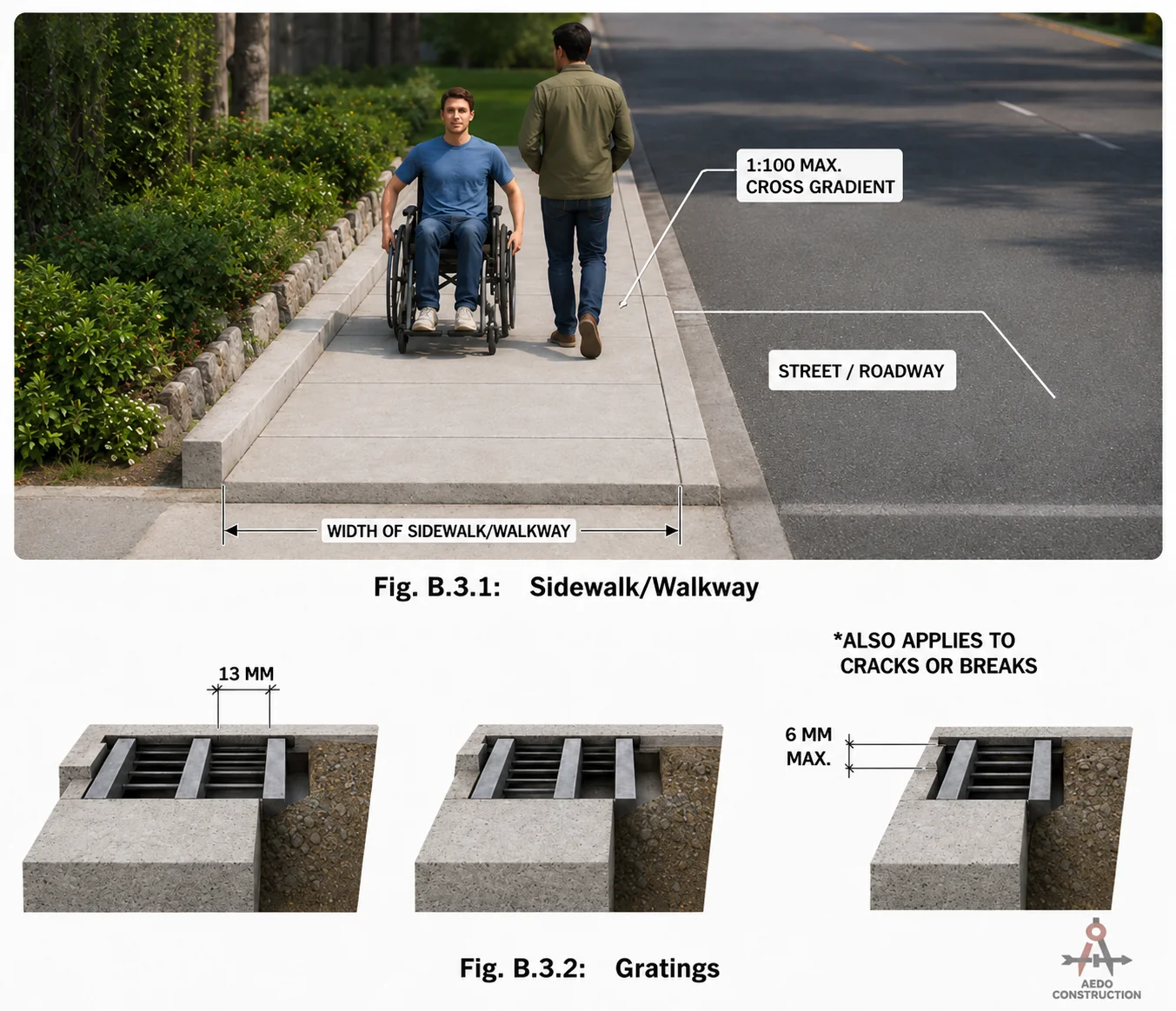
B.3.1Sidewalks/walkways: Maximum cross gradient 1:100 (1%) across the full width toward roadway. Surface shall be firm, stable, and slip-resistant.
B.3.2Gratings: Maximum opening gap 13 mm. Grating shall be flush with surrounding surface. Luminance contrast: min 30% from surroundings.
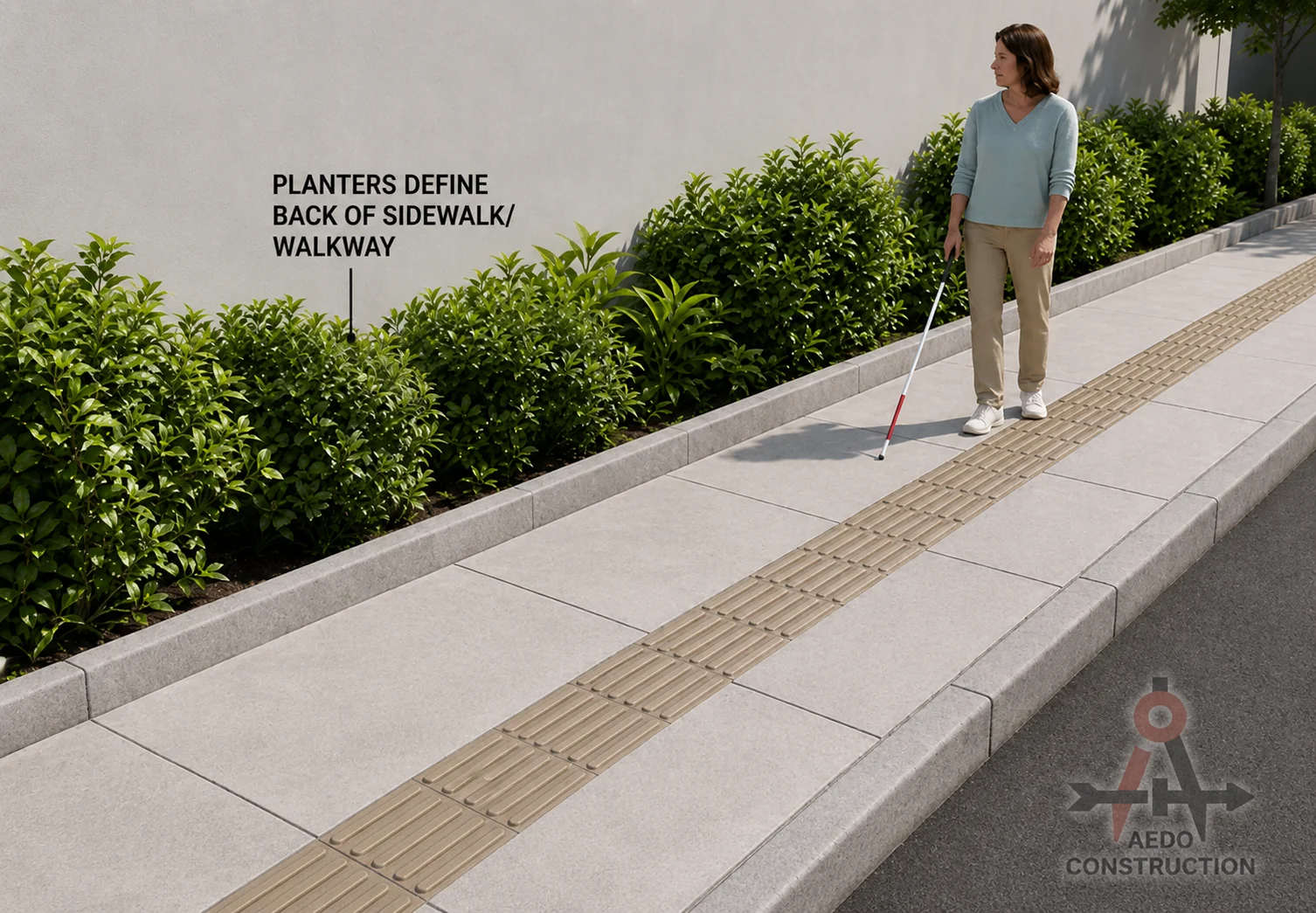
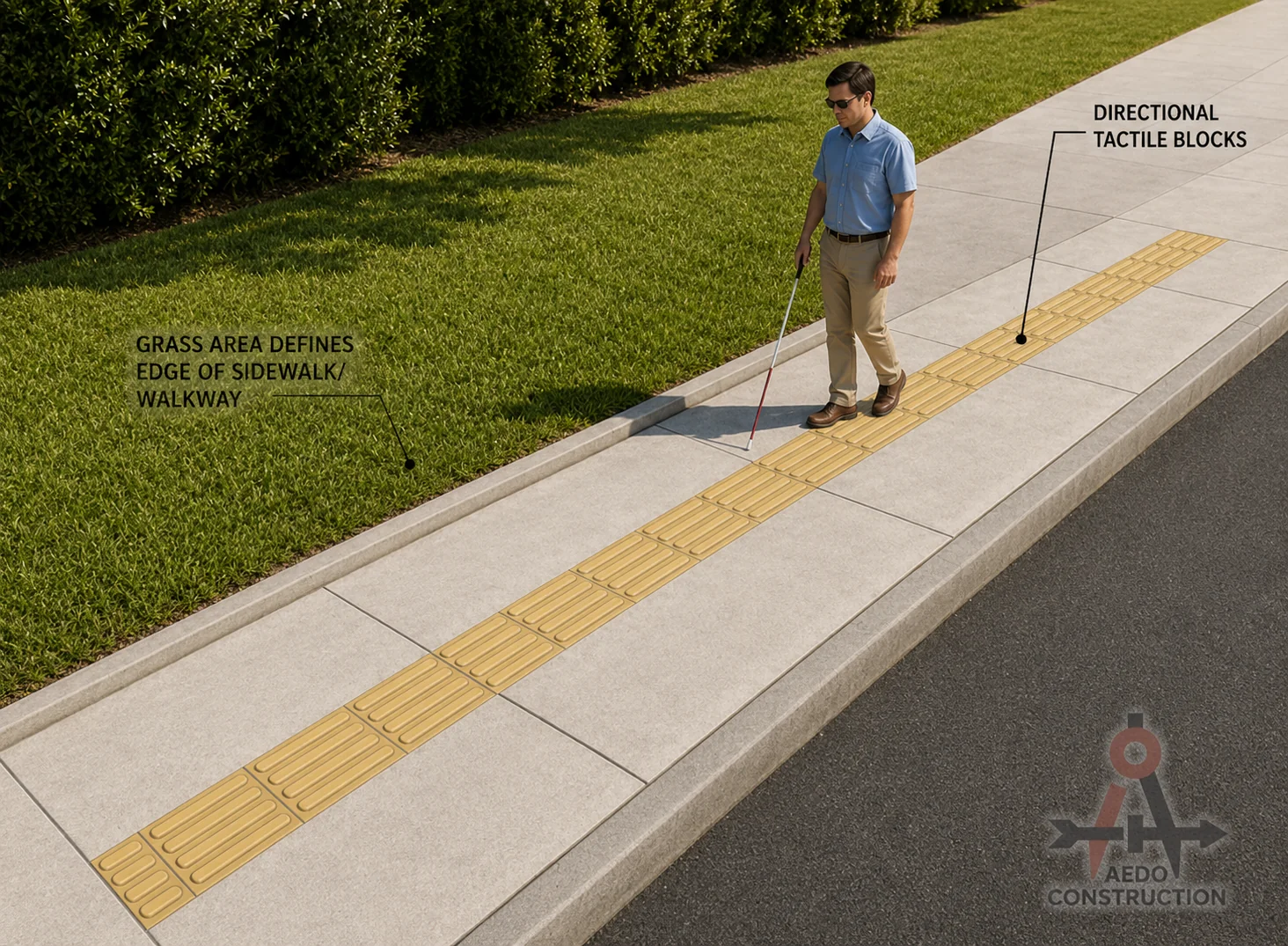
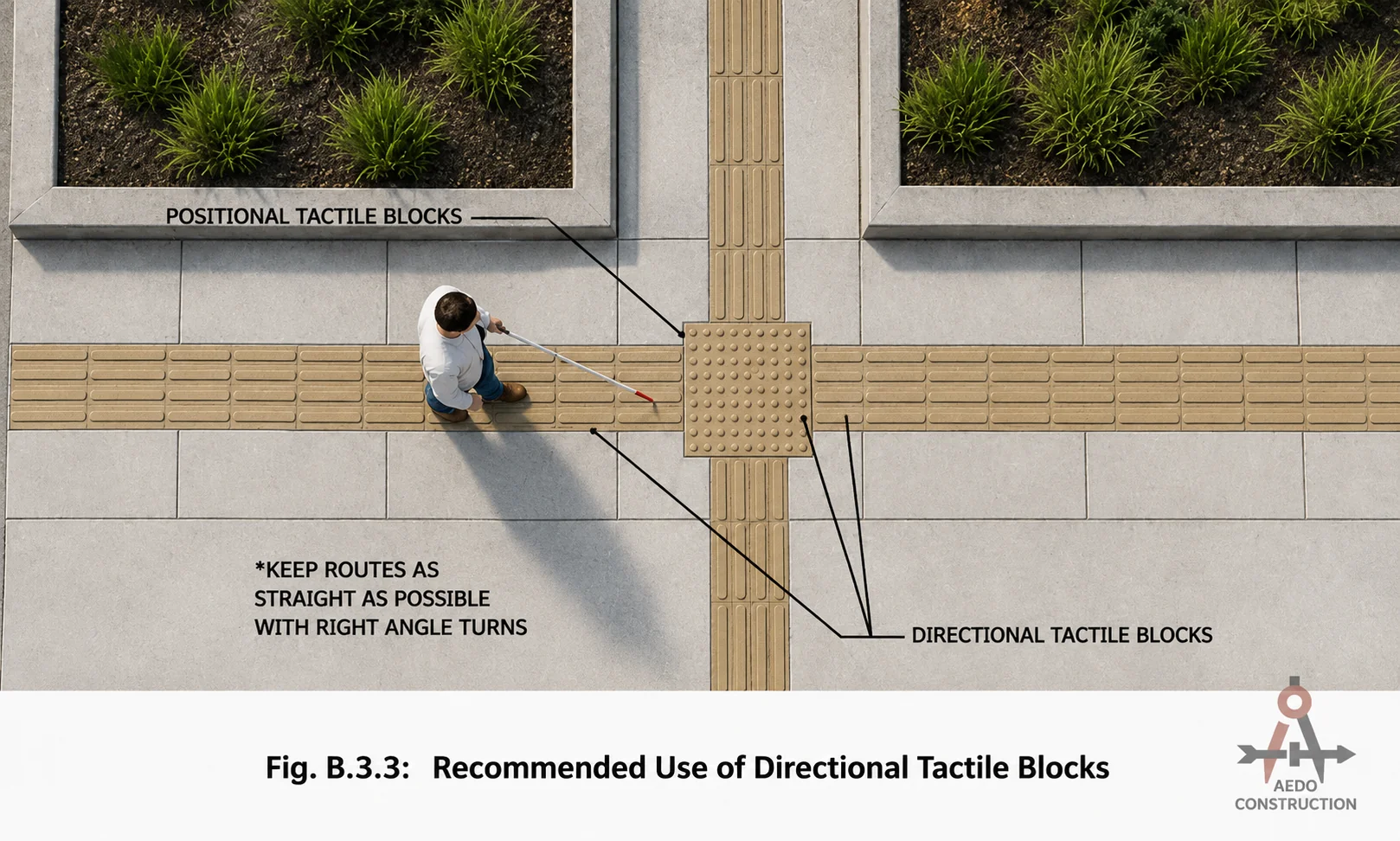
B.3.3Directional tactile blocks (bar pattern) along accessible route. Routes kept as straight as possible with right-angle turns.
B.3.4Positional tactile blocks (dot pattern) at decision points: intersections, changes of direction, hazards, stair heads, and road crossings.
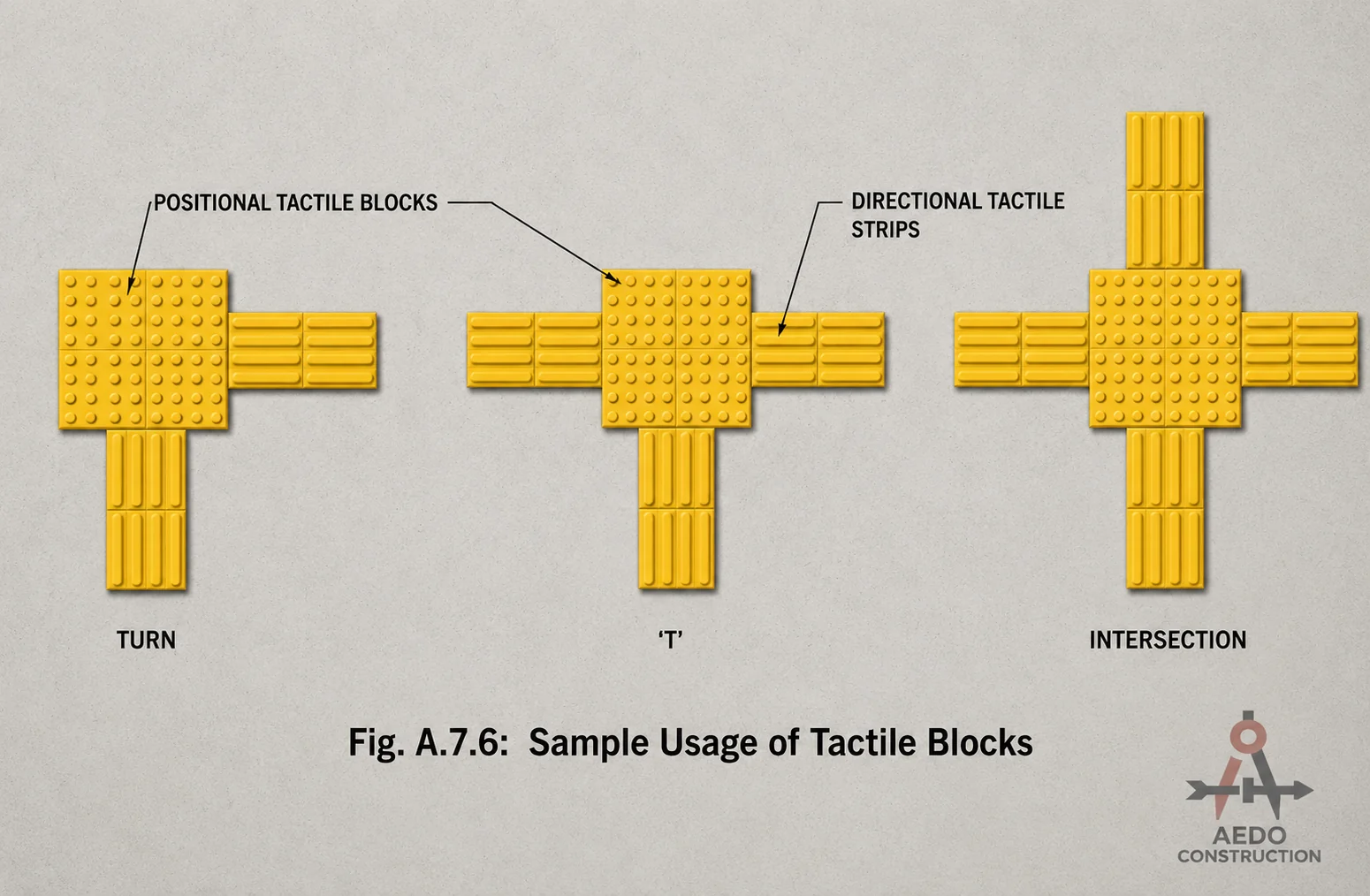
A.7.6Turn configurations: combine positional + directional blocks. T-intersections and full intersections have standardized block layouts.
Key Dimensions
Max Cross Gradient1:100 (1%)
Max Grating Gap13 mm
Min Contrast30% luminance
Tactile at Stairs300 mm top / 600 mm btm
Fig. B.3.1Fig. B.3.2Fig. B.3.3Fig. A.7.6
Tactile Blocks Planters
Directional Tactile · Planters Edge
Tactile Blocks Grass Edge
Directional Tactile · Grass Edge
Recommended Use Directional Tactile
Fig. B.3.3 · Directional Tactile Use
Sample Usage of Tactile Blocks
Fig. A.7.6 · Tactile Block Layouts
Sidewalk and Gratings
Fig. B.3.1 Sidewalk/Walkway · Fig. B.3.2 Gratings
08

Curb Ramps

BP344 · Appendix B.2
Provisions
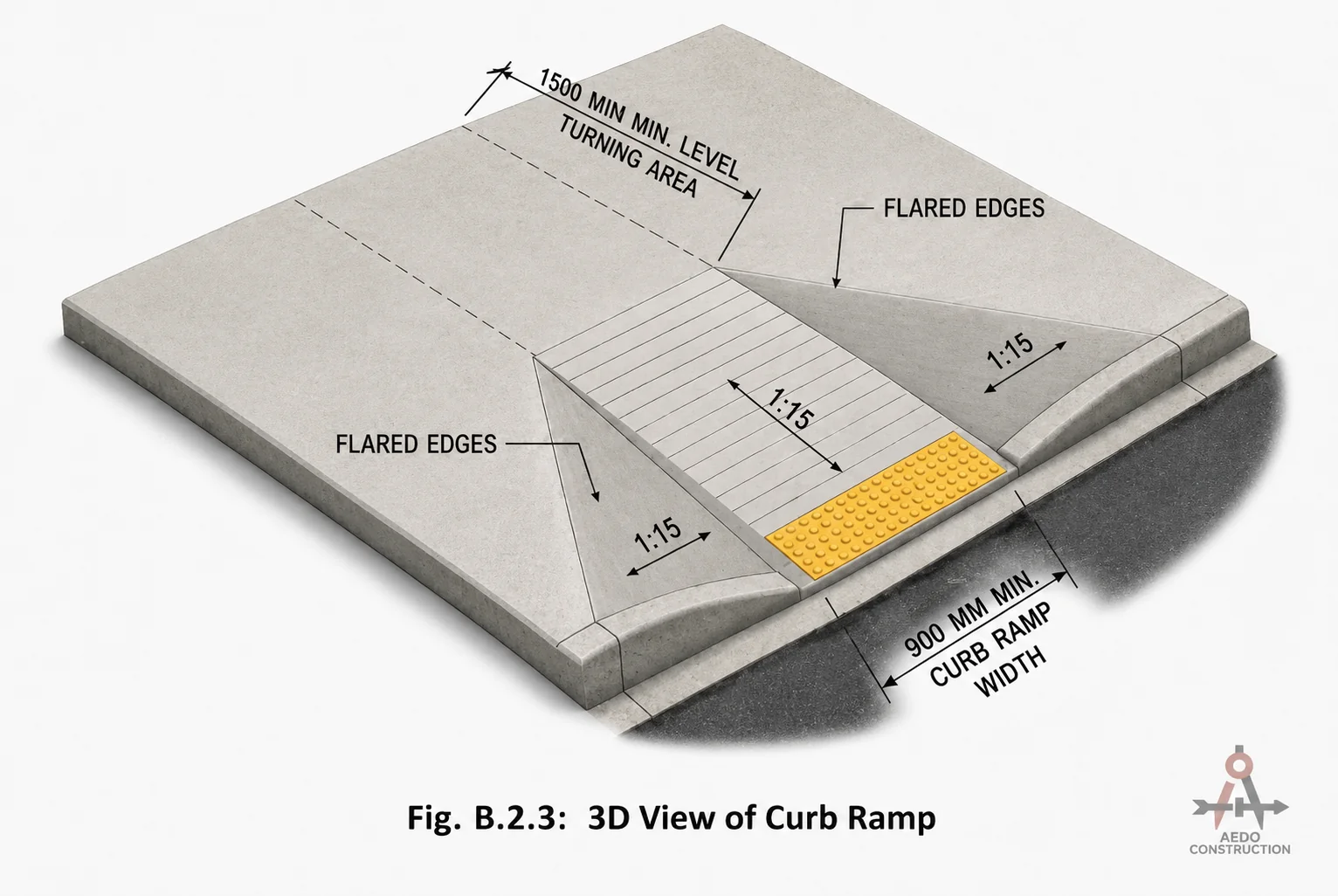
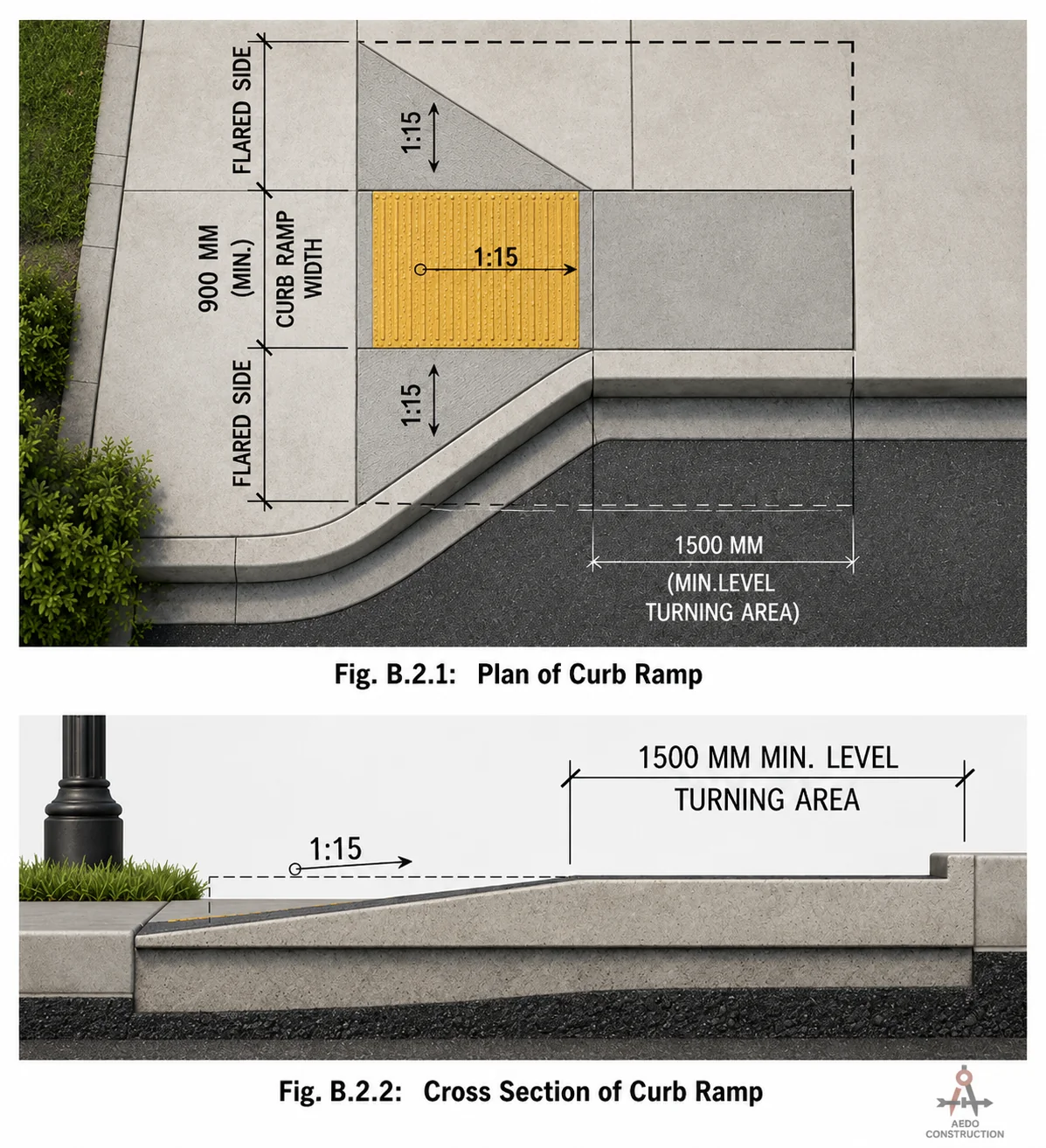
B.2.1Minimum curb ramp width: 900 mm. Flared sides slope: maximum 1:15. Ramp shall be centered on the pedestrian crossing.
B.2.2Maximum ramp slope: 1:15 (6.67%). Minimum level turning area at top of curb ramp: 1500 mm.
B.2.3Warning tactile blocks (dot pattern, yellow) at bottom of curb ramp to alert visually impaired of the road crossing.
B.2.4Curb ramp surface: slip-resistant, firm, stable. Flush transition to road surface with no vertical lip.
Key Dimensions
Min Width900 mm
Max Slope1:15 (6.67%)
Flared Sides1:15
Level Turning Area1500 mm min
Fig. B.2.1Fig. B.2.2Fig. B.2.3
3D View of Curb Ramp
Fig. B.2.3 · 3D View of Curb Ramp
Plan and Cross Section of Curb Ramp
Fig. B.2.1 Plan · B.2.2 Cross Section
09

Dropped Sidewalks

BP344 · Appendix B.5 · DPWH Standards
Provisions
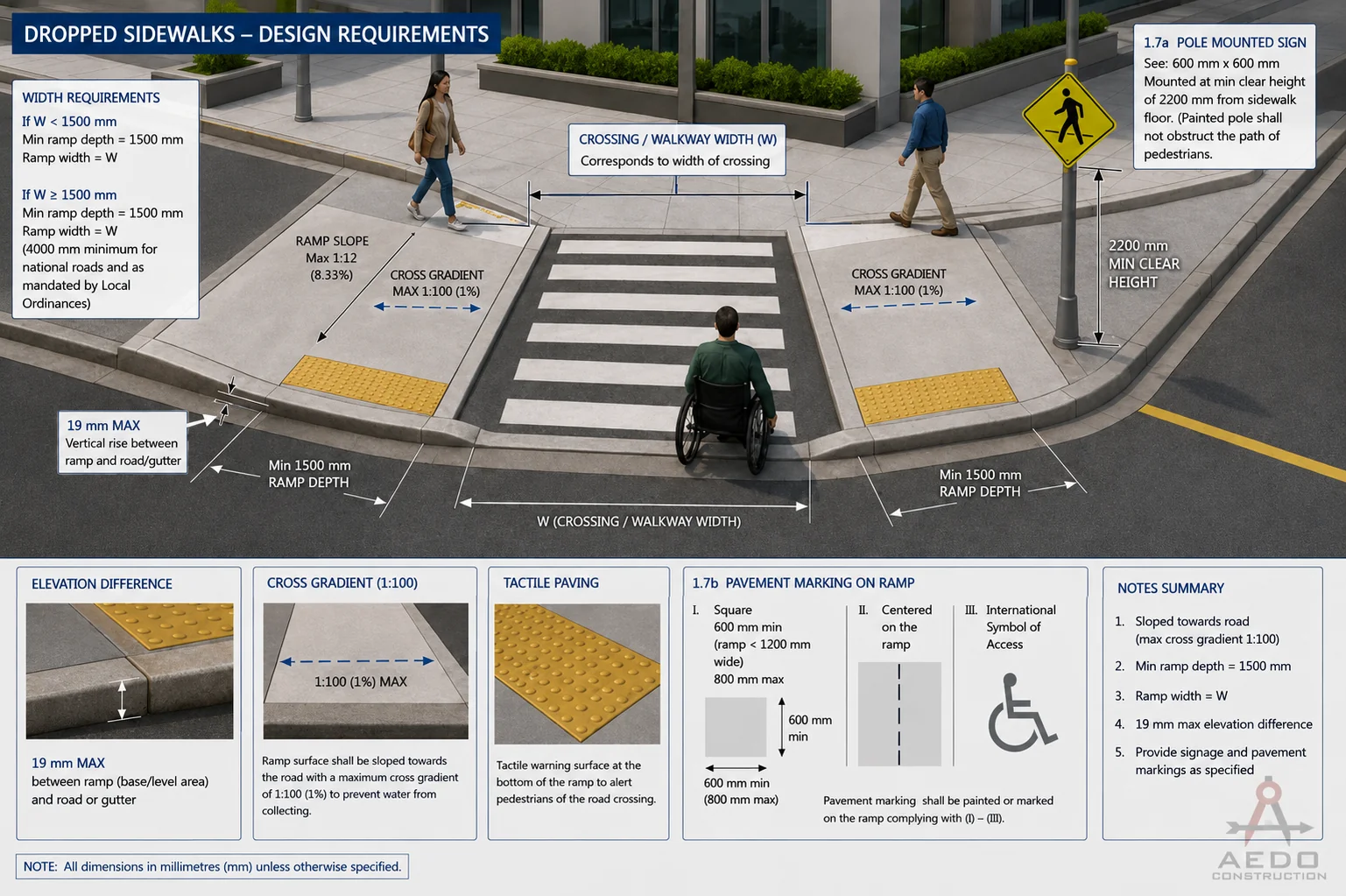
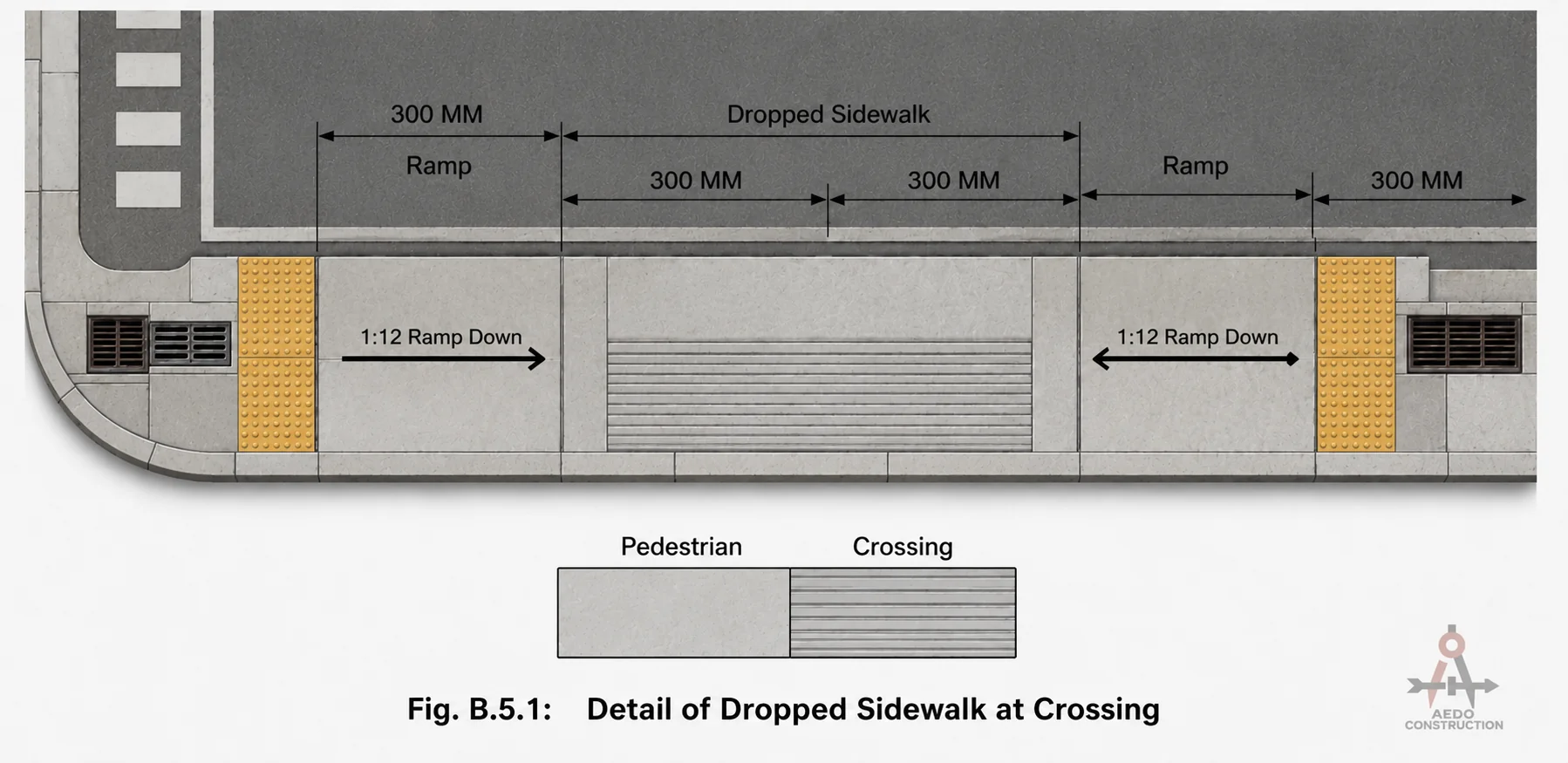
B.5.1Ramp width equals crossing/walkway width (W). If W < 1500 mm: min ramp depth 1500 mm, ramp width = W.
B.5.2Maximum slope: 1:12 (8.33%). Maximum cross gradient: 1:100 (1%). Ramp surface slopes toward road to shed water.
B.5.3Maximum vertical elevation difference between ramp and road/gutter: 19 mm. Ramped transition, no abrupt edge.
B.5.4Pole-mounted sign: at min clear height of 2200 mm. Sign shall not obstruct path of travel.
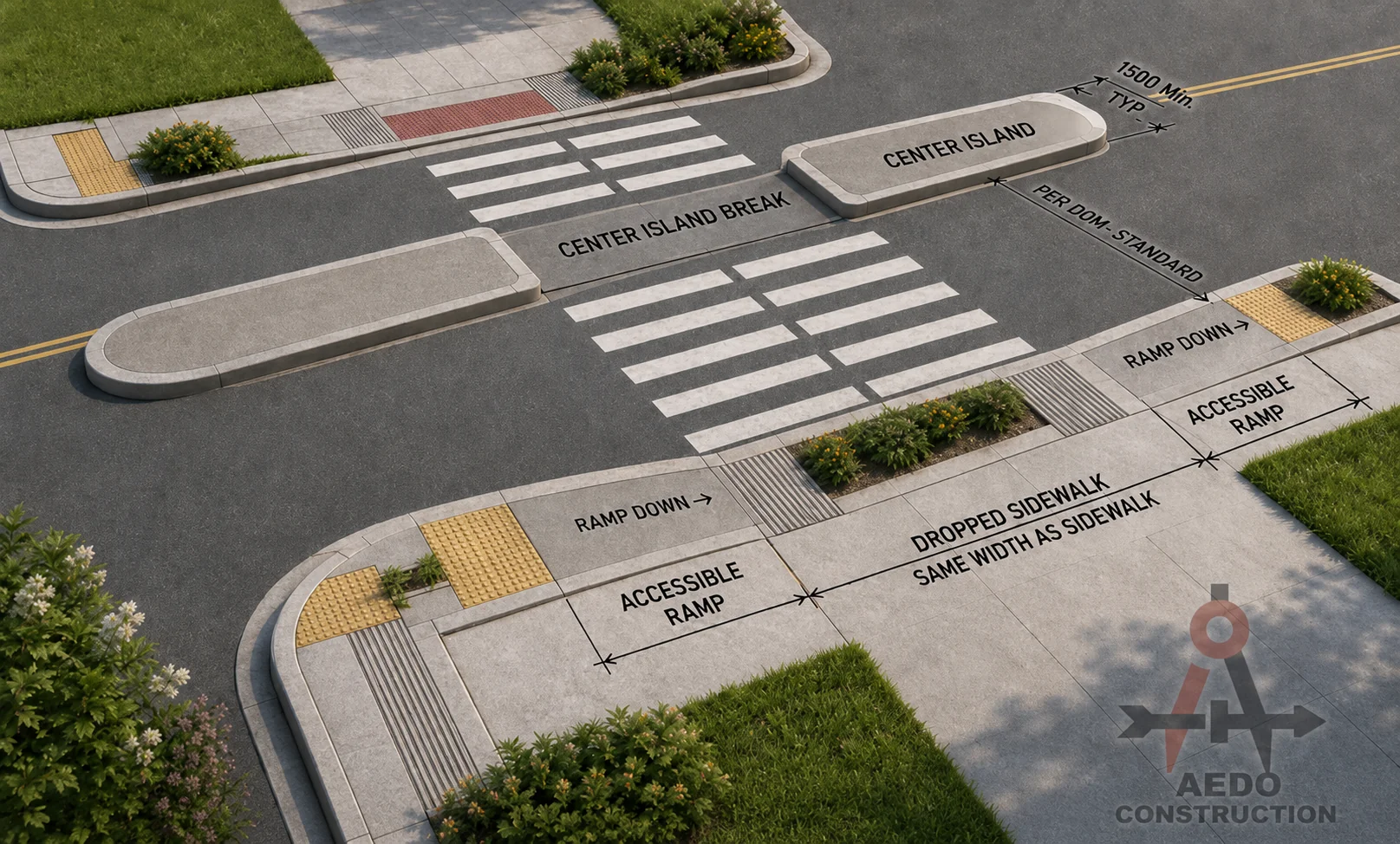
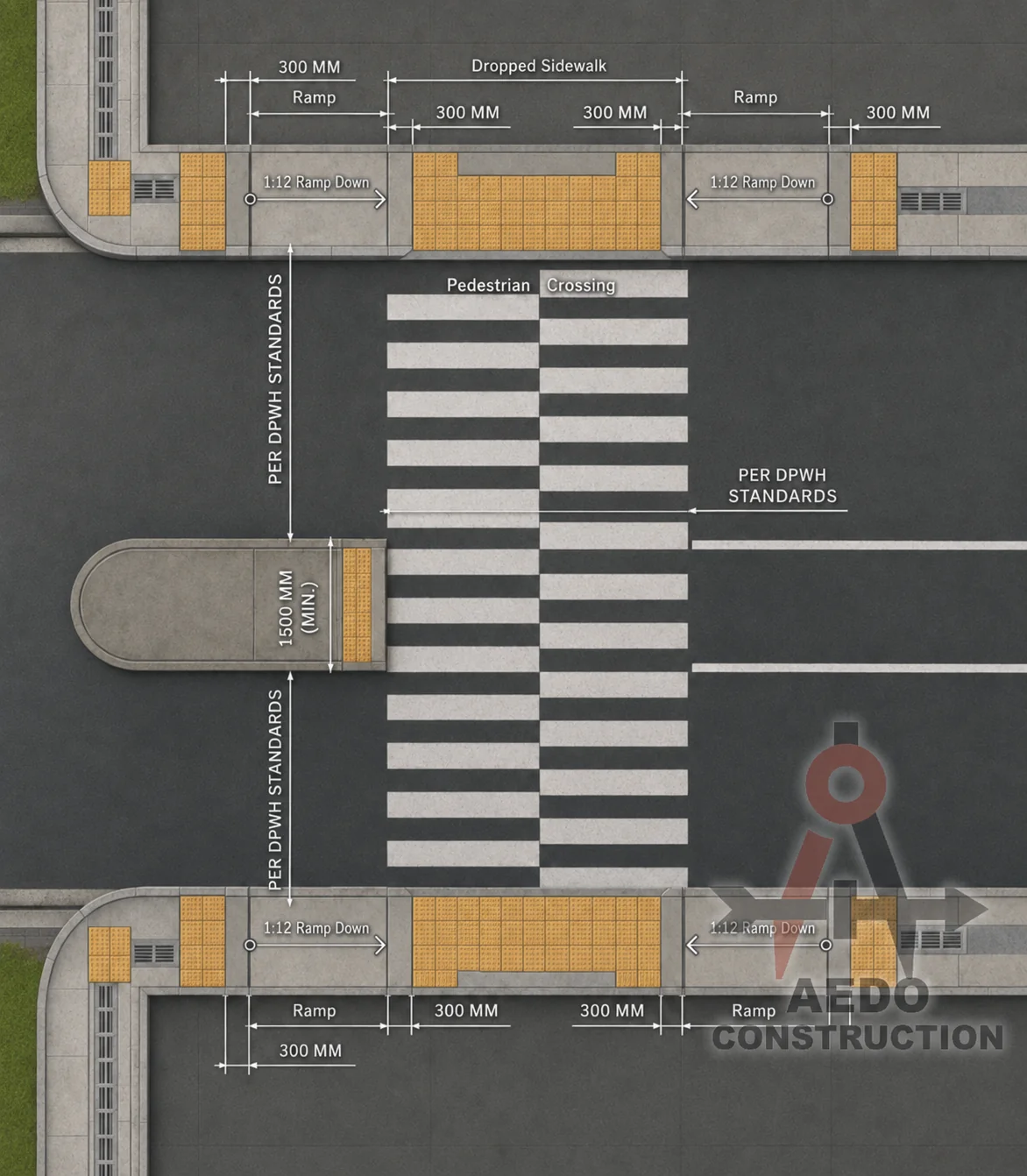
DPWHPer DPWH standards for national roads: 300 mm + 300 mm guard zones + ramp area + 300 mm + 300 mm on both sides. Center islands require accessible break.
Key Dimensions
Ramp Depth (min)1500 mm
Max Slope1:12 (8.33%)
Cross Gradient1:100 (1%)
Max Elev. Diff.19 mm
Guard Zone300 mm each side
Fig. B.5.1
Dropped Sidewalks Design Requirements
Design Requirements
Detail at Crossing
Fig. B.5.1 · Detail at Crossing
Center Island Dropped Sidewalk
Aerial · Center Island Break
Dropped Sidewalk per DPWH
Aerial · DPWH Standards Layout
10

Stairs & Stair Nosing

BP344 · Appendix A.10
Provisions
A.10.1Complementary ramps, lifts, or escalators shall be provided alongside all staircases on an accessible route.
A.10.2Uniform risers: max 150 mm. Uniform treads: min 300 mm. All risers shall have a backward tilt of 25 mm. Open stringers not allowed.
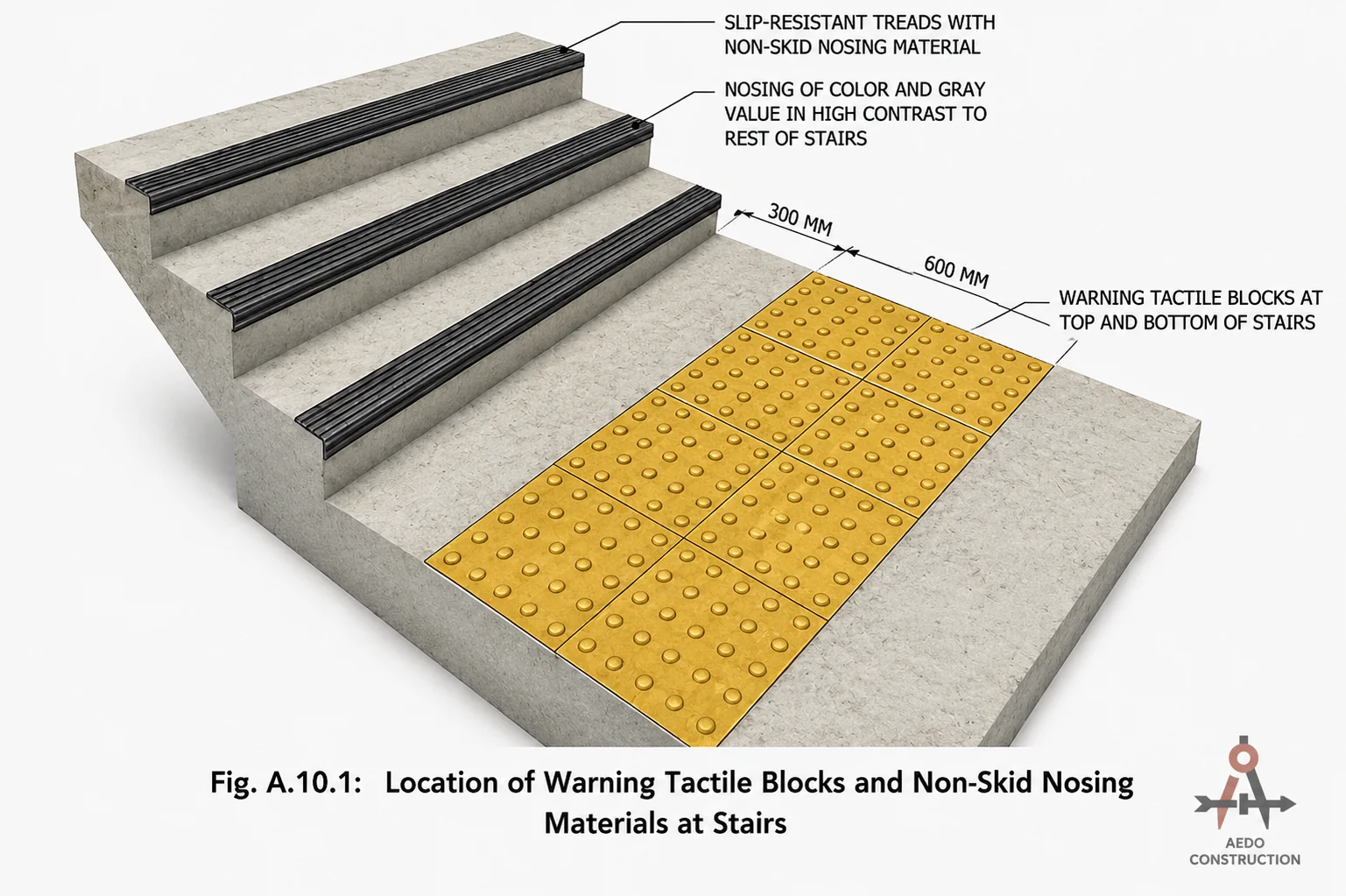
A.10.3Warning tactile blocks at stairs: depth 600 mm, spanning full stair width. Installed 300 mm from top nosing and at bottom landing. Also at intermediate landings.
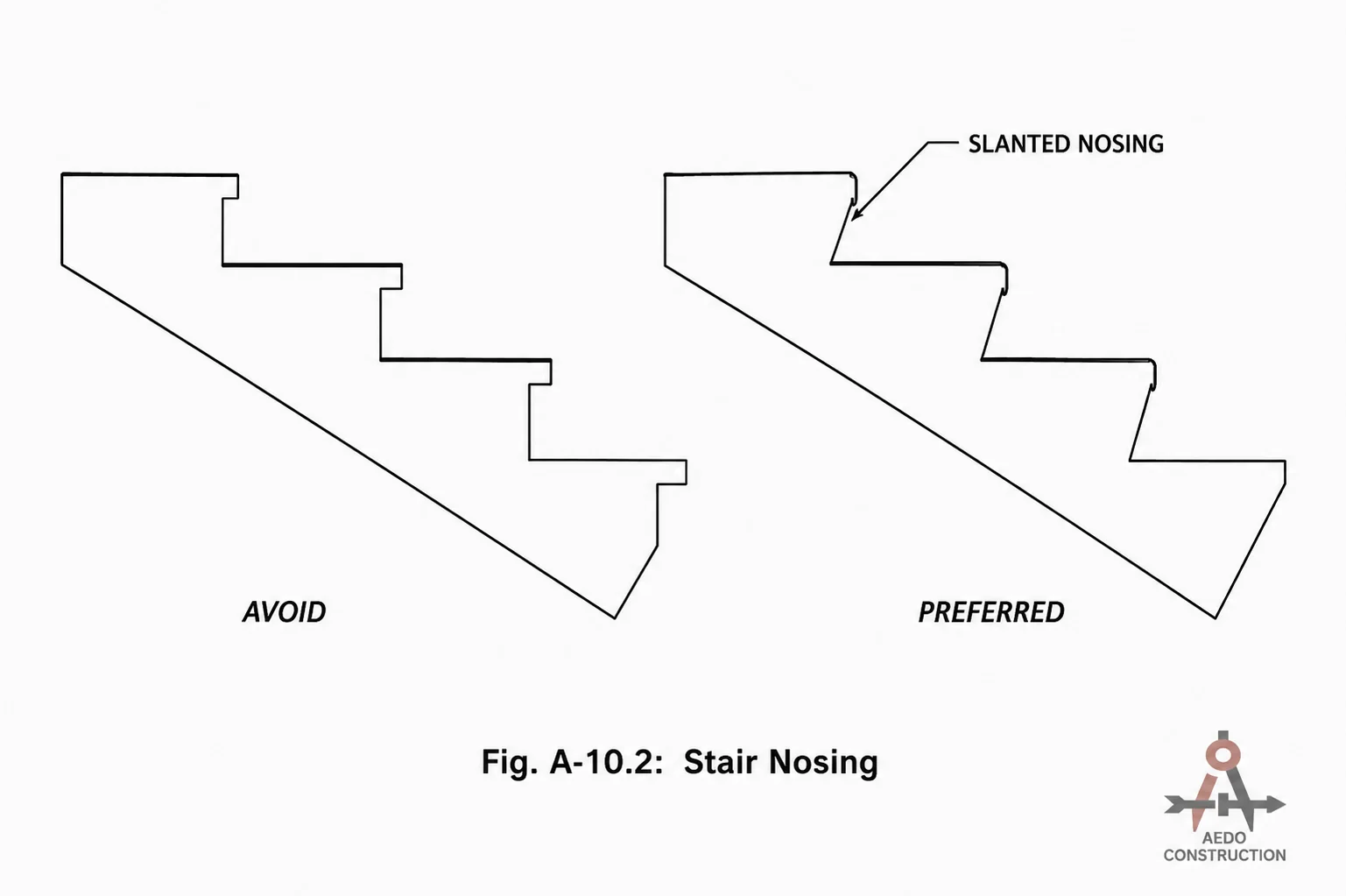
A.10.4Stair nosing: slanted/chamfered profile. Nosing shall not protrude. Min 30% luminance contrast from riser and tread. Slip-resistant in wet and dry conditions.
A.10.5Handrails on both sides; continuous full length. Upper extensions marked with destination in Braille + written characters. Handrail heights same as ramps: 700 mm and 900 mm.
Key Dimensions
Max Riser150 mm
Min Tread300 mm
Riser Backward Tilt25 mm
Tactile Warning Depth600 mm
Tactile Setback (top)300 mm from nosing
Nosing Contrast30% min luminance
Handrail Heights700 mm & 900 mm
Fig. A.10.1Fig. A.10.2A.10.1–A.10.8
Warning Tactile Blocks at Stairs
Fig. A.10.1 · Warning Tactile & Nosing
Stair Nosing Profile
Fig. A.10.2 · Stair Nosing Profile
11

Floor Surfaces

BP344 · Section 3 · Channel Covers & Gratings
Provisions
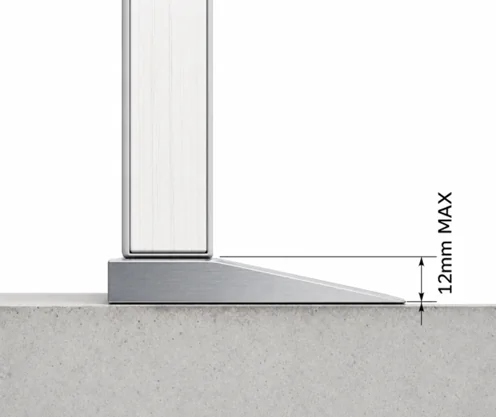
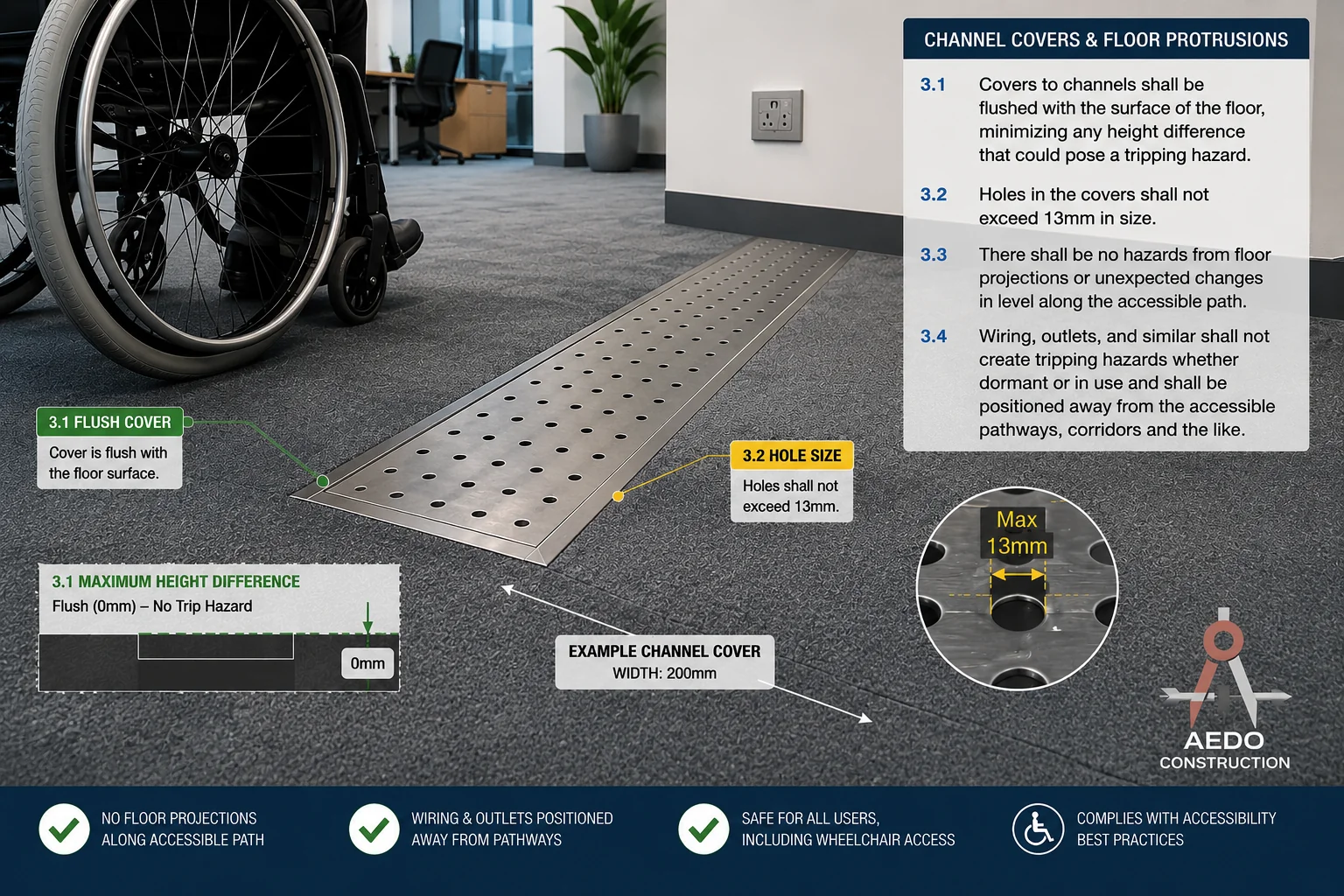
3.1Channel covers shall be flush with the surface of the floor, minimizing any height difference. Maximum height difference: 0 mm (no trip hazard).
3.2Holes in covers shall not exceed 13 mm in size. This prevents wheelchair caster wheels and cane tips from catching.
3.3No floor projections or unexpected changes in level along the accessible path. Wiring and outlets shall not create tripping hazards.
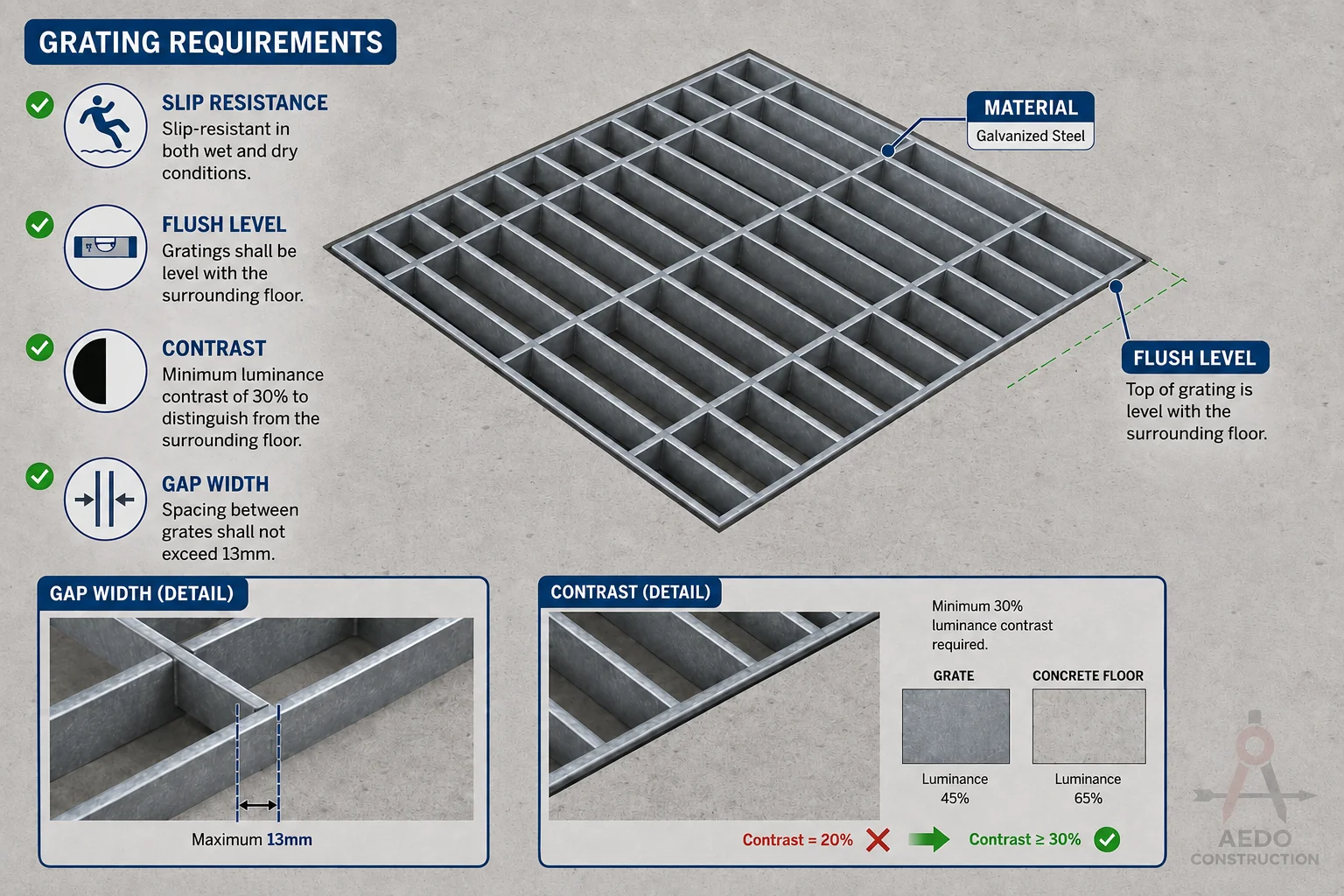
3.4Gratings: slip-resistant in wet and dry conditions, flush level with surroundings, minimum 30% luminance contrast, gap width max 13 mm.
Key Dimensions
Max Hole Size13 mm
Height Difference0 mm (flush)
Min Luminance Contrast30%
Max Grating Gap13 mm
Section 3.1–3.4
Channel Covers and Floor Protrusions
Channel Covers & Floor Protrusions
Grating Requirements
12

Lighting & Illumination

BP344 · Section 12 · Clause 12.1–12.4
Provisions
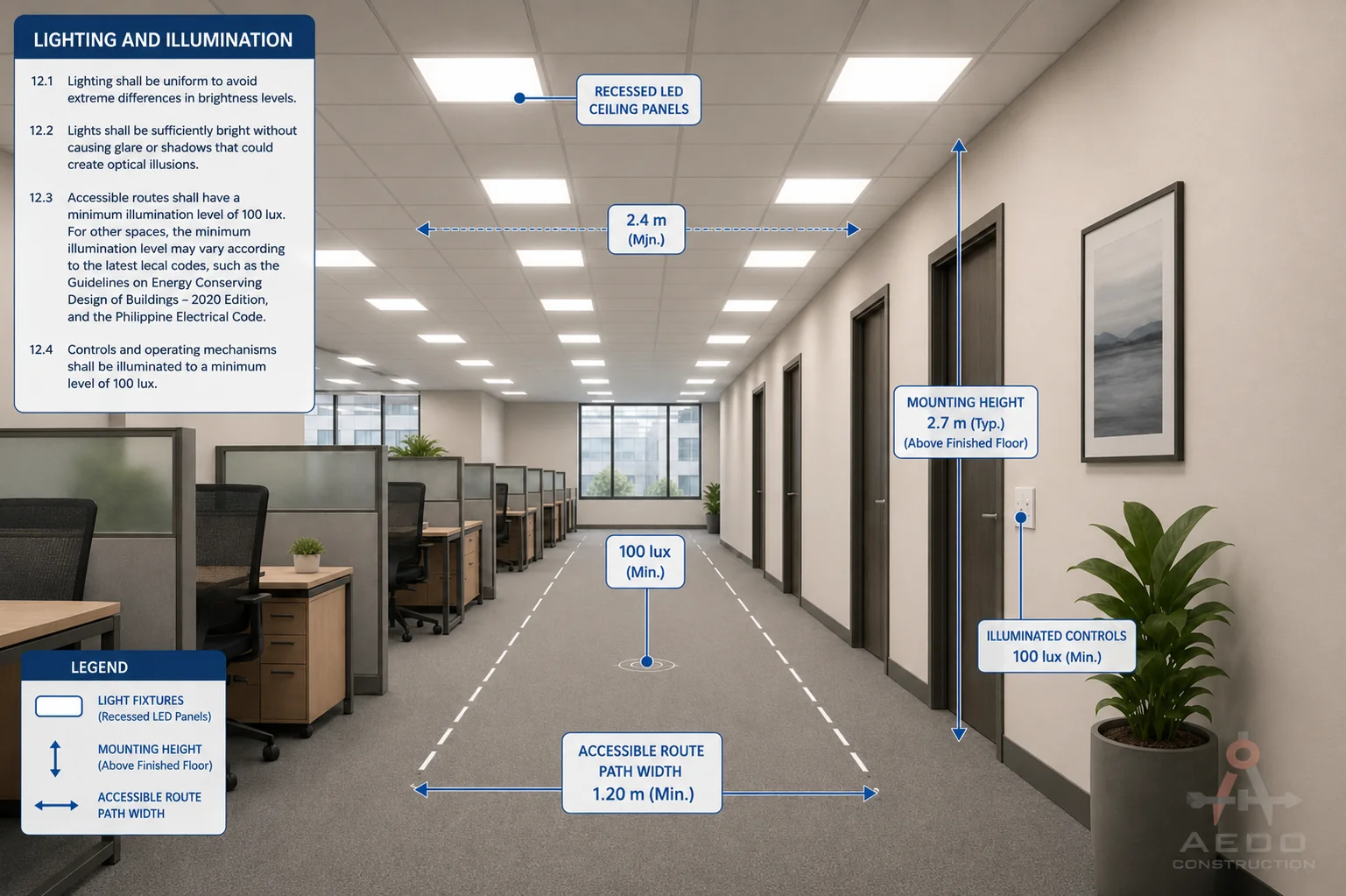
12.1Lighting shall be uniform to avoid extreme differences in brightness levels along accessible routes.
12.2Lights shall be sufficiently bright without causing glare or shadows that could create optical illusions or disorientation.
12.3Accessible routes: minimum illumination level of 100 lux. Other spaces per latest local codes (e.g., Guidelines on Energy Conserving Design, 2020).
12.4Controls and operating mechanisms illuminated to min 100 lux. Mounting height: 2.7 m (typical) above finished floor.
Key Dimensions
Accessible Route100 lux min
Controls Illumination100 lux min
Fixture Height2.7 m (typical)
Min Route Width1.20 m
Clause 12.1–12.4
Lighting and Illumination
Lighting & Illumination · Accessible Route Requirements
13

Open Spaces & Bollards

BP344 · Section 4 · Appendix A.9
Provisions
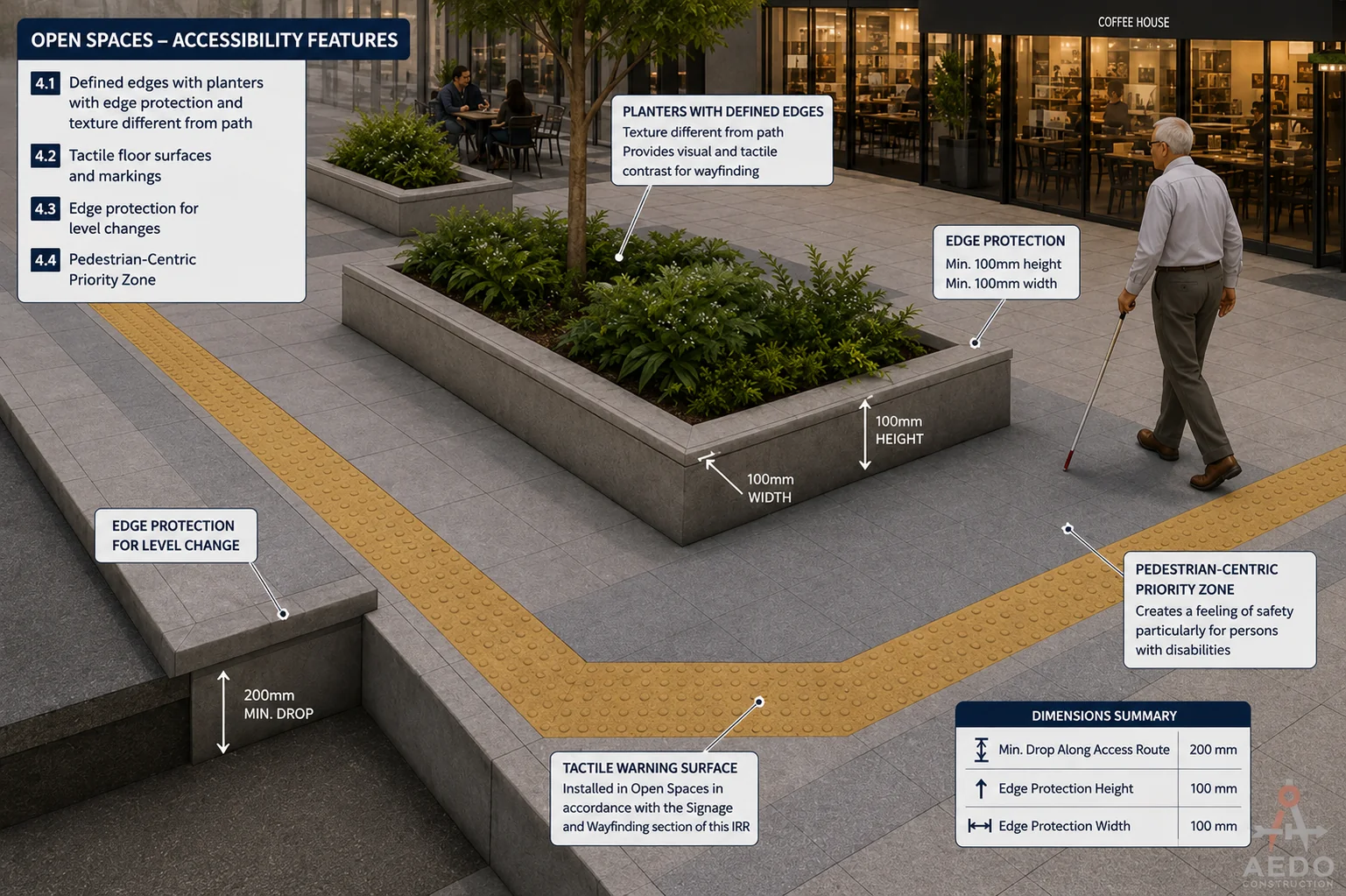
4.1Open spaces: defined edges with planters providing edge protection and texture contrast from path. Defines accessible route visually and tactilely.
4.2Tactile floor surfaces and markings within open spaces. Edge protection at level changes: minimum 100 mm high × 100 mm wide.
4.3Minimum drop along access route: 200 mm. Pedestrian-centric priority zones for persons with disabilities.
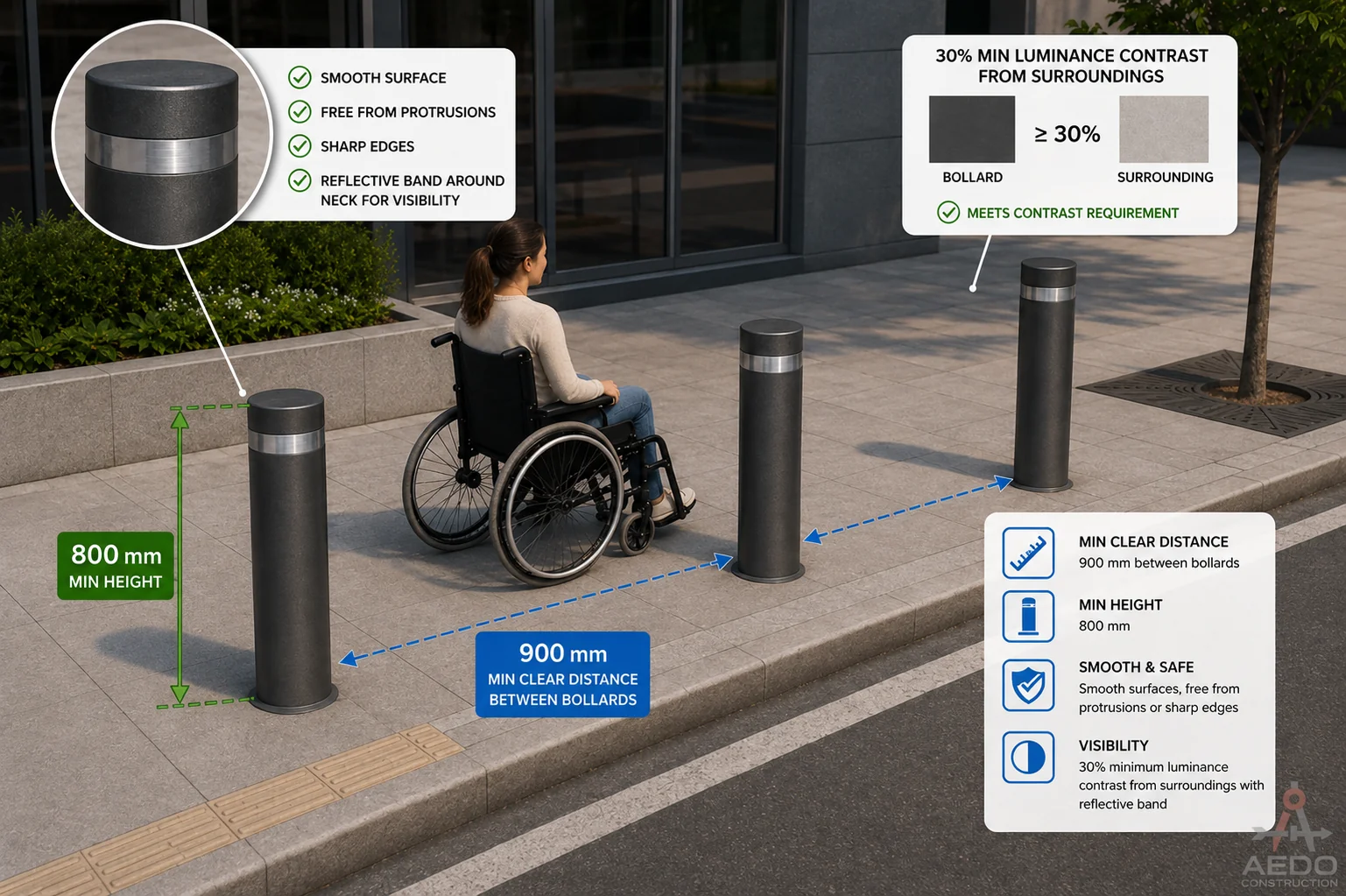
A.9.1Bollards: minimum height 800 mm. Minimum clear distance between bollards: 900 mm to allow wheelchair passage.
A.9.2Bollards: smooth surfaces, free from protrusions/sharp edges. Minimum 30% luminance contrast from surroundings. Reflective band around neck for visibility.
Key Dimensions
Bollard Height (min)800 mm
Bollard Clearance900 mm min
Edge Protection H100 mm min
Edge Protection W100 mm min
Min Contrast30% luminance
Section 4.1–4.4Appendix A.9
Open Spaces Accessibility Features
Open Spaces · Accessibility Features
Bollards Accessibility Requirements
Bollards · Clear Distance & Contrast
14

Overhead Hazards & Protrusions

BP344 · Clause 14.1 · Appendix A
Provisions
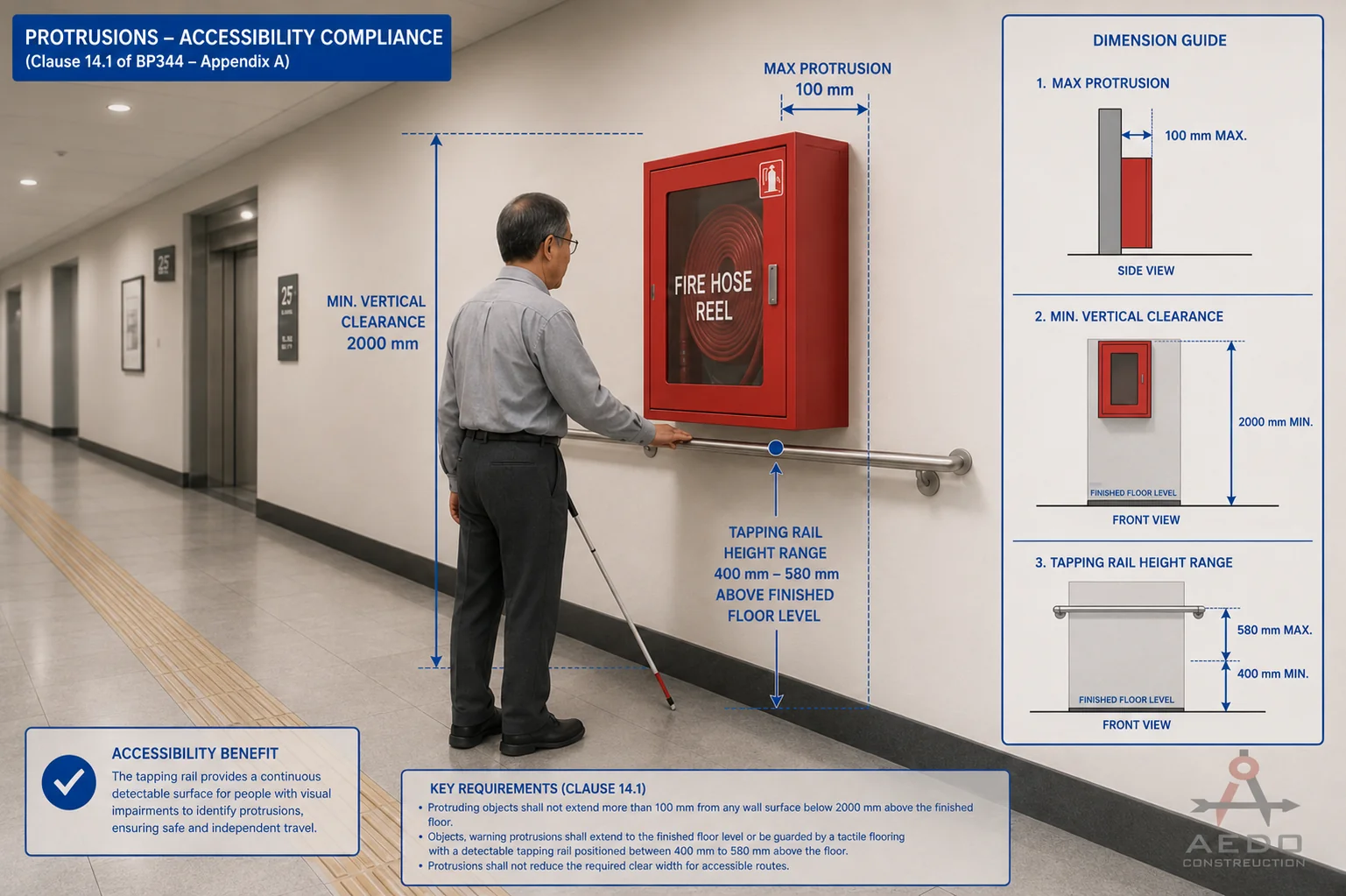
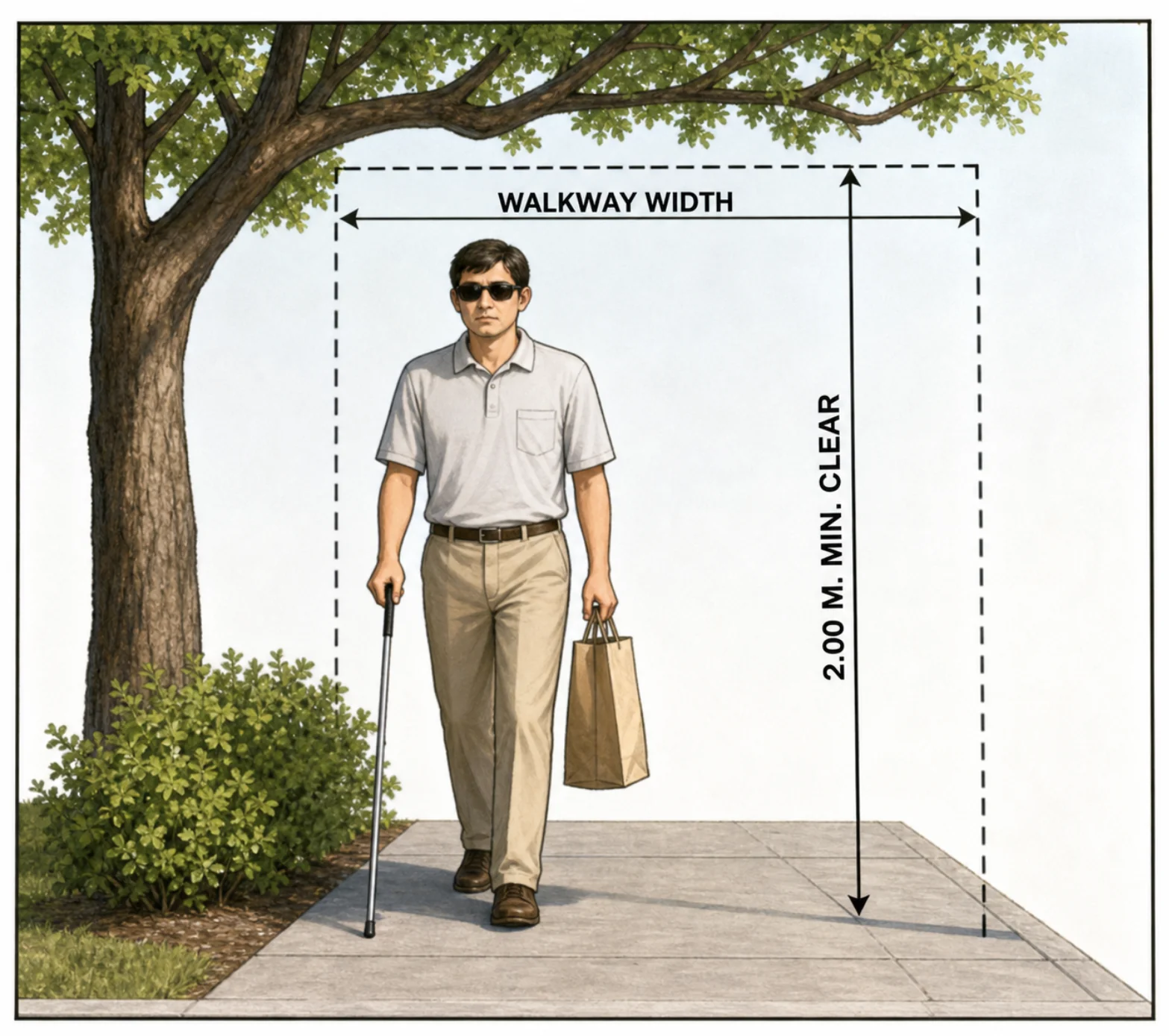
14.1Maximum wall protrusion: 100 mm at heights between 685 mm and 2000 mm above finished floor level.
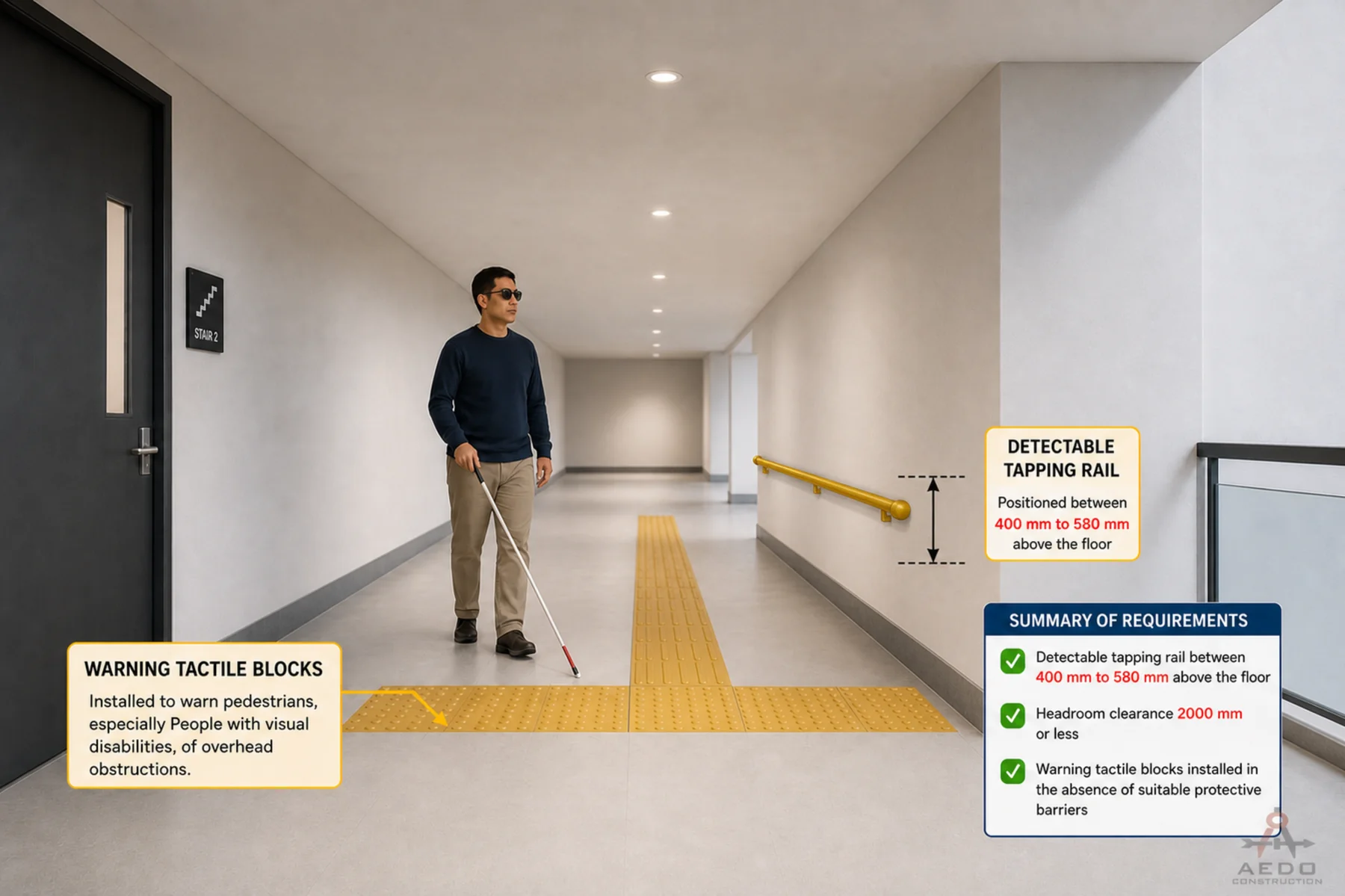
14.2Minimum vertical headroom clearance along accessible routes: 2000 mm. Objects below 2000 mm must be detectable by cane.
14.3Detectable tapping rail required at overhead hazards: positioned 400–580 mm above floor to be detected by white cane.
14.4Warning tactile blocks installed below overhead protective barriers and hazards to alert visually impaired of obstructions.
14.5Objects include: fire hose reels, display cases, signboards, protruding pipes, and wall-mounted equipment.
Key Dimensions
Max Protrusion100 mm
Min Headroom2000 mm
Tapping Rail Height400–580 mm
Clause 14.1
Detectable Tapping Rail
Detectable Tapping Rail · Headroom
Protrusions Accessibility Compliance
Protrusions · Clause 14.1 Compliance
15

Swimming Pools

BP344 · Section 15 · Pool Accessibility
Provisions
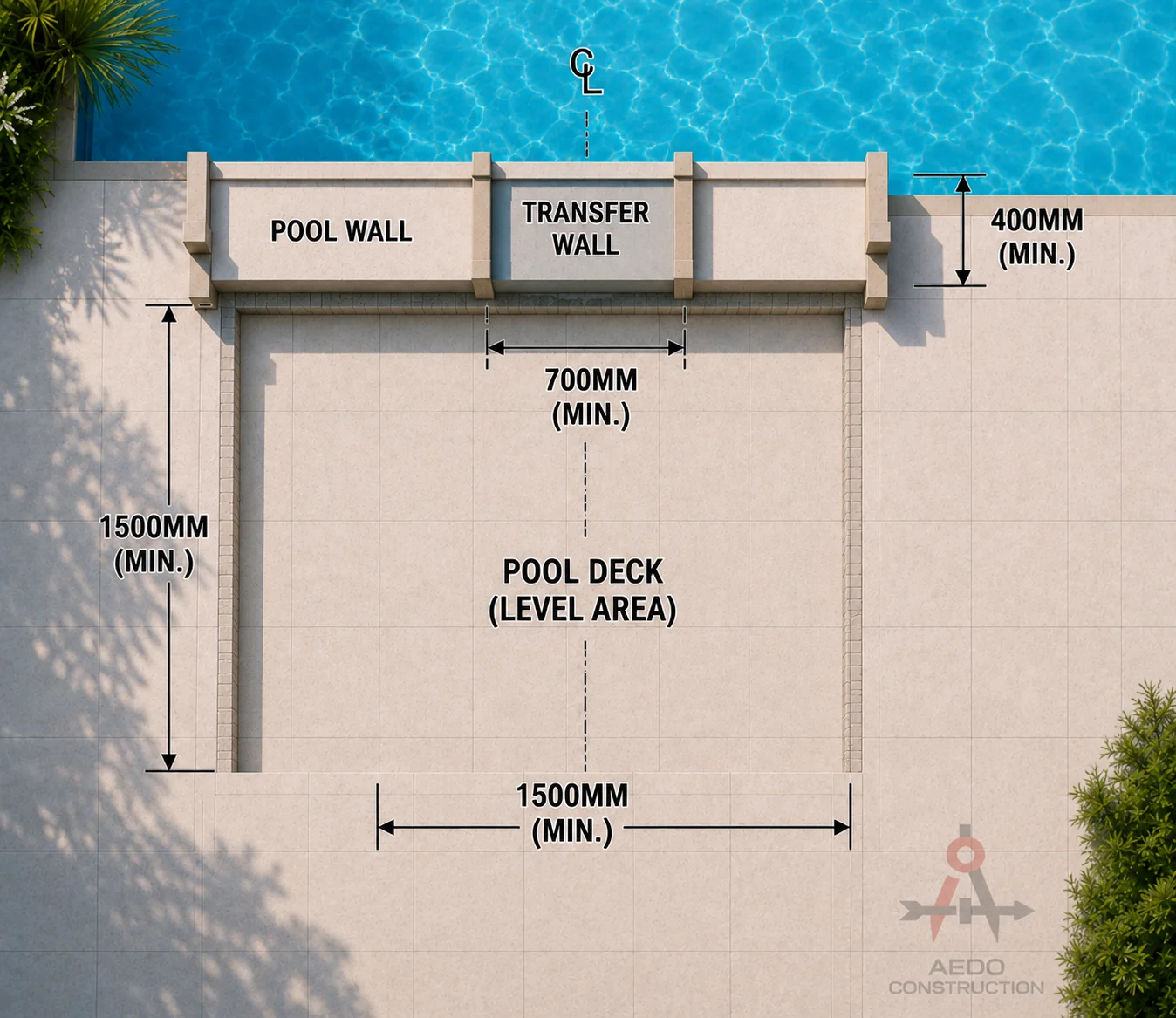
15.1Transfer wall minimum width: 700 mm. Pool wall and transfer wall shall be centered (CL) for symmetric access.
15.2Pool deck level area: minimum 1500 mm from transfer wall to provide maneuvering space for wheelchair-to-pool transfers.
15.3Pool side clearance: minimum 400 mm between transfer wall and pool water edge.
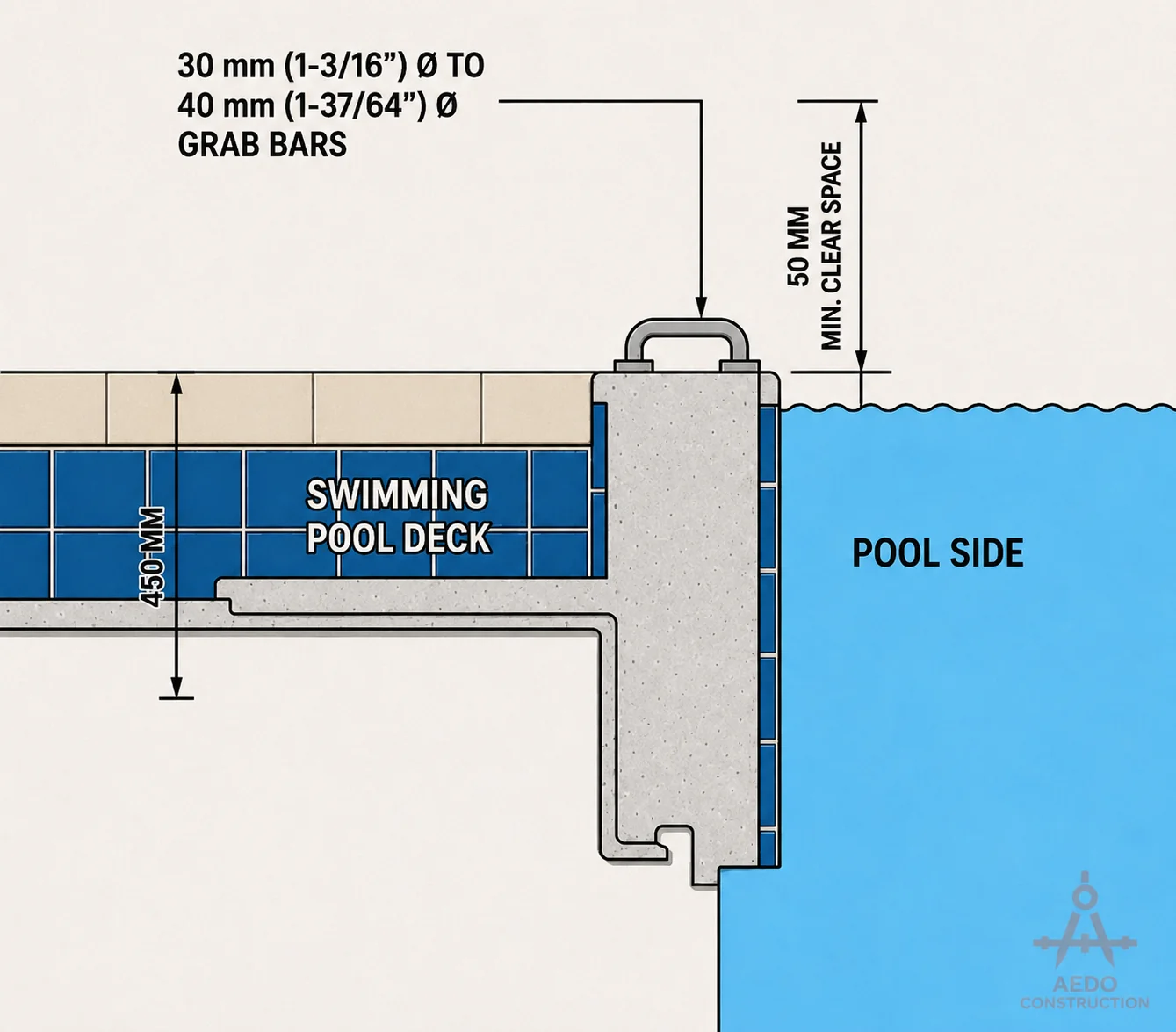
15.4Pool grab bars: diameter 30–40 mm. Minimum 50 mm clear space between bar and pool side. Pool deck height approximately 458 mm.
15.5Pool deck shall be level and slip-resistant. Non-slip surface treatment required in wet conditions.
Key Dimensions
Transfer Wall Width700 mm min
Pool Deck Level Area1500 mm min
Pool Side Clearance400 mm min
Grab Bar Diameter30–40 mm
Bar Clearance50 mm min
Section 15
Pool Transfer Wall Plan View
Pool Transfer Wall · Plan View
Pool Deck Grab Bar Section
Pool Deck Grab Bar · Section View
16

Corridors & Passageways

BP344 · Appendix C.5
Provisions
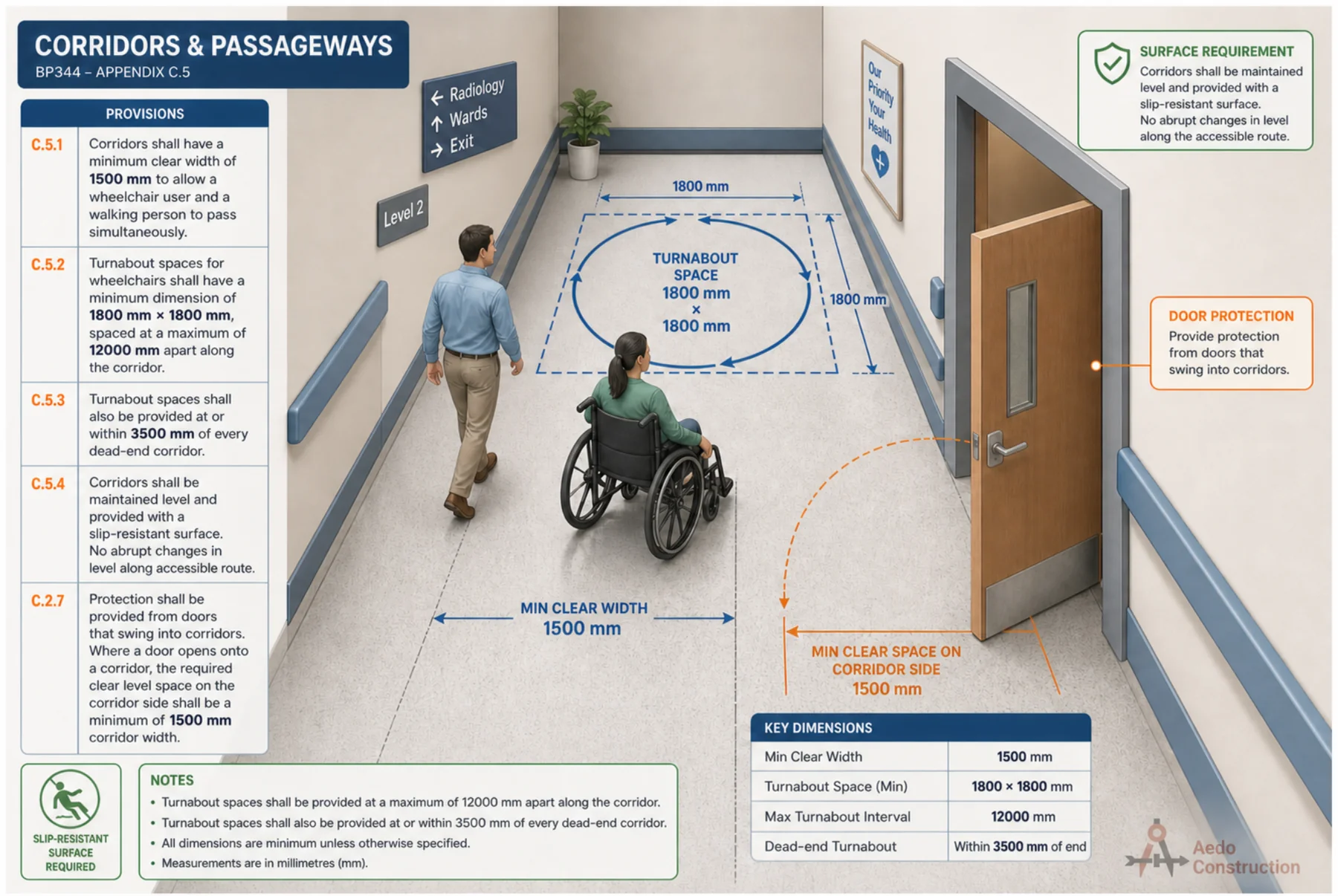
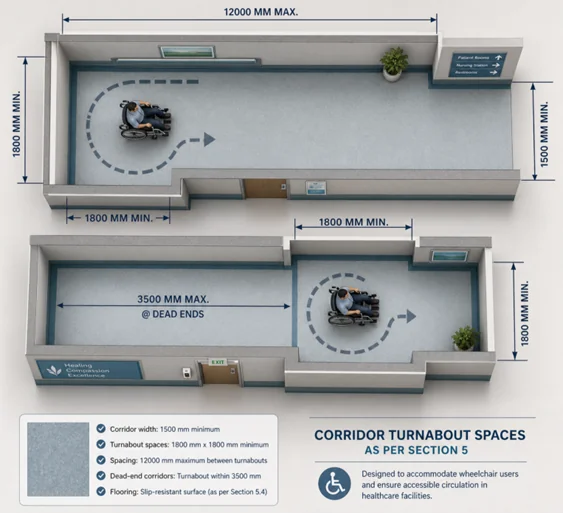
C.5.1Corridors shall have a minimum clear width of 1500 mm to allow a wheelchair user and a walking person to pass simultaneously.
C.5.2Turnabout spaces for wheelchairs shall have a minimum dimension of 1800 mm × 1800 mm, spaced at a maximum of 12000 mm apart along the corridor.
C.5.3Turnabout spaces shall also be provided at or within 3500 mm of every dead-end corridor.
C.5.4Corridors shall be maintained level and provided with a slip-resistant surface. No abrupt changes in level along accessible route.
C.2.7Protection shall be provided from doors that swing into corridors. Where a door opens onto a corridor, the required clear level space on the corridor side shall be a minimum of 1500 mm corridor width.
Key Dimensions
Min Clear Width1500 mm
Turnabout Space1800 × 1800 mm
Max Turnabout Interval12000 mm
Dead-end TurnaboutWithin 3500 mm of end
Fig. C.5.1C.5.1–C.5.4
17

Elevators & Platform Lifts

BP344 · Appendix C.8 · C.9
Provisions
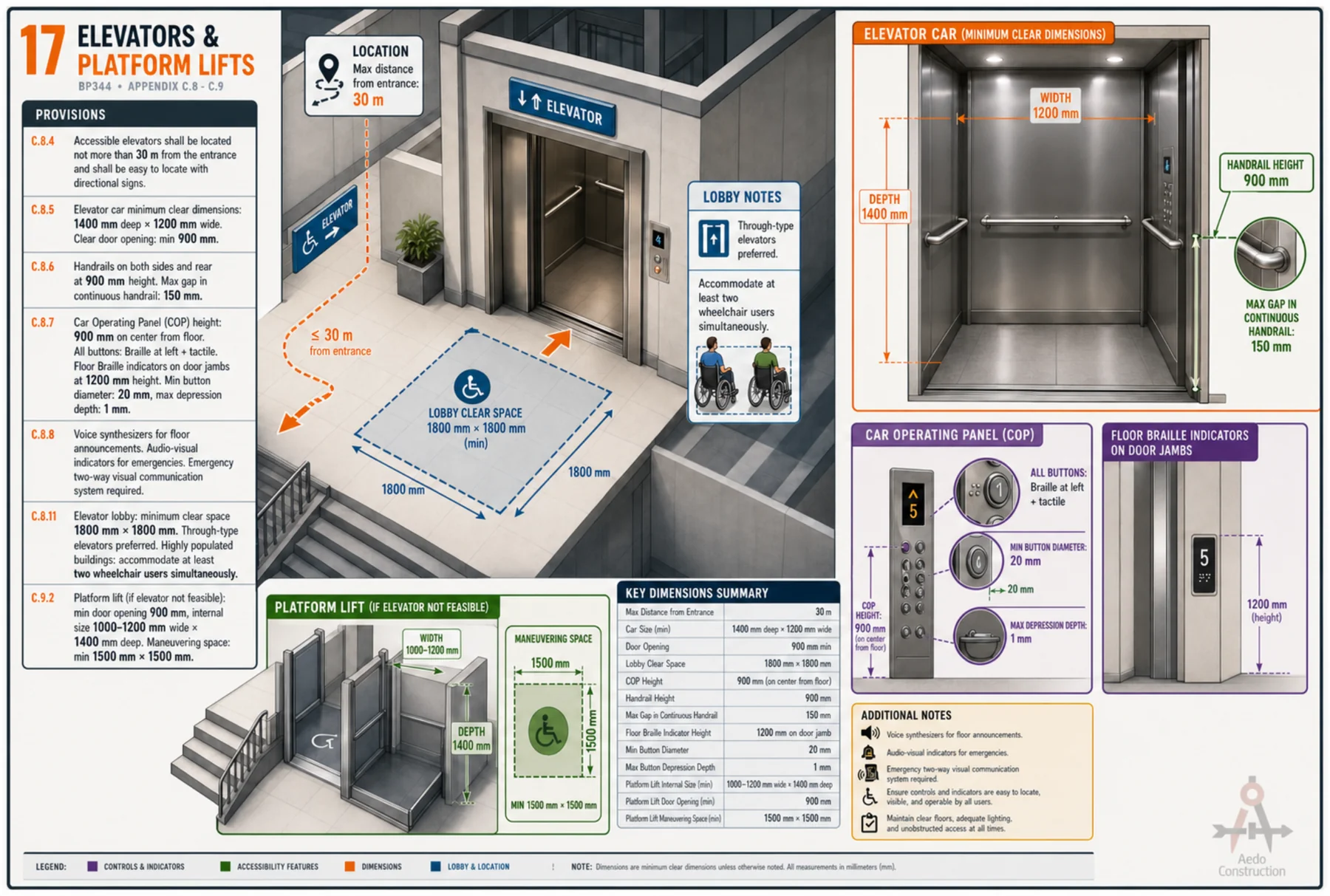
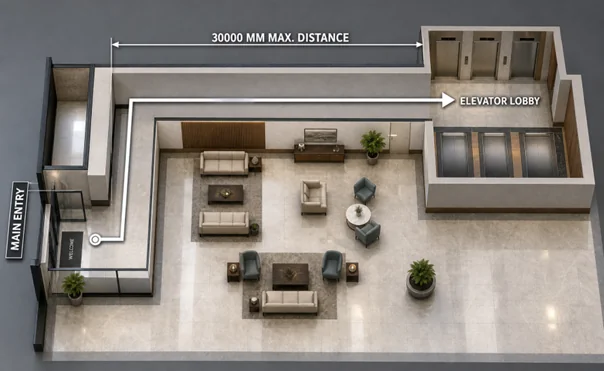
C.8.4Accessible elevators shall be located not more than 30 m from the entrance and shall be easy to locate with directional signs.
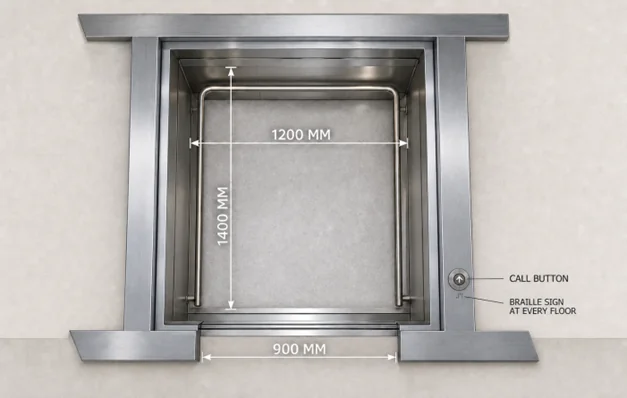
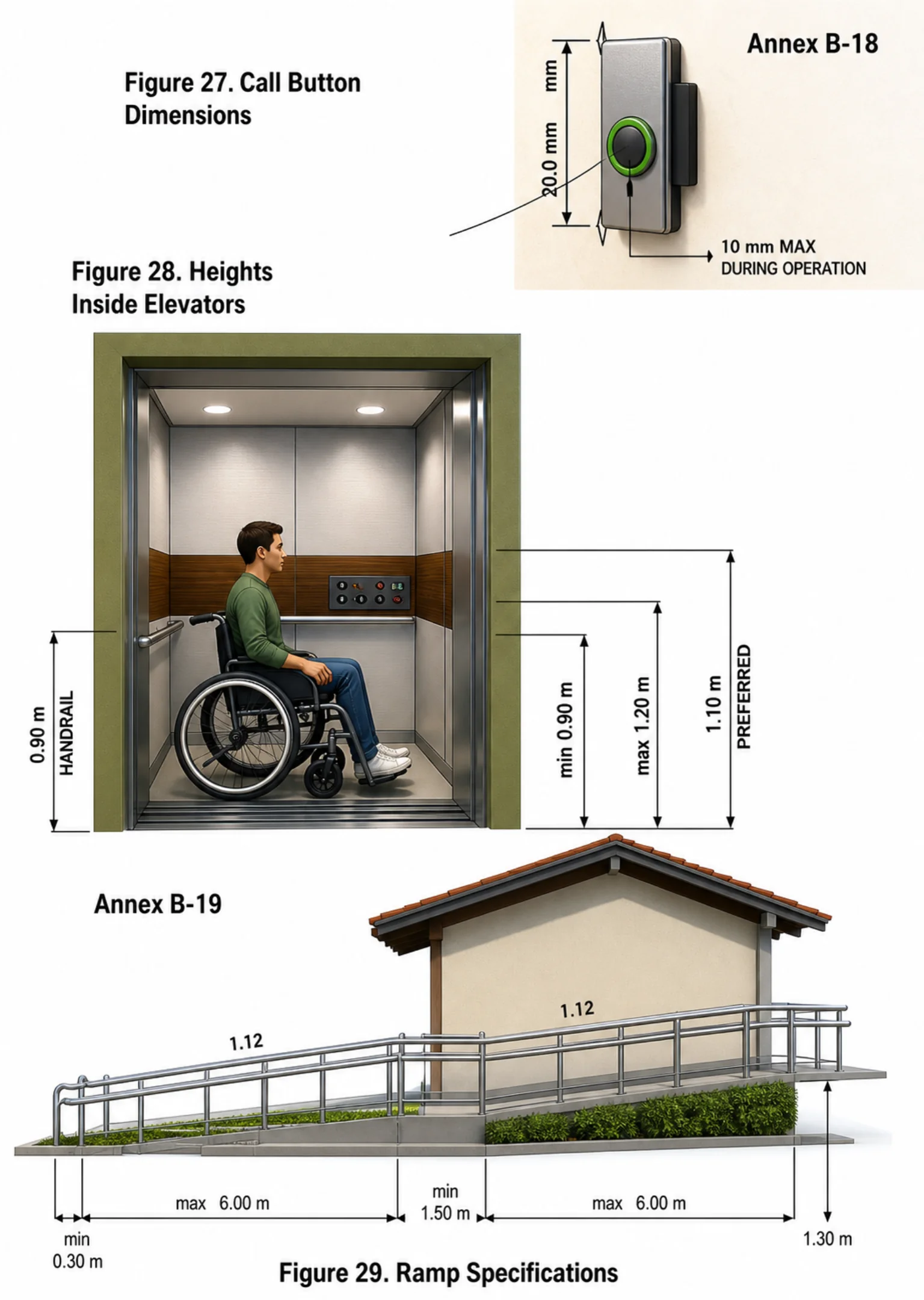
C.8.5Elevator car minimum clear dimensions: 1400 mm deep × 1200 mm wide. Clear door opening: min 900 mm.
C.8.6Handrails on both sides and rear at 900 mm height. Max gap in continuous handrail: 150 mm.
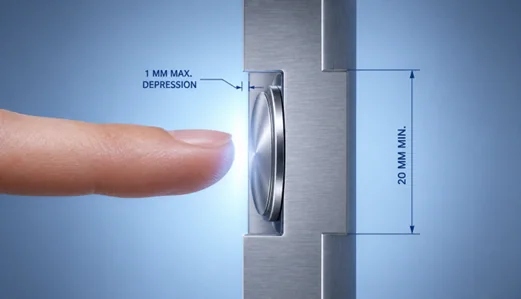
C.8.7Car Operating Panel (COP) height: 900 mm on center from floor. All buttons: Braille at left + tactile. Floor Braille indicators on door jambs at 1200 mm height. Min button diameter: 20 mm, max depression depth: 1 mm.
C.8.8Voice synthesizers for floor announcements. Audio-visual indicators for emergencies. Emergency two-way visual communication system required.
C.8.11Elevator lobby: minimum clear space 1800 mm × 1800 mm. Through-type elevators preferred. Highly populated buildings: accommodate at least two wheelchair users simultaneously.
C.9.2Platform lift (if elevator not feasible): min door opening 900 mm, internal size 1000–1200 mm wide × 1400 mm deep. Maneuvering space: min 1500 mm × 1500 mm.
Key Dimensions
Max Distance from Entrance30 m
Car Size (min)1400 mm deep × 1200 mm wide
Door Opening900 mm min
Lobby Clear Space1800 × 1800 mm
COP Height900 mm
Handrail Height900 mm
Floor Braille Indicator1200 mm on door jamb
Min Button Diameter20 mm
Fig. C.8.1Fig. C.8.2Fig. C.8.5C.8.1–C.8.12
18

Escalators & Passenger Conveyances
BP344 · Appendix C.10
Provisions
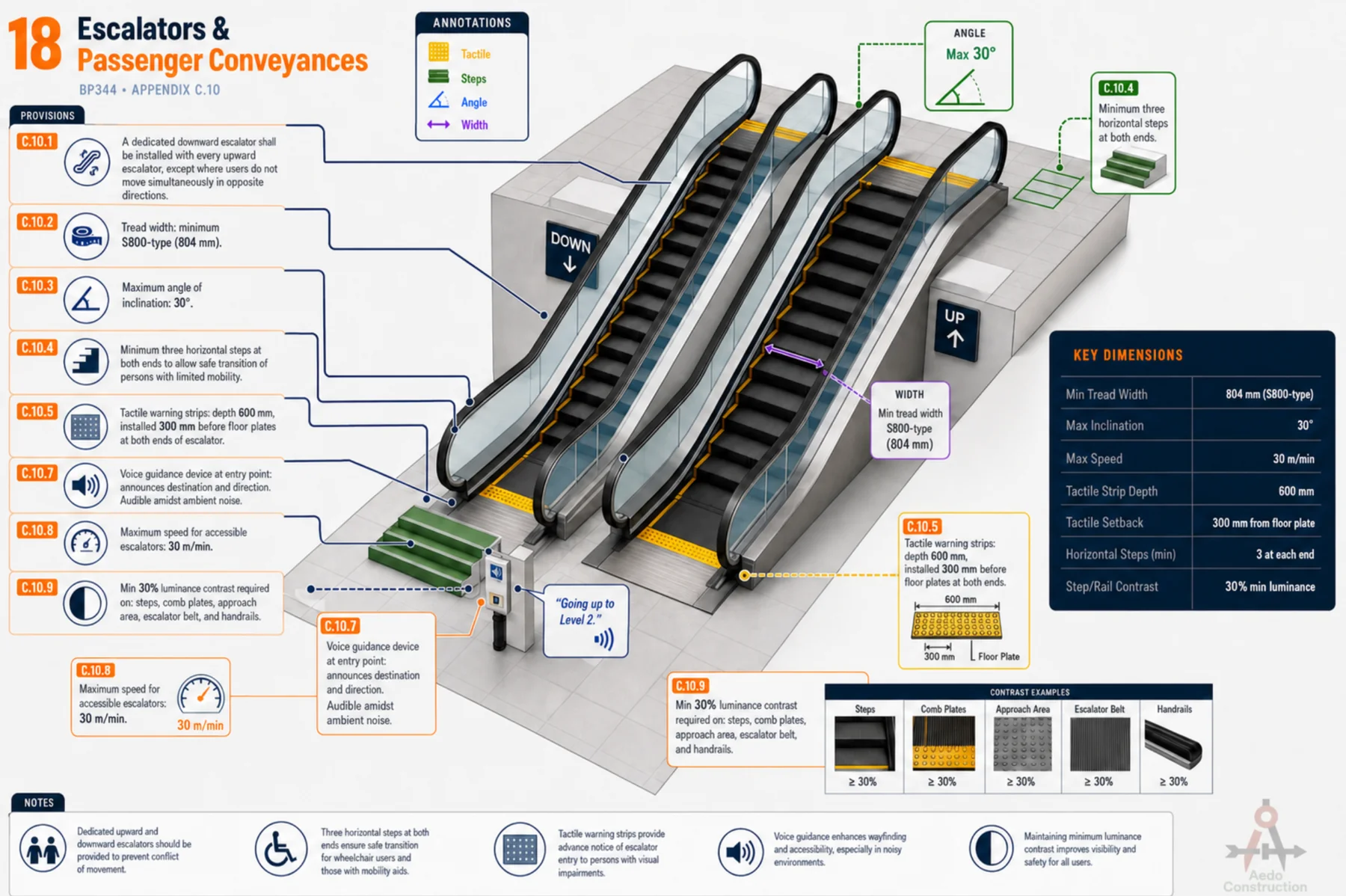
C.10.1A dedicated downward escalator shall be installed with every upward escalator, except where users do not move simultaneously in opposite directions.
C.10.2Tread width: minimum S800-type (804 mm).
C.10.3Maximum angle of inclination: 30°.
C.10.4Minimum three horizontal steps at both ends to allow safe transition of persons with limited mobility.
C.10.5Tactile warning strips: depth 600 mm, installed 300 mm before floor plates at both ends of escalator.
C.10.7Voice guidance device at entry point: announces destination and direction. Audible amidst ambient noise.
C.10.8Maximum speed for accessible escalators: 30 m/min.
C.10.9Min 30% luminance contrast required on: steps, comb plates, approach area, escalator belt, and handrails.
Key Dimensions
Min Tread Width804 mm (S800-type)
Max Inclination30°
Max Speed30 m/min
Tactile Strip Depth600 mm
Tactile Setback300 mm from floor plate
Horizontal Steps (min)3 at each end
Step/Rail Contrast30% min luminance
C.10.1–C.10.9
19

ATMs, Kiosks & Ticket Machines

BP344 · Appendix C.12
Provisions
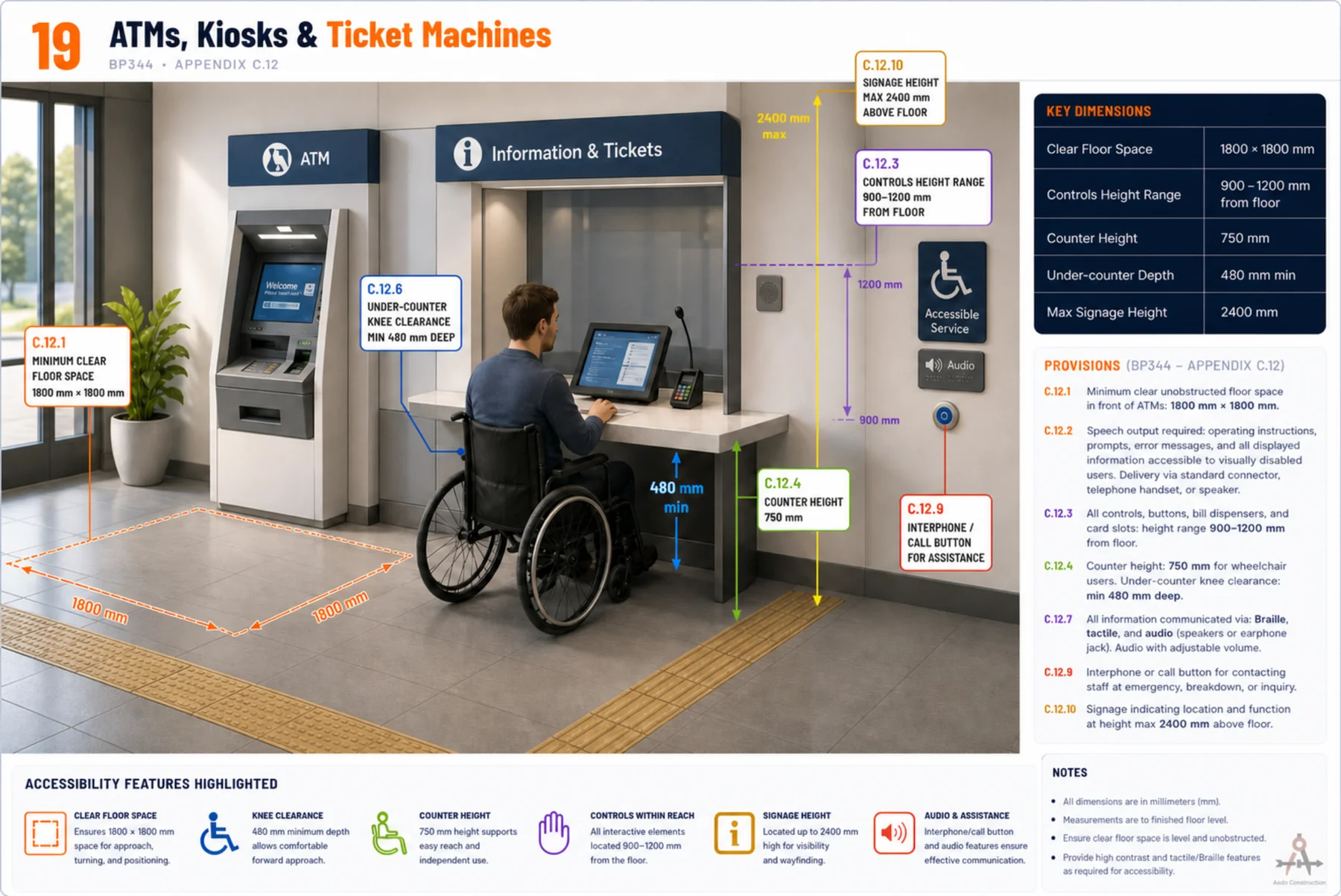
C.12.1Minimum clear unobstructed floor space in front of ATMs: 1800 mm × 1800 mm.
C.12.2Speech output required: operating instructions, prompts, error messages, and all displayed information accessible to visually disabled users. Delivery via standard connector, telephone handset, or speaker.
C.12.3All controls, buttons, bill dispensers, and card slots: height range 900–1200 mm from floor.
C.12.6Counter height: 750 mm for wheelchair users. Under-counter knee clearance: min 480 mm deep.
C.12.7All information communicated via: Braille, tactile, and audio (speakers or earphone jack). Audio with adjustable volume.
C.12.9Interphone or call button for contacting staff at emergency, breakdown, or inquiry.
C.12.10Signage indicating location and function at height max 2400 mm above floor.
Key Dimensions
Clear Floor Space1800 × 1800 mm
Controls Height Range900–1200 mm
Counter Height750 mm
Under-counter Depth480 mm min
Max Signage Height2400 mm
C.12.1–C.12.10
20

Changing Places

BP344 · Appendix C.7
Provisions
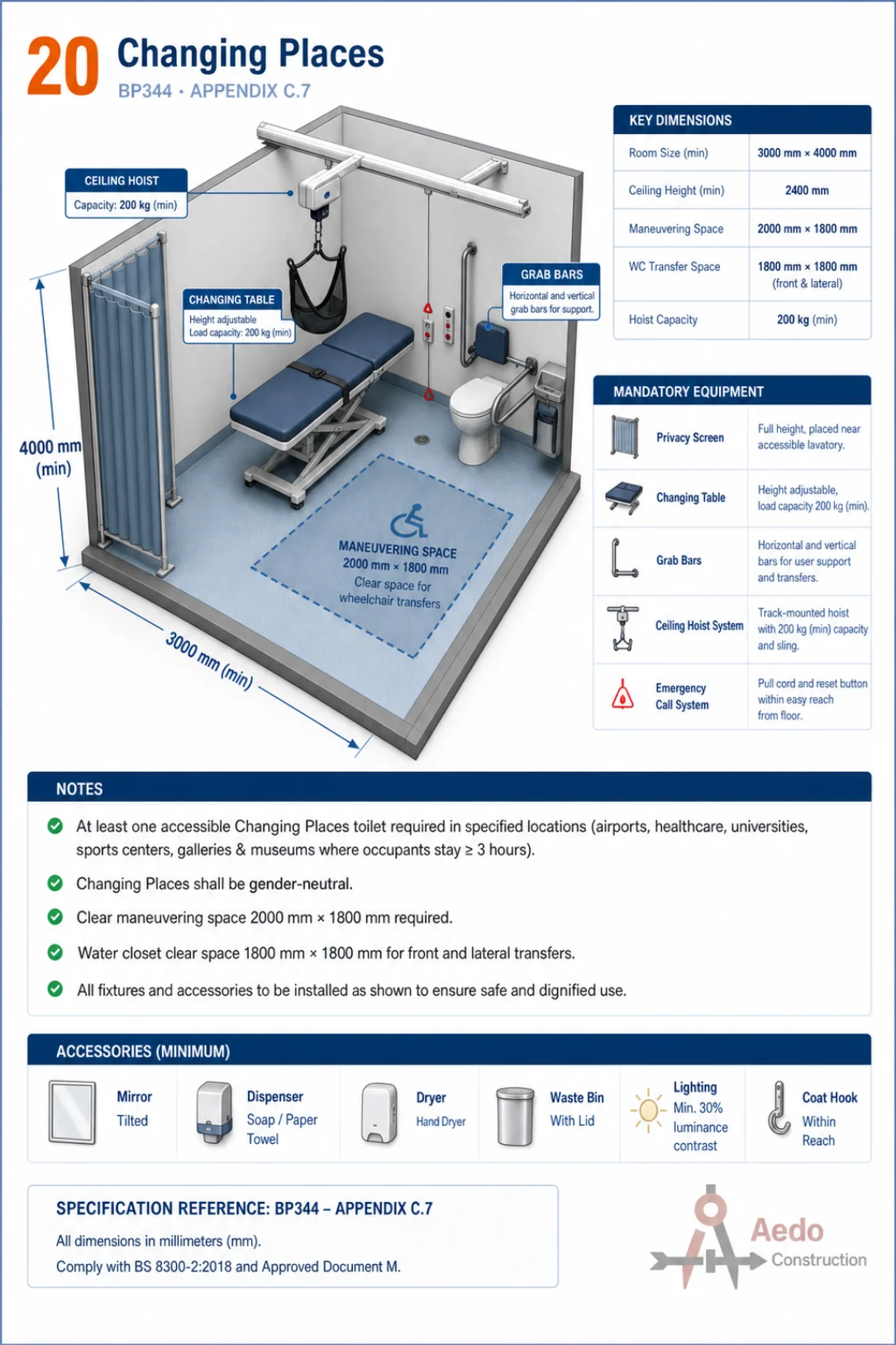
C.7.1At least one accessible changing place required in areas with extended stays: airports, healthcare facilities, universities, sports centers, galleries & museums (facilities where occupants stay ≥ 3 hours).
C.7.2Changing Places shall be gender-neutral to allow users to be accompanied and assisted.
C.7.3Minimum room size: 3000 mm × 4000 mm. Minimum ceiling height: 2400 mm to allow safe use of ceiling hoist system.
C.7.4Clear maneuvering space: 2000 mm × 1800 mm. Water closet clear space: 1800 mm × 1800 mm for frontal and lateral wheelchair transfers.
C.7.5Mandatory equipment: privacy screen, changing table, ceiling track hoist supporting min 200 kg, tilted mirrors, grab bars, bidet, emergency call button, strobe light alarm.
C.7.6Accessories (mirrors, dispensers, dryer, waste bin): min 30% luminance contrast. Placed near accessible lavatory.
Key Dimensions
Room Size (min)3000 × 4000 mm
Ceiling Height (min)2400 mm
Maneuvering Space2000 × 1800 mm
WC Transfer Space1800 × 1800 mm
Hoist Capacity200 kg min
C.7.1–C.7.6
21

Restaurants & Dining

BP344 · Appendix C.16
Provisions
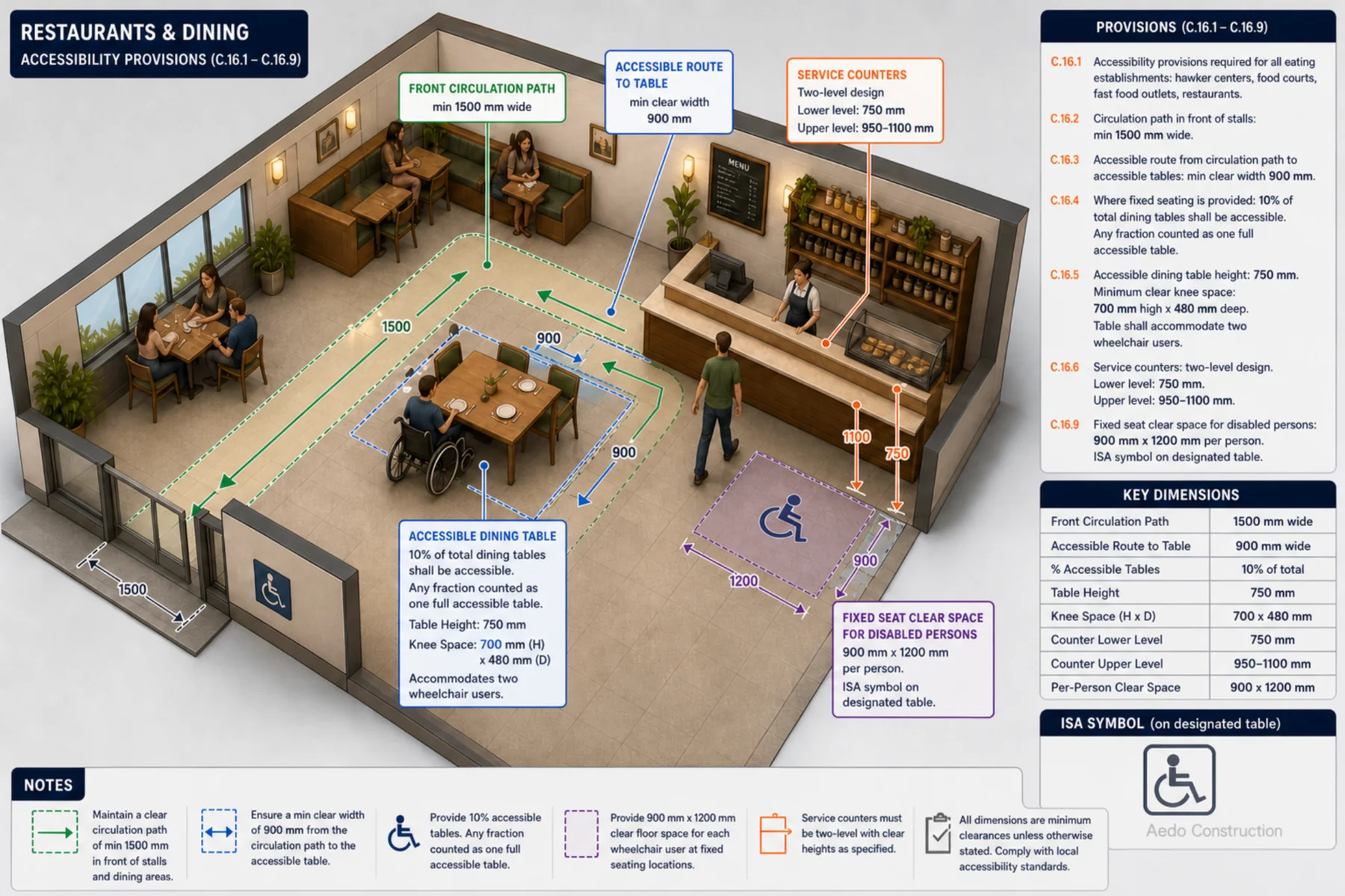
C.16.1Accessibility provisions required for all eating establishments: hawker centers, food courts, fast food outlets, restaurants.
C.16.2Circulation path in front of stalls: min 1500 mm wide.
C.16.3Accessible route from circulation path to accessible tables: min clear width 900 mm.
C.16.4Where fixed seating is provided: 10% of total dining tables shall be accessible. Any fraction counted as one full accessible table.
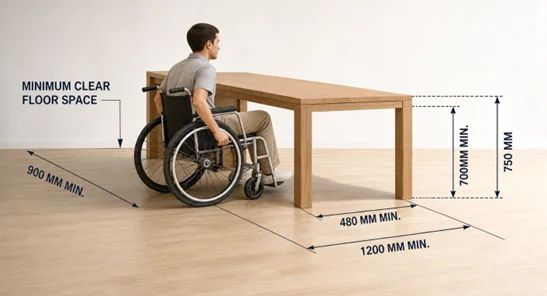
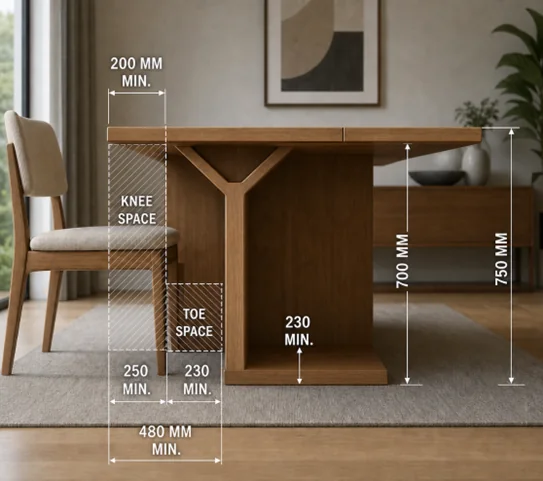
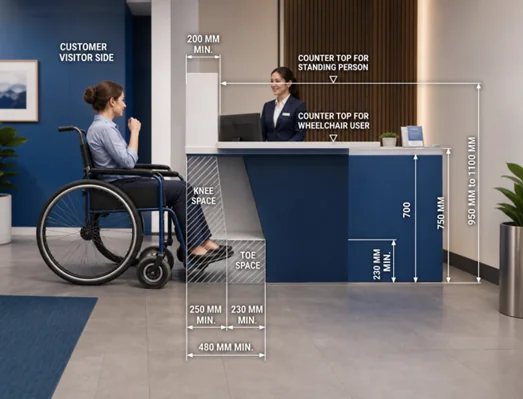
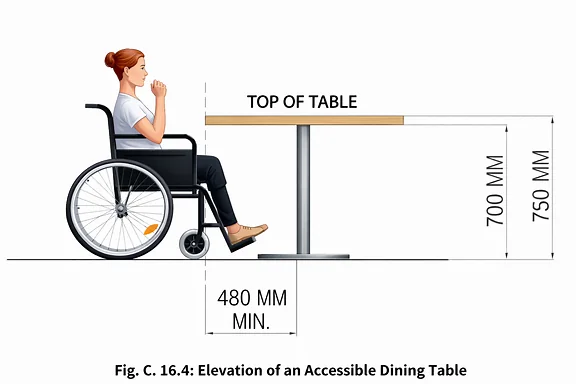
C.16.5Accessible dining table height: 750 mm. Minimum clear knee space: 700 mm high × 480 mm deep. Table shall accommodate two wheelchair users.
C.16.6Service counters: two-level design. Lower level: 750 mm. Upper level: 950–1100 mm.
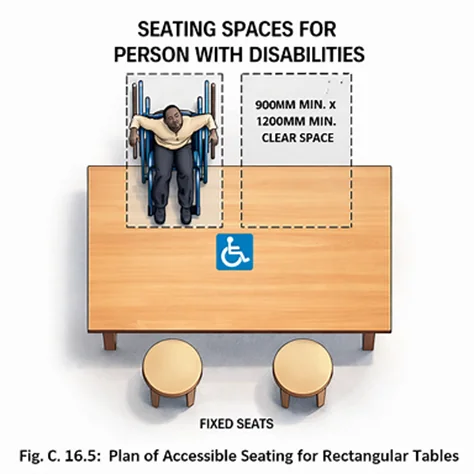
C.16.9Fixed seat clear space for disabled persons: 900 mm × 1200 mm per person. ISA symbol on designated table.
Key Dimensions
Front Circulation Path1500 mm wide
Accessible Route to Table900 mm wide
% Accessible Tables10% of total
Table Height750 mm
Knee Space (H × D)700 × 480 mm
Counter Lower Level750 mm
Counter Upper Level950–1100 mm
Per-Person Clear Space900 × 1200 mm
C.16.1–C.16.9Fig. C.16.1–C.16.5
22

Hotels & Transient Lodging

BP344 · Appendix C.17
Provisions
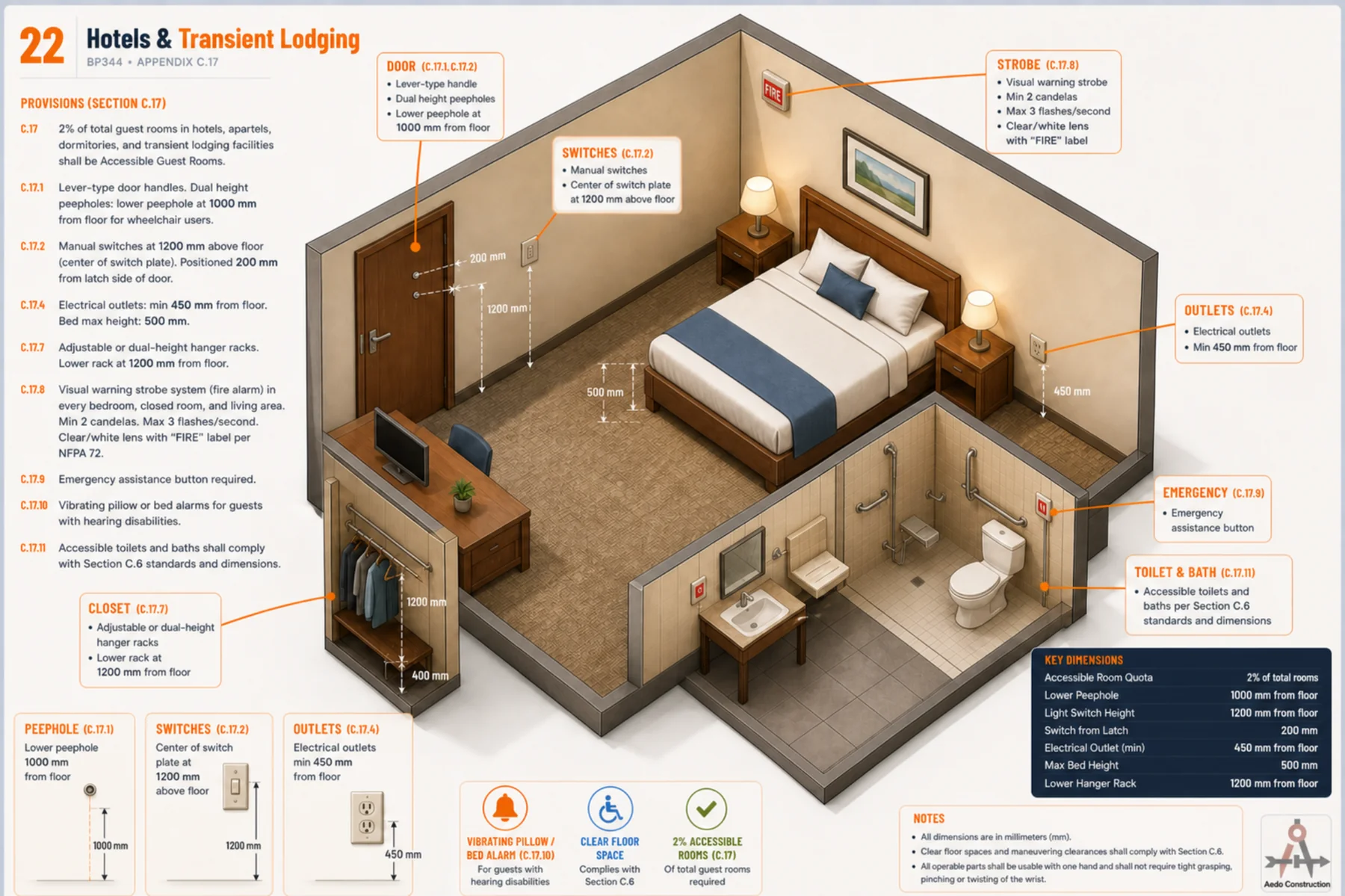
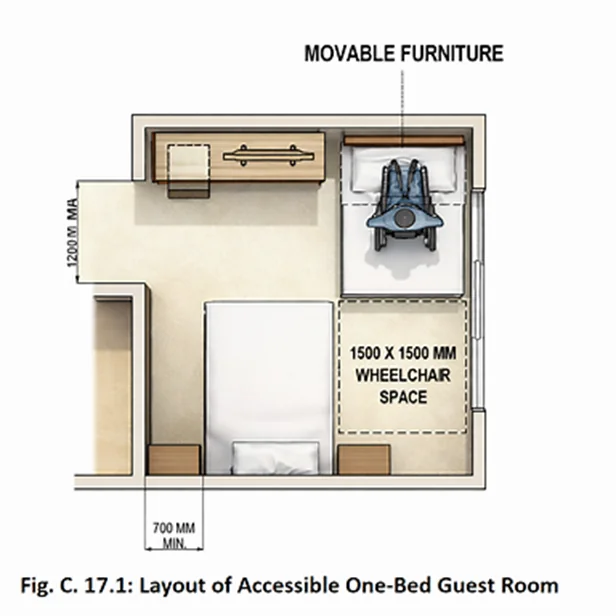
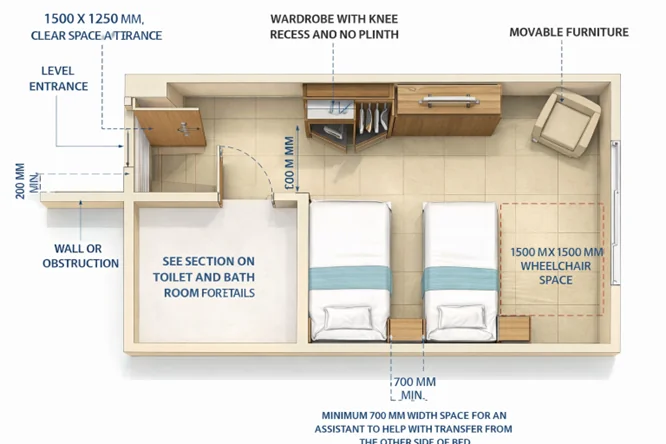
C.172% of total guest rooms in hotels, apartels, dormitories, and transient lodging facilities shall be Accessible Guest Rooms.
C.17.1Lever-type door handles. Dual height peepholes: lower peephole at 1000 mm from floor for wheelchair users.
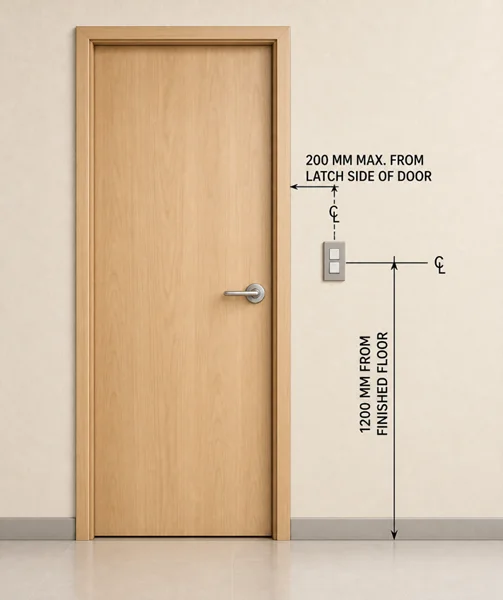
C.17.2Manual switches at 1200 mm above floor (center of switch plate). Positioned 200 mm from latch side of door.
C.17.4Electrical outlets: min 450 mm from floor. Bed max height: 500 mm.
C.17.7Adjustable or dual-height hanger racks. Lower rack at 1200 mm from floor.
C.17.8Visual warning strobe system (fire alarm) in every bedroom, closed room, and living area. Min 2 candelas. Max 3 flashes/second. Clear/white lens with "FIRE" label per NFPA 72.
C.17.9Emergency assistance button required.
C.17.10Vibrating pillow or bed alarms for guests with hearing disabilities.
C.17.11Accessible toilets and baths shall comply with Section C.6 standards and dimensions.
Key Dimensions
Accessible Room Quota2% of total rooms
Lower Peephole1000 mm from floor
Light Switch Height1200 mm from floor
Switch from Latch200 mm
Electrical Outlet (min)450 mm from floor
Max Bed Height500 mm
Lower Hanger Rack1200 mm from floor
Fig. C.17.1Fig. C.17.2C.17.1–C.17.11
23

Safety & Areas of Refuge

BP344 · Appendix D.4 · D.5 · D.6
Provisions
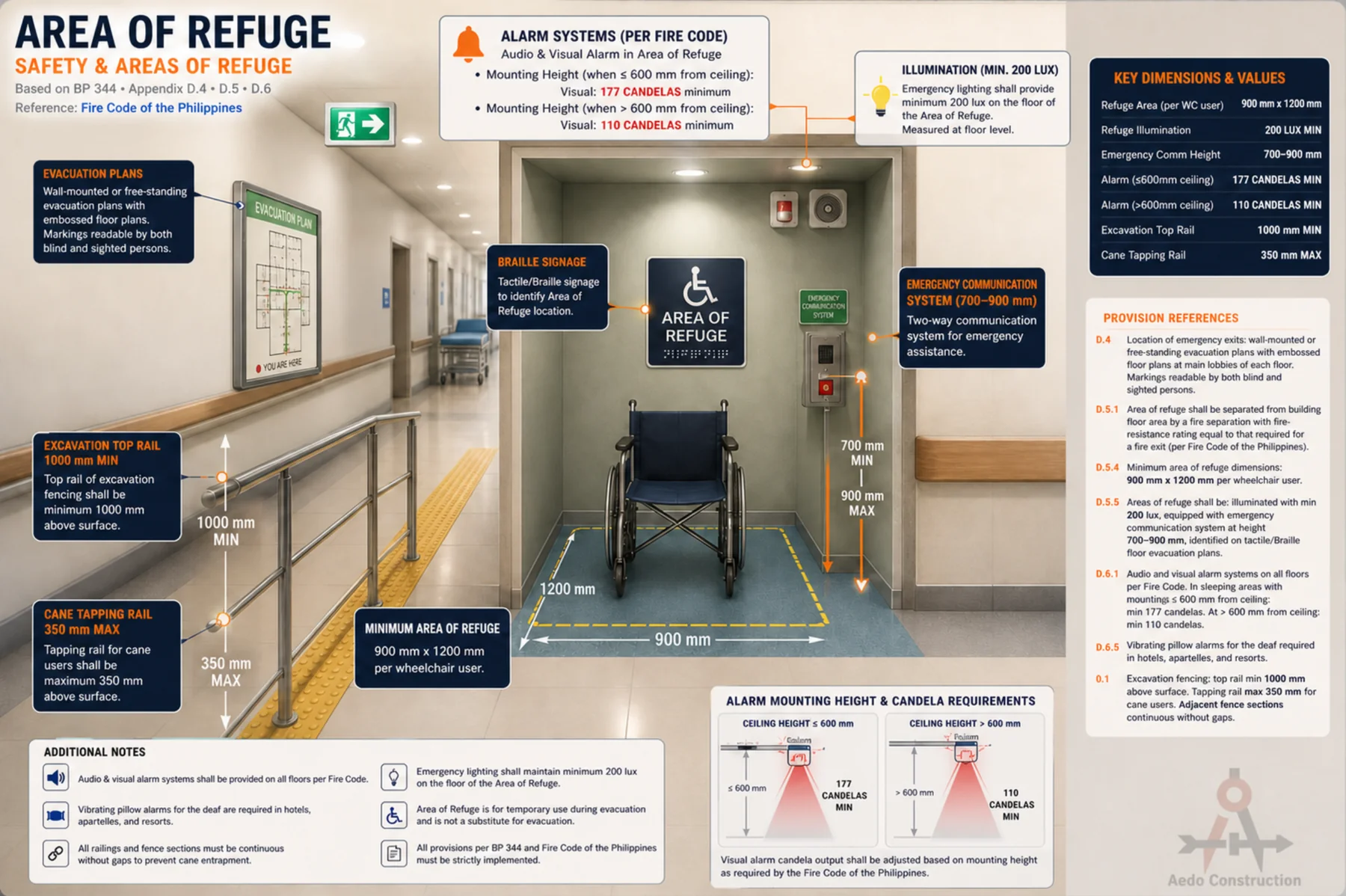
D.4Location of emergency exits: wall-mounted or free-standing evacuation plans with embossed floor plans at main lobbies of each floor. Markings readable by both blind and sighted persons.
D.5.1Area of refuge shall be separated from building floor area by a fire separation with fire-resistance rating equal to that required for a fire exit (per Fire Code of the Philippines).
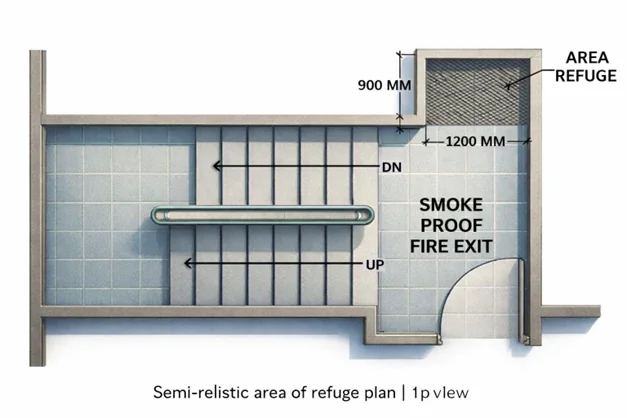
D.5.4Minimum area of refuge dimensions: 900 mm × 1200 mm per wheelchair user.
D.5.5Areas of refuge shall be: illuminated with min 200 lux, equipped with emergency communication system at height 700–900 mm, identified on tactile/Braille floor evacuation plans, designated in evacuation procedure documents.
D.6.1Audio and visual alarm systems on all floors per Fire Code. In sleeping areas with mounting ≤ 600 mm from ceiling: min 177 candelas. At >600 mm from ceiling: min 110 candelas.
D.6.5Vibrating pillow alarms for the deaf required in hotels, apartelles, and resorts.
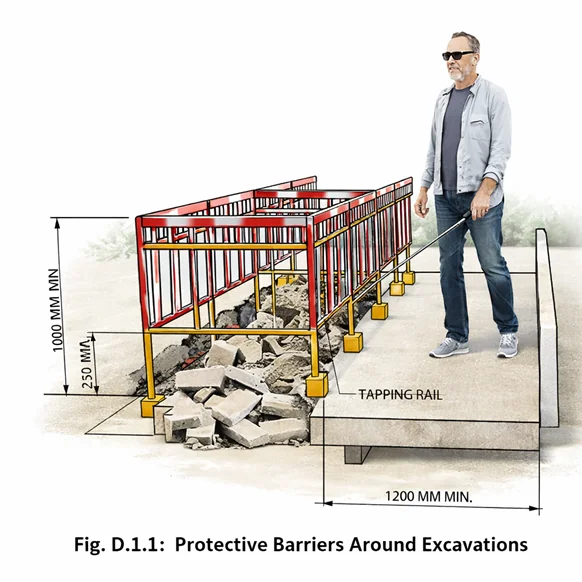
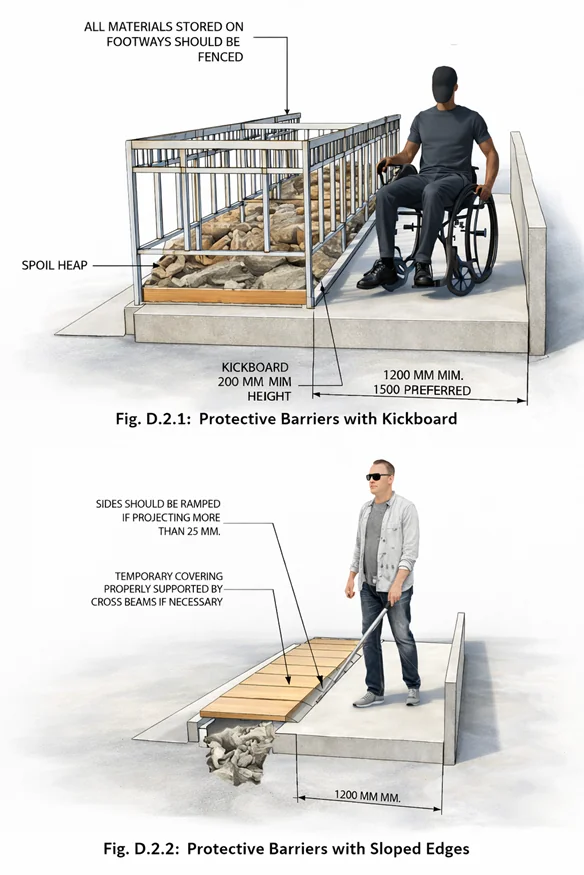
D.1Excavation fencing: top rail min 1000 mm above surface. Tapping rail max 350 mm for cane users. Adjacent fence sections continuous without gaps.
Key Dimensions
Refuge Area (per WC user)900 × 1200 mm
Refuge Illumination200 lux min
Emergency Comm Height700–900 mm
Alarm (≤600mm ceiling)177 candelas min
Alarm (>600mm ceiling)110 candelas min
Excavation Top Rail1000 mm min
Cane Tapping Rail350 mm max
Fig. D.1.1Fig. D.5.1D.4–D.6
24

Bluetooth Beacons & Hearing Systems
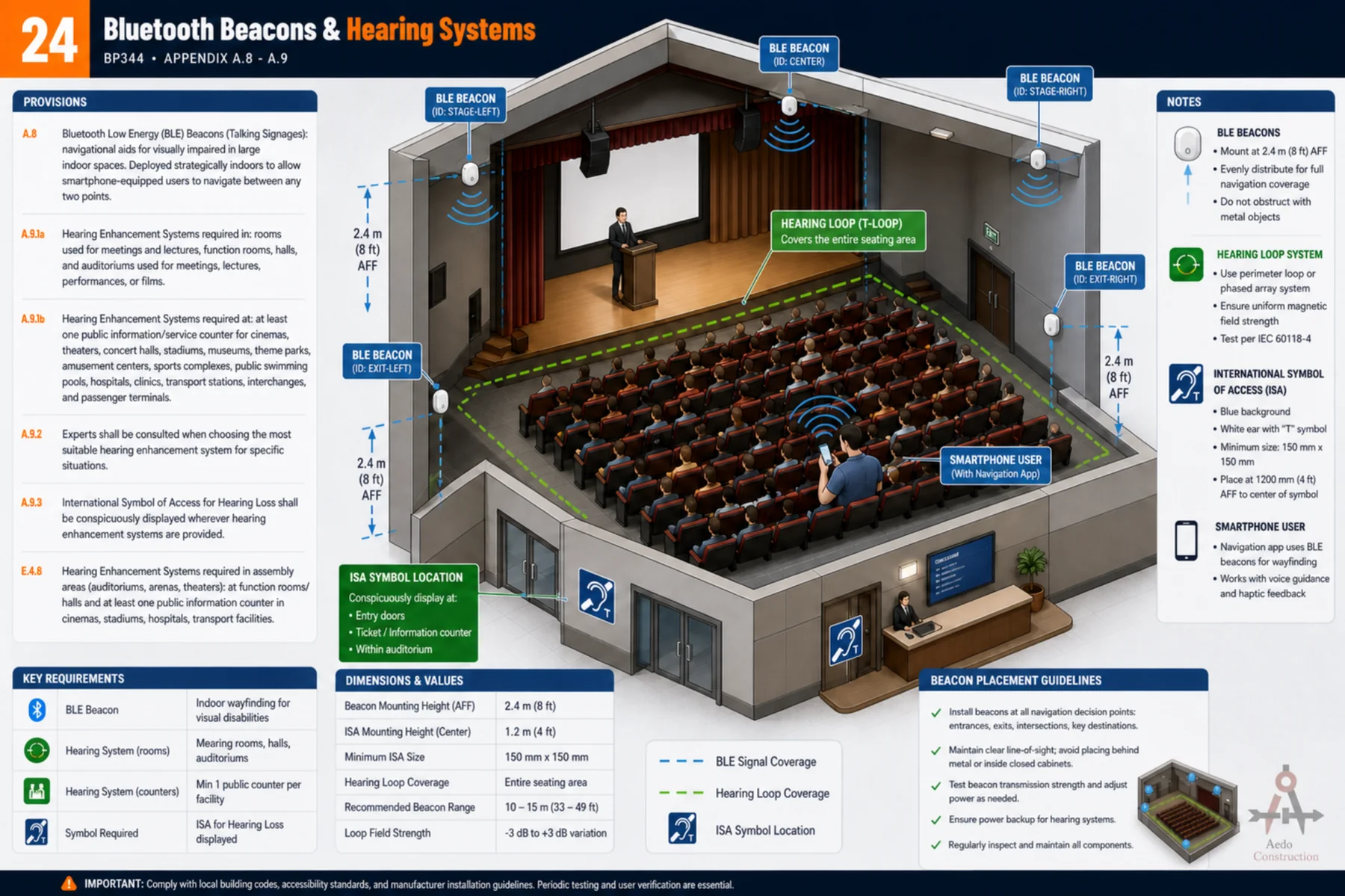
BP344 · Appendix A.8 · A.9
Provisions
A.8Bluetooth Low Energy (BLE) Beacons (Talking Signages): navigational aids for visually impaired in large indoor spaces. Deployed strategically indoors to allow smartphone-equipped users to navigate between any two points.
A.9.1aHearing Enhancement Systems required in: rooms used for meetings and lectures, function rooms, halls, and auditoriums used for meetings, lectures, performances, or films.
A.9.1bHearing Enhancement Systems required at: at least one public information/service counter for cinemas, theaters, concert halls, stadiums, museums, theme parks, amusement centers, sports complexes, public swimming pools, hospitals, clinics, transport stations, interchanges, and passenger terminals.
A.9.2Experts shall be consulted when choosing the most suitable hearing enhancement system for specific situations.
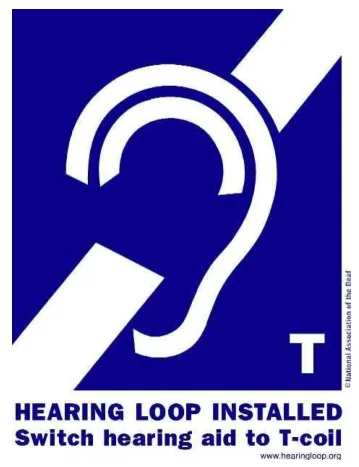
A.9.3International Symbol of Access for Hearing Loss shall be conspicuously displayed wherever hearing enhancement systems are provided.
E.4.8Hearing Enhancement Systems required in assembly areas (auditoriums, arenas, theaters): at function rooms/halls and at least one public information counter in cinemas, stadiums, hospitals, transport facilities.
Key Requirements
BLE BeaconIndoor wayfinding for visual disabilities
Hearing System (rooms)Meeting rooms, halls, auditoriums
Hearing System (counters)Min 1 public counter per facility
Symbol RequiredISA for Hearing Loss displayed
A.8A.9.1–A.9.3Fig. E.4.1
BUILD WITH THE TEAM THAT WROTE THE REFERENCE

Need a structure that's code-compliant by design?

This BP344 reference is built and maintained by AEDO Construction OPC — a Philippine design-build firm where every drawing meets NSCP 2015, BP344, and the Fire Code before it ever reaches your site. Engineers, architects, and own-tool builders under one roof.

15+
Projects Nationwide
2021
Established
100%
NSCP-Compliant
2
In-House Engineering Apps
⚙  CORE SERVICES

Design & Build · End-to-End

From blueprint to turnover — one accountable team, one contract, one fixed price.

📐

Design Plans, Drawings & Specs

Architectural floor plans, structural drawings, and bill of quantities — drawn against current code from day one.

  • Architectural floor plans
  • Structural drawings (NSCP 2015 · AISC · ACI)
  • Bill of quantities
🔨

Construction & Management

Full-scope construction & project management for architectural, structural, and interior fit-out — delivered safely, on schedule.

  • Architectural construction
  • Structural works
  • Interior fit-out
📱  ENGINEERING APPS WE BUILT

Mobile Tools for the Field

Purpose-built Android apps used by engineers, contractors, and students nationwide.

Bx
BuildX NSCP Kit
v1.0 · Android

Full NSCP 2015 reference: minimum design loads, wind calculator (§207A-207B), seismic base shear (§208), concrete, steel & foundation design — all in your pocket.

⚖ Loads 💨 Wind 🌏 Seismic 🧱 Concrete 🔩 Steel 🏗 Foundation
Get the App →
Unit Cost Analysis
v1.0 · Android

Estimate construction unit costs with editable material, labor, equipment & productivity rates. 10+ activities from excavation to gates — calibrated to local Philippine market prices.

₱ Calculator 🧱 Materials 👷 Labor 🚜 Equipment 📊 Productivity
Get the App →
Ready to build accessibly?
Let's talk through your project — site assessment, structural review, or full design-build.